
Your analytical instrument gives inconsistent readings, or your medical device delivers imprecise doses. The project is falling behind because the system's performance is erratic, creating friction between your engineering and purchasing teams.
True flow stability is a system-level outcome, not just a pump's rated flow. It results from the harmony between consistent diaphragm mechanics, precise valve action, stable motor control, and manageable system resistance.
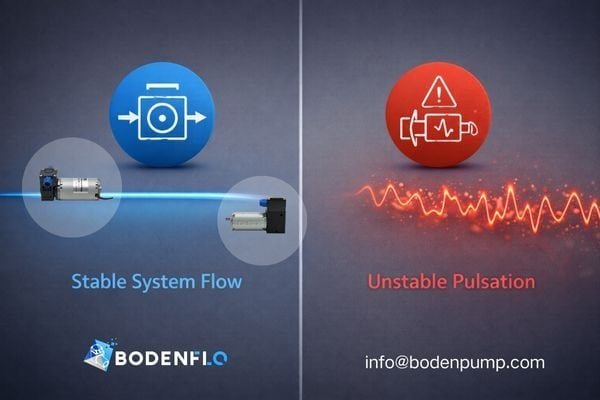
As a project manager at BODENFLO, I've guided countless projects from concept to production. I’ve seen firsthand that a common friction point between engineering and procurement is often a misunderstanding of a pump's true performance. Engineers focus on datasheet specs, purchasers see the price tag, and both often miss the crucial factor of flow stability. Let’s dive deep into the factors that determine whether a project succeeds or faces costly redesigns.
Why Does Flow Stability Matter More Than Rated Flow?
Your purchasing team sourced a pump that met the average flow spec and budget, but the engineering team reports the end product is unreliable. Now the project is stalled, and everyone is trying to figure out who is to blame.
In many analytical and medical systems, flow stability is more critical than rated flow. Rated flow is an average, but momentary instability—or pulsation—introduces errors that compromise results, affect patient safety, and ultimately tarnish a product's reputation.
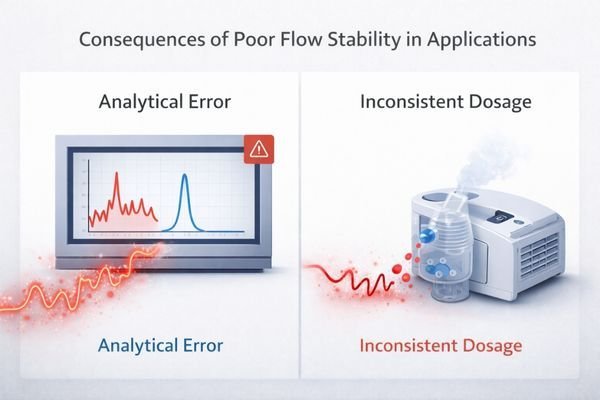
Across hundreds of projects, I've seen a recurring pattern: a team selects a pump that looks great on paper but fails in the system. It's a classic case of winning the spec battle but losing the performance war. Often, a pump with a lower average flow but higher stability would have been the right choice, saving them from costly redesigns and field failures. I always advise both engineers and purchasers to look beyond the single "L/min" number and ask about the quality of the flow, as that is what truly determines the end-user experience and product reliability.
Practical Impact of Flow Instability
| Application Area | Consequence of Unstable Flow | Why It Matters for the Project |
|---|---|---|
| Gas Sampling1 | Inaccurate concentration readings | Leads to loss of certification or product recalls. |
| Medical Devices | Inconsistent dosage or pressure delivery | Poses a direct risk to patient safety and brand liability. |
| Analytical Instruments | Poor repeatability and noisy data | Results in customer complaints and a reputation for being "unreliable." |
What Does “Flow Stability” Really Mean in Engineering Terms?
You see "stable flow" in marketing materials, but the term is too vague. You need a concrete definition to align your engineering and purchasing teams on what they are actually buying.
Flow stability is a time-based performance metric, not a static value. It is defined by minimal pulsation, high cycle-to-cycle consistency, and low long-term drift, which are far more useful metrics than a simple average flow number.
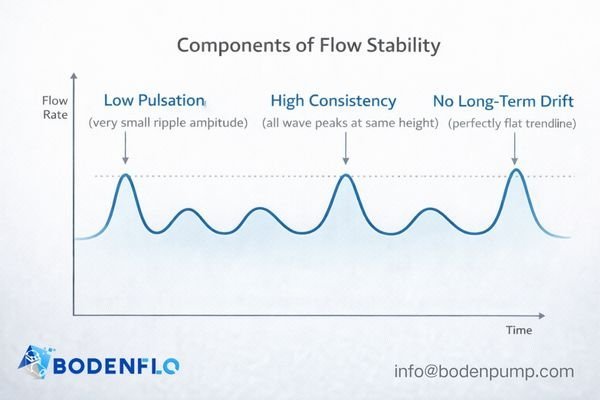
When my team and I kick off a project review, the first thing we do is align everyone—engineers, purchasers, and product managers—on what 'stability' actually means. We move past marketing fluff and get into the measurable data that predicts real-world success. An average flow rate tells you how much fluid moves in a minute, but it hides the chaos happening within each second. True stability is about predictability over time. We break it down into key performance indicators that matter for the project's long-term success, ensuring that what engineering needs is what purchasing is actually sourcing.
Key Metrics for Defining Flow Stability
- Instantaneous vs. Average Flow: The difference between the flow at any millisecond and the average over a minute.
- Pulsation Amplitude2: The size of the flow variation within a single pump cycle. Lower is better.
- Cycle-to-Cycle Consistency: The repeatability of the flow profile from one pump stroke to the next.
- Long-Term Drift: The gradual change in average flow over extended periods, which predicts future field failures.
What Is the Role of Diaphragm Mechanics in Flow Stability?
You notice your pump's flow rate slowly drifts downward during long-term testing, long after the product should have shipped. You realize you have a hidden reliability problem that will lead to future warranty claims.
The diaphragm's mechanical consistency is the foundation of stable flow. Its material choice, elasticity, and resistance to heat-induced stiffness directly control how consistently it performs over millions of cycles.
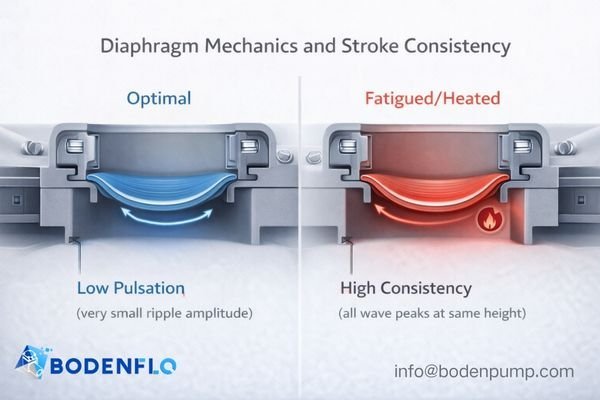
When a project runs into long-term drift issues, our engineering deep-dive frequently points to the diaphragm. From a project standpoint, what matters is that this isn't a sudden failure; it's a slow degradation that makes the product unreliable over time. This is a nightmare for warranty claims and customer satisfaction. It's why I always caution purchasing teams against being tempted by pumps using low-cost, unproven diaphragm materials3. A small saving upfront can lead to massive costs down the line when products start failing in the field. Elasticity decay is a more common and subtle killer of products than a dramatic diaphragm rupture.
Diaphragm Factors Affecting Stability
- Stroke Consistency: Does the diaphragm complete its full motion every time?
- Material Elasticity: How quickly does the material return to its neutral state? Slow recovery kills high-speed performance.
- Thermal Impact: Does the material get stiffer as the pump heats up? This is a key cause of flow droop.
- Fatigue Effect: How does performance change after millions of cycles? This predicts the product's true operational life.
How Does Valve Design Impact Flow Pulsation?
Your pump has a high-quality motor and diaphragm, yet your engineers are still battling flow pulsation. The project is stuck, and you’re looking for the hidden variable everyone has overlooked.
Often, flow instability originates from the valves, not the diaphragm itself. The response speed, sealing consistency, and rebound timing of the inlet and outlet valves are directly responsible for the pulsation in each pump cycle.
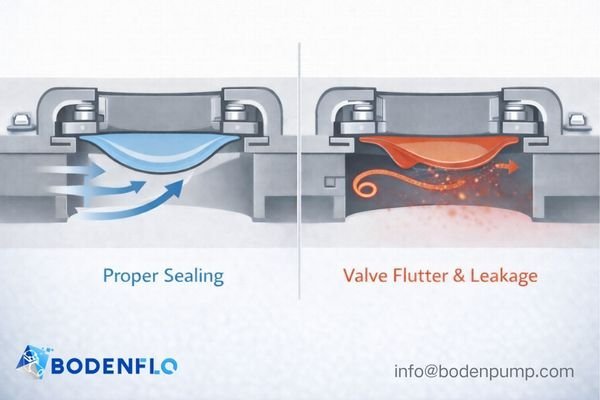
This is a 'gotcha' I warn engineering teams about early in the design phase. It's one of those lessons learned from seeing projects get stuck. I remember a medical device project that was plagued by inconsistent performance across units. The engineers were stumped. It turned out to be tiny valve inconsistencies. The fix wasn't a complex redesign, but switching to a pump with higher precision manufacturing. This is a perfect example where a slightly higher component cost saved a fortune in diagnostic time, rework, and project delays. It's a crucial detail that is impossible to see on a standard procurement spec sheet.
Common Valve-Related Stability Issues
| Issue | Description | Impact on Project |
|---|---|---|
| Slow Response | The valve doesn't open or close instantly. | Creates lag, reduces efficiency, and can cause system-level timing errors. |
| Rebound Lag | The valve material is slow to spring back into position. | Leads to momentary backflow, creating a pressure dip that affects sensitive sensors. |
| Inconsistent Seal | The valve doesn't create a perfect seal every cycle. | Causes unit-to-unit variation, a quality control nightmare for manufacturing. |
How Does Motor Behavior Influence Flow Stability?
You power the pump with a stable DC voltage, but the flow rate still fluctuates when the system load changes. The engineering team is asking for a different pump, creating a purchasing headache.
The motor's ability to maintain a constant speed under varying loads is critical. A simple voltage-driven motor will slow down as back pressure increases, whereas a pump with PWM control can actively maintain a far more stable speed and flow.
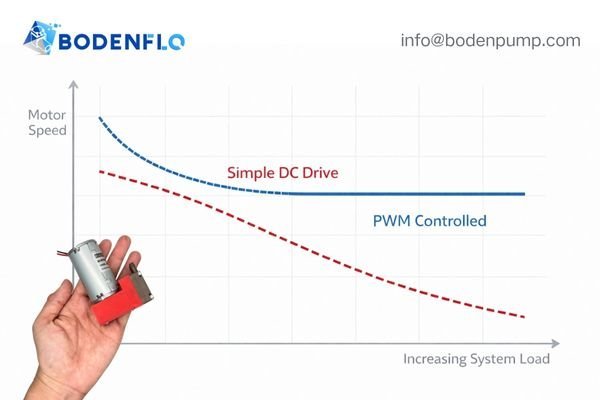
On project after project, I see teams treat the motor as a simple 'black box.' They supply power and expect consistent speed. But this assumption can derail a timeline when the system load isn't static. For any project involving long run times or variable loads—which is most of them—I push the engineering team to specify pumps with integrated control, like BLDC4. It mitigates a huge project risk that procurement often can't see on a simple spec sheet. It's better to invest in a pump with stable control than to deal with the project delays caused by chasing down unexpected performance dips.
How Do System Resistance and Back Pressure Affect Stability?
Your pump's flow is stable in initial prototypes, but customer feedback after six months in the field reports performance has degraded. Now you have a potential widespread reliability issue.
As system resistance increases over time, flow instability often becomes more pronounced even if the pump itself remains unchanged. Higher back pressure from a clogged filter or pinched tubing magnifies any minor pump inconsistencies.
I use a simple analogy for this: it's like trying to talk in a quiet room versus a loud one. Any small variations in your voice are more noticeable in the loud room. The same is true for a pump. As back pressure from an aging system rises, it makes the pump's job harder and exposes its minor flaws. This is why we, as project partners, insist on "life testing" that simulates system aging5. It helps us predict how performance will change over the product's lifetime, which is crucial for forecasting service intervals and warranty costs—a number every product manager and purchaser needs to know.
Why Do Bench Tests Fail to Predict Real-World Stability?
Your engineering team's validation data looked perfect, but the integrated prototype is failing. The project is behind schedule because you have to re-test, and trust in the initial data is broken.
Bench tests often fail to predict real stability because they don't replicate real-world conditions. A short, no-load test cannot reveal issues related to heat, fatigue, or the dynamic effects of system back pressure that will emerge in the final product.
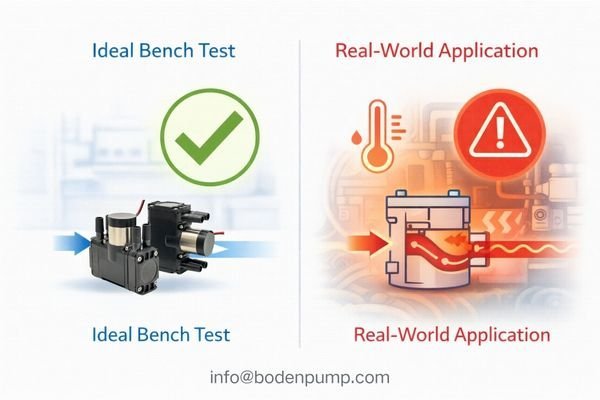
This is one of the most painful lessons in product development, and I've seen it sink timelines and budgets. An engineer shows me green-lit validation data, but a month later, the integrated prototype fails. The problem is that bench tests often ignore three critical factors:
- Thermal State6: The pump needs to run long enough to get hot, as heat changes its performance.
- Material Fatigue7: Issues from wear-and-tear only appear after millions of cycles, not in a 10-minute test.
- System Load: Testing a pump in open air tells you nothing about how it will behave when pushing against your system's actual resistance. This is the #1 cause of misleading test data.
What Common Engineering Mistakes Destroy Flow Stability?
Despite using a quality pump, your system's flow remains erratic. You want to identify the common design pitfalls that could be sabotaging your project's success.
The most common mistakes are treating the pump as an ideal flow source and ignoring the system's dynamic nature. Focusing only on average flow while ignoring pulsation, aging effects, and system resistance will undermine stability and project goals.
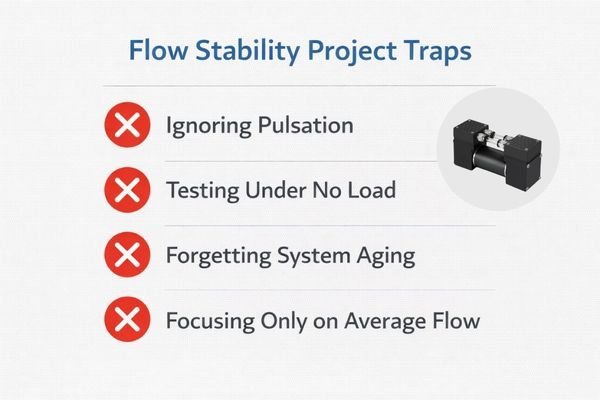
Over my career, I've seen the same design mistakes repeated. They almost always stem from oversimplifying the problem. The pump is not a magical black box that delivers a perfect flow on command; it is a complex device that is highly sensitive to its operating environment. By avoiding these common traps, engineering and purchasing teams can align from the start, dramatically improving the project's chance of launching on time and under budget, with a product that customers can trust.
Top 5 Flow Stability Project Traps to Avoid:
- Focusing Only on Average Flow: The purchasing team buys on average flow, but the engineers need low pulsation.
- Forgetting Long-Term Effects: Not planning for flow drift caused by heat and wear, which leads to future field failures.
- Ignoring System Aging: Failing to budget for higher-quality components that can handle increased back pressure over the product's life.
- Testing Under Ideal Conditions: Creating a validation plan based on misleading bench tests.
- Treating the Pump as an "Ideal Source": Assuming the pump's output is independent of load, leading to surprise performance drops.
What Design Strategies Can Achieve Truly Stable Flow?
You're ready to stop fire-fighting and set your next project up for success. You need practical strategies to build a system with reliable and repeatable flow from the start.
Flow stability is achieved through smart system design, not just component selection alone. The key is to reduce stress on the pump by providing performance headroom, minimizing system resistance, and controlling its operation intelligently.
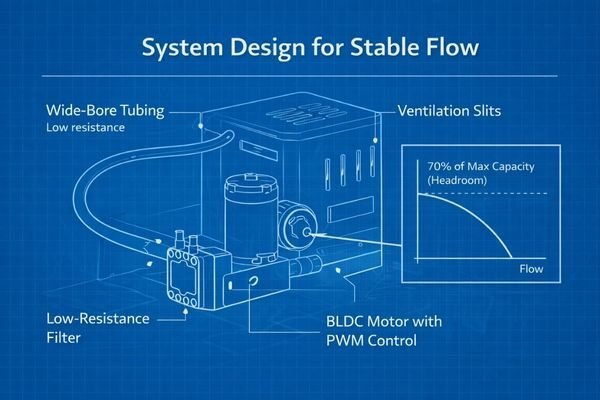
The most successful projects I've managed are those where the customer's team viewed the pump as part of a complete fluidic system. Instead of trying to find a "perfect pump" to solve a difficult system problem, we worked together to make the system's demands easier on the pump. This holistic approach8 is far more effective. For example, simply using slightly wider tubing can dramatically lower back pressure, allowing a less expensive pump to run cooler and more stably. Leaving a performance margin—choosing a pump that can comfortably exceed your requirements—is the best insurance policy against unexpected field issues. It's about designing a low-stress environment where the pump can operate consistently for its entire service life.
A Practical Checklist for Stable Flow Design
- Design for Headroom: Select a pump that meets the requirement at 60-70% of its max capability.
- Minimize System Resistance: Use wider tubing and low-resistance filters to lower operational stress.
- Implement Smart Control: Use PWM to run the pump only at the speed necessary, reducing heat, noise, and wear.
- Manage Heat: Ensure good ventilation to prevent thermal buildup from degrading performance over time.
Final Thought
Flow stability is a system-level outcome, not just a pump specification. It is achieved through the careful interplay of mechanical, electrical, and fluidic components working together in your specific application.
If your application depends on accurate, repeatable flow rather than just peak performance, discussing stability at the system level early in the design phase can prevent costly redesigns and project delays. We specialize in helping project teams navigate these complexities. Reach out to discuss your system's specific requirements.
📧 info@bodenpump.com
-
Explore this link to discover essential techniques that enhance gas sampling accuracy, crucial for compliance and safety. ↩
-
Understanding Pulsation Amplitude is crucial for optimizing pump performance and ensuring system stability. ↩
-
Explore this link to discover the most reliable diaphragm materials that enhance pump performance and longevity. ↩
-
Understanding BLDC pumps will help you appreciate their advantages in variable load applications and improve project outcomes. ↩
-
Exploring system aging can provide insights into maintenance needs and improve product reliability over time. ↩
-
Understanding thermal state is crucial for accurate product testing, ensuring performance aligns with real-world conditions. ↩
-
Exploring material fatigue helps in recognizing long-term product durability, essential for reliable engineering solutions. ↩
-
Understanding the holistic approach can enhance your project management skills and improve system efficiency. ↩