
*Your pump runs completely "blind," leaving you unaware of clogs, overheating, or fatigue until it’s too late. This unpredictability creates a constant risk of catastrophic system failure and costly downtime.
Integrated smart sensors for pressure, flow, and vibration give the pump "awareness." This allows it to self-regulate, predict failures, and transform from a simple component into an intelligent, self-monitoring diagnostic tool.
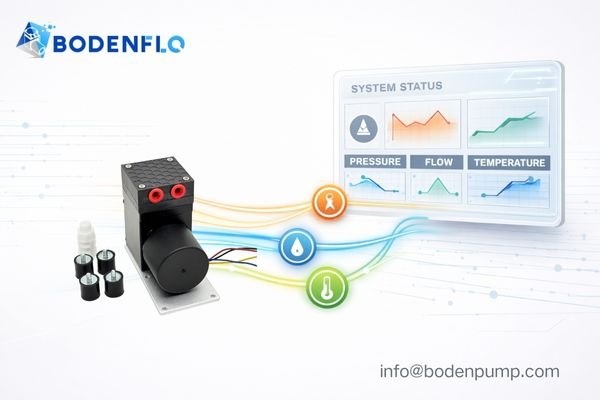
As a project manager here at BODENFLO, I’ve seen countless innovative devices held back by a single, passive component. The most significant leap forward in pump technology isn’t just about making pumps more powerful; it’s about making them more aware. We are essentially giving the pump senses—the ability to not only perform a task but to report back on its own health and the status of the entire fluidic system. This feedback loop is the key to unlocking the next generation of reliability and control.
Why Is the Transition from "Blind" to "Aware" Pump Systems Essential for Modern Industry?
You depend on a critical pump but have zero insight into its real-time condition. This "blind" operation is like a ticking time bomb, threatening your system’s reliability and uptime.
This transition is essential because traditional pumps can’t detect failures in time. In critical sectors like healthcare, the immense cost of downtime makes the predictive power of "aware" systems a necessity.
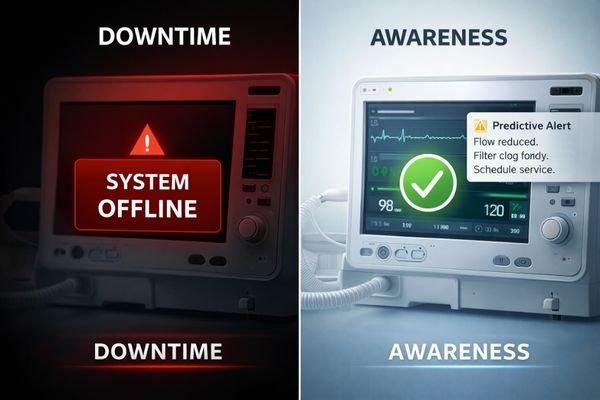
The "run-to-failure1" model is officially obsolete for any high-stakes application. Engineers and product managers can no longer afford to be in the dark. The demand is for data, and it starts at the component level.
The Limitations of Traditional Open-Loop Pumps
An open-loop pump receives a command (e.g., "turn on") and executes it without any feedback. It’s a one-way street filled with risks.
| Risk of "Blind" Operation | Consequence |
|---|---|
| Undetected Clogs | The motor works harder, overheats, and burns out. Flow stops without warning. |
| Motor Overheating | Insulation breaks down, leading to premature electrical failure. |
| Membrane Fatigue | Micro-tears develop, causing a slow, undetectable loss of performance until a complete failure. |
The Cost of Downtime
In critical sectors, a pump failure is never just a pump failure. In healthcare, it could mean a diagnostic machine going offline during peak hours. In environmental monitoring, it could mean losing months of irreplaceable climate data from a remote station. The secondary costs of downtime far exceed the cost of the component itself.
The Promise of Smart Fluidics2
By integrating sensors, we fundamentally change the pump’s role. It ceases to be a passive component and becomes an active, intelligent diagnostic tool. It can report on its own health and, just as importantly, detect problems elsewhere in the fluidic path, providing a holistic view of system integrity.
What Specific Sensors Are Redefining the Performance of Micro Diaphragm Pumps?
You know sensors are the answer, but which ones deliver the most value? Adding the wrong sensor suite just increases cost without solving the core reliability problems.
The sensors redefining performance are pressure transducers for stability, non-invasive flow sensors for purity, and thermal/vibration sensors. These act as the pump’s ears and eyes to monitor health.

Choosing the right sensors is about giving the pump the right "senses" for the application. A pump in a medical device needs a different sensory toolkit than one in an industrial printer. Our job is to engineer the optimal combination.
Pressure & Vacuum Transducers3
These are the most fundamental sensors for closed-loop control. They provide an instant, continuous electrical signal that is proportional to the pressure or vacuum level. This allows the pump’s controller to know exactly how hard it’s working and adjust its speed to maintain a constant, stable output, regardless of changes in system resistance.
Non-Invasive Flow Sensors4
For applications involving high-purity medical reagents or sensitive chemicals, nothing can touch the fluid. Non-invasive sensors (often ultrasonic) clamp onto the outside of the tubing and measure flow without making contact.
| Method | Contact with Media? | Ideal For |
|---|---|---|
| Invasive | Yes | General Industrial Use |
| Non-Invasive | No | Medical, Biotech, High-Purity |
Thermal & Vibration Sensors
These sensors act as the pump’s "pulse" and "temperature." A thermal sensor attached to the motor casing can detect an overheating condition long before permanent damage occurs. A MEMS accelerometer (vibration sensor) monitors the pump’s acoustic signature. Changes in this signature are early indicators of bearing wear or diaphragm stiffness, allowing for true predictive maintenance.
How Does Closed-Loop Feedback Improve Volumetric Precision and Battery Life?
Your portable device dies too quickly because its pump runs at full power constantly. You need the pump to be smart enough to use only the energy it needs.
Closed-loop feedback allows the pump to automatically tune its motor speed based on real-time sensor data. This dynamic adjustment improves precision and dramatically reduces power consumption, extending battery life.
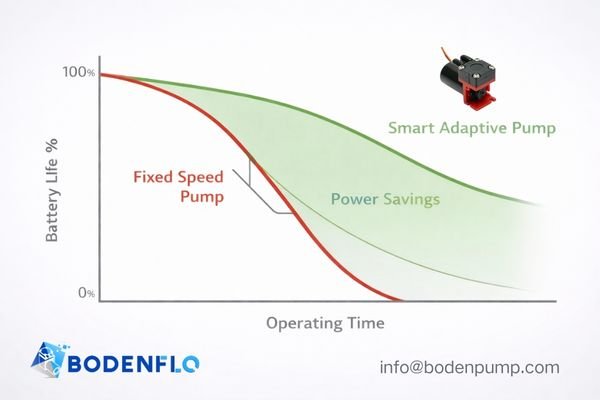
This concept of autotuning is what truly separates a smart pump. It’s not just running; it’s thinking, adapting, and optimizing its own performance in real-time.
The Logic of PWM Autotuning
The pump controller uses Pulse Width Modulation (PWM)5 to manage motor speed. Based on sensor input, the controller constantly "autotunes" this PWM signal. If a change in atmospheric pressure at high altitude causes a performance drop, the controller automatically increases motor speed to compensate and maintain the target flow rate. It’s cruise control for fluidics.
Energy Efficiency for Portable Devices
This is a game-changer for battery-powered devices. A portable suction unit might need 100% power to create the initial vacuum, but only 15% power to maintain it. A smart pump automatically throttles down, drawing only the necessary current. I’ve seen this extend the operational battery life of a client’s device by over 30%.
Stable Output Across Lifespan
Every diaphragm slowly loses elasticity over its lifespan. In a normal pump, this means flow rates will gradually decrease. In a smart pump, the controller detects this performance drop and slightly increases motor speed over time to compensate, ensuring the flow rate remains within specification until the very end of the pump’s calculated useful life.
Can Real-Time Monitoring Predict Failure Before It Happens?
You’re tired of being surprised by pump failures that halt production or compromise safety. You need a system that warns you of trouble before it becomes a disaster.
Yes, real-time monitoring can predict failures. By analyzing sensor data patterns, a smart pump can differentiate between a clog and a leak, calculate its own remaining useful life, and prevent catastrophic failures.
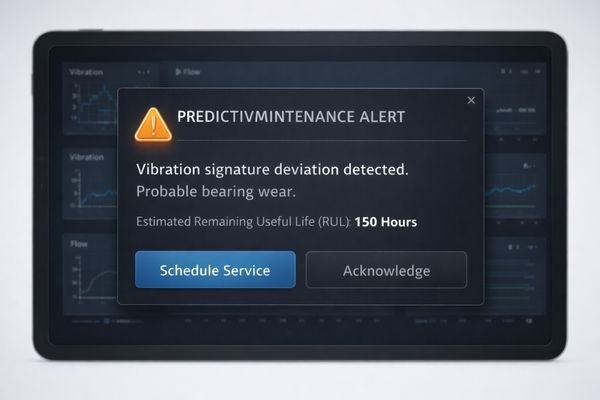
This is the holy grail of industrial reliability: moving from a reactive to a predictive model. The pump stops being a liability and becomes a source of valuable maintenance intelligence.
Occlusion & Leakage Detection
A smart controller is programmed to recognize specific pressure signatures.
- Occlusion Signature6: A sudden, rapid spike in pressure or vacuum indicates a blocked line. The system can immediately shut down and trigger an "Occlusion" alert.
- Leakage Signature: A failure to reach or hold the target pressure while the motor runs at high speed indicates a leak (e.g., a ruptured diaphragm). The system triggers a "Leak" alert.
Predictive Maintenance Algorithms
By constantly monitoring vibration and temperature trends, the system can feed data into a Remaining Useful Life (RUL)7 algorithm. This algorithm learns the pump’s normal behavior and can detect the subtle, long-term changes that signal impending failure, providing a data-backed estimate of when maintenance will be required.
Preventing "Liquid Slugging"
In a gas-only pump, accidentally drawing in fluid can cause instant, catastrophic damage ("liquid slugging"). We can integrate a miniature moisture or optical sensor at the pump’s inlet. The moment liquid is detected, it triggers an immediate safety shut-off, saving the pump from destruction.
What are the Challenges of System-Level Integration (EMI & Miniaturization)?
The theory is great, but how do you fit all this tech into a tiny package and make it talk to your main controller without interference?
The primary challenges are shielding sensitive sensor signals from motor noise (EMI), physically engineering the components into a micro-scale footprint, and standardizing data communication protocols for seamless integration.

As engineers, these are the challenges we thrive on. Solving the puzzle of miniaturization and integration is where our expertise at BODENFLO truly shines.
Shielding from EMI
A brushed DC motor is a source of significant electromagnetic interference (EMI)8. This noise can easily corrupt the very small voltage signals from a pressure sensor or thermocouple. Our solution involves a multi-pronged approach: careful PCB layout, dedicated ground planes, physical shielding around the motor, and signal filtering in the firmware to ensure clean, reliable data.
Miniaturization Hurdles
Fitting a motor, pump mechanism, sensors, and a controller PCB into a device that fits in the palm of your hand is a massive engineering challenge. It requires co-designing the mechanical and electronic elements from day one. We use advanced 3D modeling and MEMS (Micro-Electro-Mechanical Systems) sensors to achieve the highest possible power and intelligence density.
Standardizing Data Protocols
A smart pump needs to speak a language your system understands. The industry is moving away from simple on/off analog signals and toward digital communication buses. We are building our smart pump controllers with common protocols like I2C, UART, or CAN bus9, making integration with a PLC or IoT gateway as simple as connecting a standard peripheral.
Which High-Stakes Industries Benefit Most from Smart Micro Diaphragm Pumps?
You want to know where this technology is moving from a "nice-to-have" to a "must-have." Which markets are leading the adoption curve?
The biggest benefits are seen in high-stakes industries where failure is not an option: remote medical monitoring, autonomous environmental samplers, and precision industrial dosing systems.
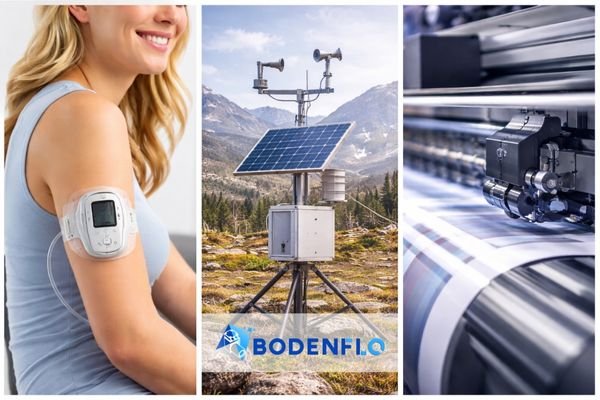
In these sectors, the ROI of a smart pump is immediate and obvious. The value of preventing a single failure outweighs the added component cost many times over.
Remote Medical Monitoring
For a wearable infusion pump or a portable home suction device, a smart pump is a critical safety feature. It can alert the patient, a caregiver, or a clinician the moment a line becomes blocked, ensuring therapy is never compromised and providing peace of mind.
Autonomous Environmental Samplers
These stations are often placed in remote, hard-to-reach locations. A human intervention to fix a simple clog is incredibly expensive. A smart pump can self-monitor, adjust for filter loading over months, and transmit its health status, ensuring data integrity and drastically reducing costly service trips.
Industrial Inkjet & Dosing
In high-speed printing, incorrect ink pressure can damage a printhead worth thousands of dollars. In chemical manufacturing, incorrect dosing can ruin an entire batch. A smart pump that monitors and maintains exact pressure or flow in real-time is an essential insurance policy against catastrophic financial loss.
How Is Bodenflo Engineering the Next Generation of Intelligent Fluidics?
You’re ready to explore smart fluidics for your project. You need a partner who is not just following trends but actively building the future of this technology.
BODENFLO is committed to pioneering the next generation of intelligent fluidics. Our R&D is intensely focused on sensor integration, providing our OEM partners with a decisive competitive advantage.
Our R&D Roadmap
We invest heavily in developing solutions that solve tomorrow’s problems. Our roadmap includes further miniaturization of sensor packages, developing more sophisticated predictive maintenance algorithms, and expanding our range of digital communication protocols to ensure our pumps are ready for Industry 5.0 and beyond.
The Competitive Advantage
Choosing a smart pump isn’t an expense; it’s an investment in reliability. By reducing the total cost of ownership through a massive reduction in downtime, service calls, and warranty claims, a BODENFLO smart pump delivers a powerful return on investment.
Want to see how smart sensors can improve your device? Request a technical consultation and a demo of our integrated modules.
📧 info@bodenpump.com
-
Understanding the limitations of the run-to-failure model can help you make informed decisions in high-stakes applications. ↩
-
Exploring Smart Fluidics can reveal innovative solutions that enhance system integrity and prevent costly downtimes. ↩
-
Explore this link to understand how Pressure & Vacuum Transducers enhance pump control and efficiency in various applications. ↩
-
Discover the benefits of Non-Invasive Flow Sensors for high-purity applications and their role in ensuring safety and accuracy. ↩
-
Understanding PWM is crucial for optimizing motor control in various applications, including smart pumps. ↩
-
Exploring Occlusion Signature can enhance your knowledge of proactive maintenance strategies and improve system reliability. ↩
-
Understanding RUL is crucial for optimizing maintenance schedules and preventing unexpected failures. ↩
-
Explore this link to learn effective strategies for mitigating EMI, crucial for ensuring reliable sensor data in engineering applications. ↩
-
Understanding these protocols is essential for seamless integration in smart devices; this resource will clarify their unique features and applications.
* ↩