
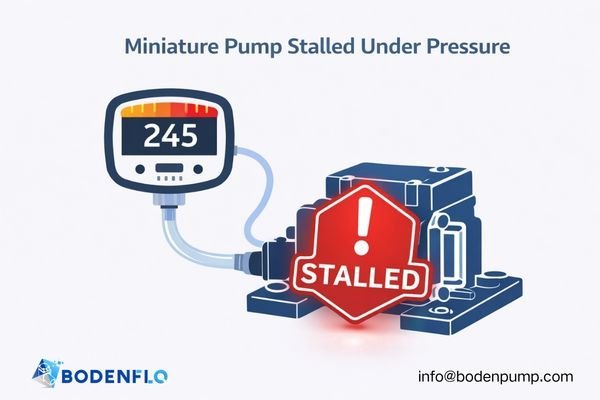
Your device suddenly loses power. When it reboots, the miniature pump stalls against the residual pressure in the line, failing to restart and causing a critical system error.
Miniature pumps fail to restart under load because the residual backpressure creates a high starting torque requirement that the motor cannot overcome, especially when the diaphragm is at its top dead center position.
As a project manager at BODENFLO with over 7 years of experience, I have seen this exact issue derail project timelines and compromise product launches. A power flicker, a quick user restart—these are not rare events. A miniature pump that can’t handle them is a major risk to your project’s success. I want to walk you through why this "stall" nightmare happens and how you can engineer a robust solution to avoid it.
Why Do Miniature Pumps Fail to Restart Under Load?
The power flickers, and your device reboots. But the once-working miniature pump just buzzes and sits there, stalled. Why does a little leftover pressure completely disable it?
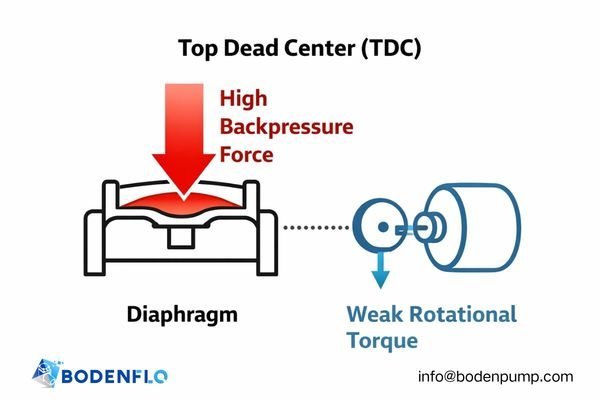
A miniature pump stalls because residual backpressure multiplies the starting torque needed. This is worst when the diaphragm stops at its "top dead center," where the motor has the least mechanical advantage to overcome the force.
This is one of the most frustrating failure modes because the pump isn’t broken; it’s just stuck. Understanding the physics behind this common problem is the first step to solving it.
The Locked-Rotor Scenario
When a pump stops, any pressure remaining in the outlet tube acts like a solid wall pushing back against the diaphragm or piston. To start moving again, the motor must generate enough initial force—called starting torque—to overcome this static pressure. This required torque can be several times higher than the torque needed for normal, continuous operation. If the motor can’t produce this initial burst of power, it enters a "locked-rotor1" state. It draws a lot of current but doesn’t turn.
Physics of the Dead Center
The problem is most severe when the pump’s diaphragm stops at its highest point, or "Top Dead Center2" (TDC). At this exact position, the rotational force from the motor has the worst possible leverage to push the diaphragm down. With high backpressure pushing up, the motor simply lacks the mechanical advantage to get past this "hump."
The Reality of Power Cut-offs
This isn’t a theoretical lab problem. Consider a medical device that has a power interruption. When power is restored seconds later, the pressure in the patient’s tubing has not had time to dissipate. The pump must restart against this full load. If it fails, the device’s therapy is interrupted, creating a critical failure.
Which Motor Selection Defines Restart Torque vs. Efficiency?
You need a pump that restarts reliably, but you also need it to be efficient and not drain the battery. How do you choose a motor that gives you both without compromise?
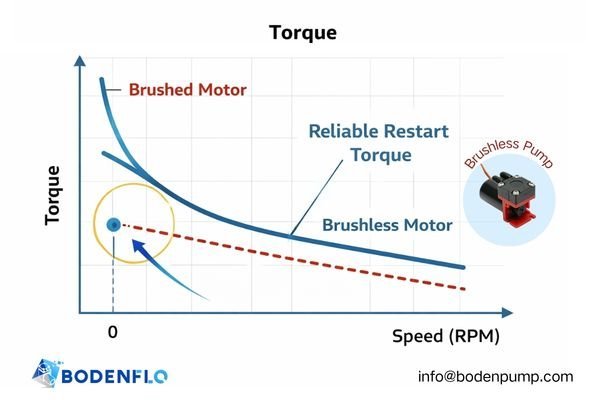
The key is selecting a high-quality brushless DC motor. Its closed-loop control provides superior low-speed torque for restarts, unlike brush motors. Proper eccentric mechanism design also balances the ability to overcome resistance with overall flow efficiency.
The motor is the heart of the miniature pump, and its characteristics directly determine the pump’s ability to handle tough restarts. It’s a delicate balance between raw power and intelligent design.
Brush vs. Brushless Torque Curves
A standard brush DC motor’s torque is highest at zero speed, but it’s uncontrolled and can be inconsistent. A high-quality brushless DC (BLDC) motor with an integrated driver uses sensors to apply force exactly where needed. This allows it to generate a much higher and more reliable starting torque, making it the superior choice for applications requiring restarts under load.
The Gear Ratio Secret
The mechanical design that converts the motor’s rotation into the diaphragm’s up-and-down motion is crucial. The design of this eccentric mechanism involves a trade-off: a shorter stroke provides more leverage to overcome resistance, while a longer stroke delivers higher flow. A well-engineered pump finds the optimal balance to provide both strong restarting capability and the specified flow rate.
Overcoming Stiction
"Stiction," or static friction, is another obstacle. After a pump has been idle, the rubber seals and valve flaps can slightly stick to the mating surfaces. This adds another layer of initial resistance that the motor must overcome on startup, on top of any backpressure.
Do You Need an Extra Relief Valve for a System-Level Workaround?
Your chosen pump struggles to restart under pressure. Now you’re facing a tough choice: add extra hardware like a relief valve or try a complex software fix?
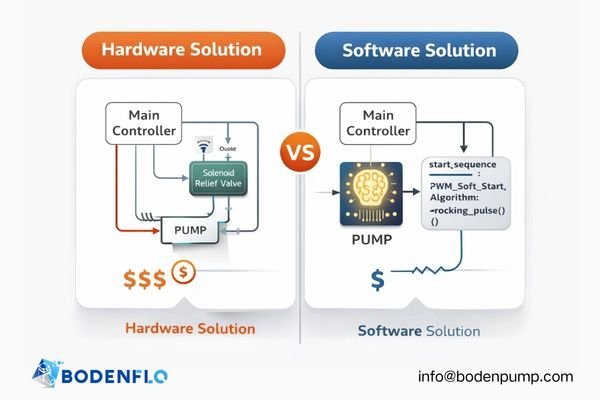
While adding an exhaust valve is a reliable hardware fix, it adds cost, complexity, and project risk. Software solutions can work, but the most crucial factor is ensuring your power supply can handle the massive inrush current during the attempt.
When the pump itself can’t handle the restart, you’re forced to solve the problem at the system level. Each approach has significant trade-offs that can impact your project’s budget and timeline.
The Cost of Complexity
The most direct hardware solution is to add a small solenoid exhaust valve to your system. Before starting the pump, the controller first opens this valve for a split second to relieve the backpressure, allowing the pump to start in a no-load condition.
- Pros: Very reliable.
- Cons: Adds cost, increases the product’s size, introduces another potential point of failure, and complicates the control logic.
The Software Fix
A clever software trick is to use a "pulsed" or "rocking" start. The controller can send a series of strong, short PWM pulses to the motor, attempting to "rock" it back and forth to break past the TDC and overcome the pressure. This can be effective but requires careful tuning and may not work under all pressure conditions.
Sizing Your Power Supply
This is a critical point many engineers miss. The inrush current3 during a restart-under-load attempt can be 5-10 times the normal operating current. If your power supply isn’t robust enough, this current spike will cause a momentary voltage drop. This voltage sag can be severe enough to reset your system’s main microprocessor, leading to a frustrating boot loop.
How Does Bodenflo Engineer "High-Restart" Reliability into Every Miniature Pump?
You want a miniature pump that just works, without needing extra valves or complex software. How can a pump be designed from the ground up to handle these real-world challenges?
Reliability isn’t an accident. We achieve superior restart performance by co-engineering the motor, mechanics, and materials to work in harmony, providing high torque while minimizing internal resistance.
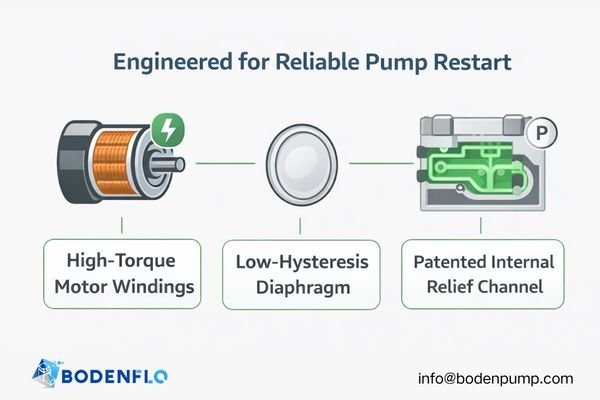
At BODENFLO, we don’t believe in leaving this problem for our clients to solve at the system level. We tackle it head-on with an integrated design philosophy.
Optimized Motor Windings
We don’t just use off-the-shelf motors. We work with our motor partners to specify custom windings that are optimized for high starting torque. This ensures our brushless DC motors have the raw power needed to overcome significant backpressure right from the start.
Low-Friction Membrane Materials
The diaphragm itself can be a source of resistance. We use high-performance elastomer materials that are specially formulated to be highly flexible and have low internal friction (hysteresis). This means the motor wastes less energy just flexing the material and can dedicate more of its power to fighting the external load.
Internal Relief Design4
This is our most innovative solution. Select BODENFLO models feature a patented internal micro-relief structure within the pump head. This design allows a minuscule, controlled amount of pressure to bleed off when the pump is stopped, without compromising the sealed integrity during operation. This clever feature reduces static backpressure just enough to allow the pump to reliably restart under loads of 50kPa or more, without any external components.
Where Is Restart Capability a "Must-Have" Application?
You’re wondering if this restart capability is a "nice-to-have" or truly essential. Which applications simply cannot afford to fail a restart?
In medical, environmental, and industrial monitoring applications, a failed restart is not an inconvenience—it’s a critical failure that can compromise patient safety, data integrity, or system uptime.
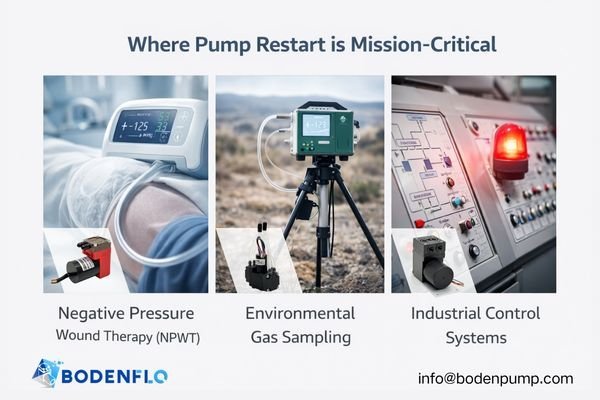
For some devices, reliable restart isn’t just a feature; it’s the core of its function and safety promise.
| Application | Why Restart is Critical |
|---|---|
| Medical NPWT (Negative Pressure Wound Therapy5) | These devices cycle on and off to maintain a therapeutic vacuum. A single failed restart can lead to a loss of negative pressure, compromising the wound healing process and causing a critical alarm. |
| Environmental Gas Sampling | A sampler might be programmed to take a 5-minute sample every hour. The tubing can be long and full of resistance. The miniature pump must reliably start on schedule every time, or the entire day’s environmental data is lost. |
| Industrial Monitoring | In a 24/7 process control system, a pump might be part of an automated loop. After any power cycle or maintenance reset, if the pump fails to restart against system pressure, it can halt the entire production line, leading to costly downtime. |
In these scenarios, specifying a miniature pump with proven restart-under-load capability is a non-negotiable requirement.
How Can You Troubleshoot Your Pump’s Restart Problems in 3 Steps?
Your prototype is failing to restart, and you need to find the root cause quickly. Is it the pump, the system, or the power supply?
You need a systematic approach. By checking the pressure, the power, and the external components in that order, you can efficiently isolate the source of the restart failure.

Don’t just randomly swap parts. Follow these three logical steps to diagnose the problem like a pro.
Step 1: Check the Pressure Gradient6
The first step is to quantify the problem. Connect a pressure gauge to the pump’s outlet. Run the system, then stop it, and note the residual pressure the pump must restart against. This tells you if you have a "high-pressure trap" in your system. If the pressure is higher than the pump’s specified restart capability, you’ve found your primary issue.
Step 2: Audit the Voltage Drop7
If the pressure is within spec, the next suspect is the power supply. Connect an oscilloscope probe to the pump’s power input terminals. Set the trigger to capture the voltage when the pump tries to start. If you see a significant voltage drop or "sag" at the moment of the startup attempt, your power supply or wiring cannot handle the inrush current.
Step 3: The "One-Way" Test
Sometimes, the problem isn’t the pressure in front of the pump but pressure coming from behind it. If an external check valve in your system fails, it can allow system pressure to leak backward into the pump chamber. A simple test is to disconnect the pump from the system and see if it restarts. If it works perfectly when isolated, you likely have a faulty external valve that is trapping pressure where it shouldn’t be.
Conclusion: Don’t Let Backpressure Kill Your Product’s Reputation
The strategic choice is making ‘restart-under-load’ a key test criterion early in your design phase, not an afterthought discovered during production. Our engineering team can help. We can simulate the most demanding restart scenarios to match you with the right pump. Don’t let a restart failure compromise your project. Contact us at info@bodenpump.com to ensure your micro pump runs worry-free under any condition.
-
Understanding the locked-rotor scenario is crucial for troubleshooting pump failures effectively. ↩
-
Exploring Top Dead Center helps in grasping the challenges pumps face during operation, enhancing maintenance strategies. ↩
-
Learning about inrush current is crucial for preventing system resets and ensuring stable operation in your projects. ↩
-
Explore this link to understand how Internal Relief Design enhances pump efficiency and reliability, a key innovation in modern engineering. ↩
-
Explore this link to understand how NPWT works and its critical role in wound healing. ↩
-
Understanding the pressure gradient is crucial for diagnosing pump issues effectively, ensuring optimal performance. ↩
-
Exploring voltage drop effects can help you prevent power supply issues, ensuring your pump operates smoothly. ↩