
Your brushed air pump is overheating in a compact design, risking catastrophic failure. This isn’t just a quality issue; it’s a critical system-level oversight that needs a clear engineering solution.
The key is treating it as a system challenge. Because brushed pumps lack internal protection, you must implement external monitoring with an NTC thermistor, use smart controls, and optimize system airflow. This prevents motor burnout and ensures reliability in high-pressure applications.
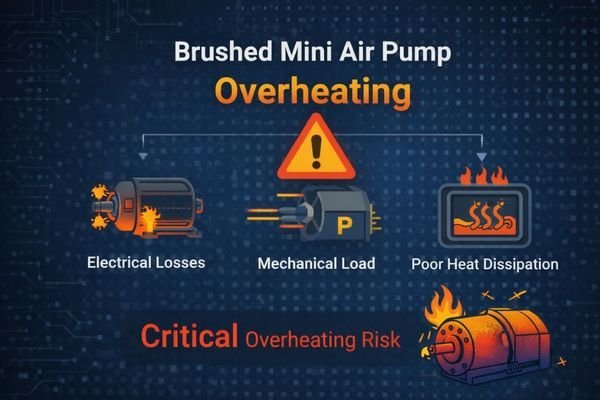
I’ve seen countless OEM projects get derailed by unexpected overheating. A brushed pump that performs perfectly on a lab bench suddenly fails once integrated into the product’s tight enclosure. This is especially dangerous because, unlike their brushless counterparts, brushed pumps have no internal control board to manage current limits or thermal shutdown. If they overheat, they don’t just stop—they burn out. This article explains how to prevent that disaster.
Why Do Brushed Air Pumps Overheat in Compact Devices?
You’ve selected a pump that meets performance specs, yet it’s running dangerously hot. This risks premature failure, melted components, and a completely dead device in the customer’s hands.
This happens because brushed pumps are uniquely vulnerable in compact systems. Heat is generated by electrical friction and mechanical load, and then it gets trapped by poor heat dissipation, creating a thermal runaway that the unprotected motor cannot survive.
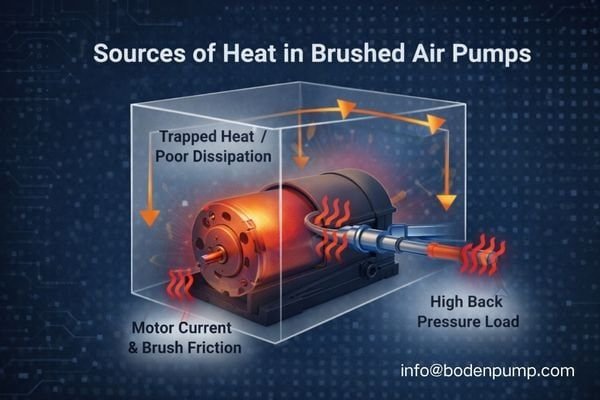
In my experience, this problem always boils down to three factors. An engineer’s job is not just to select a pump, but to manage its entire thermal environment—especially for a brushed motor. First, you have electrical losses1. This includes the standard current flow (copper loss) plus the unique heat generated by the physical friction of the brushes against the commutator. Second is the mechanical load, a major factor in high-pressure inflation applications. Forcing the pump to work against high back pressure dramatically increases current draw and heat. Finally, the killer is poor heat dissipation2. A small, sealed enclosure acts like an oven, trapping all this heat and causing a steady temperature rise until something fails.
| Heat Source | Description | Impact on Temperature |
|---|---|---|
| Motor Current & Brush Friction | Higher load and the inherent friction of a brushed motor. | Rapid and direct temperature rise. |
| Back Pressure | High resistance from tubing, valves, or inflation tasks. | Forces higher power consumption and intense heat. |
| Enclosure Design | Limited airflow and small internal volume. | Traps heat, leading to thermal runaway and burnout. |
What Are the Early Signs of Overheating in Mini Air Pump Systems?
Your device is failing intermittently, but you’re not sure why. You suspect overheating, but you need to know the specific warning signs before a catastrophic motor burnout occurs.
The signs are subtle changes long before total failure. Watch for a drop in flow rate, a rise in motor current, or new noises. Ignoring these leads to melted pump heads, seized bearings, or a dead motor.
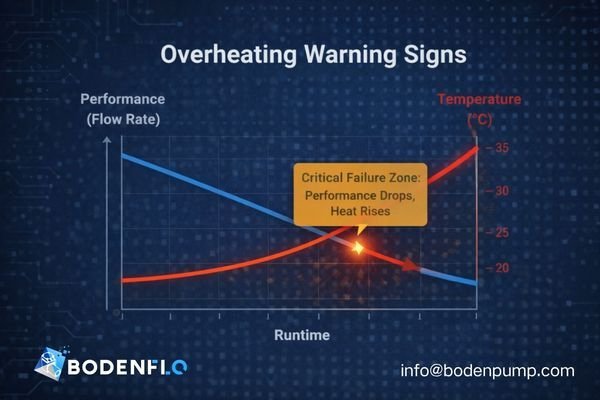
Overheating is a progressive killer for brushed pumps. Knowing the signs is critical. The first symptom is often performance degradation3. As the pump head gets hot, the rubber diaphragm or valves can soften, causing a noticeable drop in flow or pressure. If you’re monitoring power, you’ll see a corresponding rise in current draw as the hot motor struggles. Finally, listen. An overheating pump may develop a strained, louder noise as its bearings are stressed and components expand. If you ignore these signs, the outcome is predictable: the pump head temperature rises until the rubber melts, the bearings seize from heat, or the motor windings simply burn out.
How to Monitor Temperature in a Brushed Air Pump System?
You know you need to monitor the temperature to prevent burnout, but what is the most reliable and cost-effective method for a production device?
The most effective OEM solution is integrating an NTC thermistor directly on the pump’s motor casing. This provides accurate, real-time data to your microcontroller, allowing you to implement crucial shutdown or speed control logic.
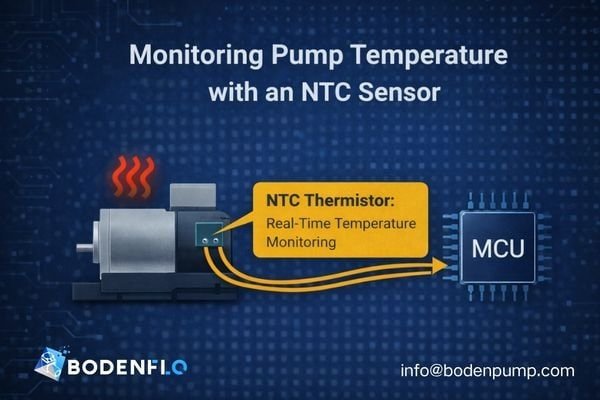
For a brushed pump, monitoring isn’t optional; it’s the protection circuit you have to build yourself.
Direct Temperature Monitoring Methods
- NTC Thermistor4: This is my top recommendation. A small NTC thermistor glued to the motor casing provides a continuous resistance value that correlates to temperature, enabling precise control logic (e.g., "if temp > 80°C, then shut off power").
- Thermal Switch: A simpler, on/off device. It opens or closes at a preset temperature. It’s cheap protection but offers no granular control—it acts as a last-resort emergency stop.
Indirect Monitoring Methods
- Current Monitoring5: Because rising temperature increases current draw, monitoring current is an excellent proxy for heat. You can set a current limit in your firmware to throttle or shut down the pump.
- Runtime Estimation: The most basic method. Through testing, you determine the pump overheats after 10 minutes. Your firmware then forces a shutdown after 9 minutes. It’s imprecise but better than nothing for low-cost devices.
My best practice advice is always a combination: an NTC thermistor for direct measurement, backed by current monitoring and smart control logic.
| Method | Accuracy | Cost | Response Speed | Recommended Use Case |
|---|---|---|---|---|
| NTC Sensor | High | Medium | Fast | Most professional OEM systems |
| Thermal Switch | Low-Medium | Low | Medium | Basic, low-cost safety protection |
| Current Monitoring | Medium | Low | Fast | Excellent complementary method |
| Time-based Control | Low | Very Low | Slow | Simple, entry-level devices only |
What Are the Most Common Mistakes in Overheating Control?
You’ve added a fan, but the pump still overheats. Frustrated, you’re considering a bigger, more expensive pump, which will likely make the problem worse.
This happens because the root cause is a system mismatch, not a weak pump. Common mistakes include ignoring the enclosure’s oven-like effect and, most critically, failing to implement any protective control logic for the vulnerable brushed motor.
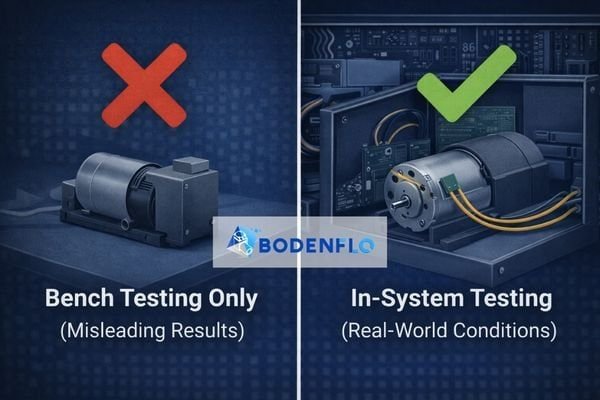
Overheating is almost always caused by system mismatch. Here are the mistakes I see engineering teams make:
| Common Mistake | Why It’s Wrong & What It Causes |
|---|---|
| Only testing at room temperature | Fails to simulate the device’s hot internal environment, leading to unexpected failures in real-world use. |
| Ignoring enclosure heat buildup | Creates an "oven effect" where heat cannot escape, guaranteeing overheating even with a correctly sized pump. |
| No protection logic | Leaves the unprotected brushed motor vulnerable to burnout, turning a preventable issue into a catastrophic failure. |
| No airflow path optimization6 | Passive vents are not enough. Without a clear inlet-outlet path, cooling is ineffective. |
| Oversizing the pump blindly | A more powerful pump generates more heat and noise, almost certainly making the overheating problem worse. |
How to Prevent Overheating Without Reducing Performance?
You must solve the overheating problem, but you can’t sacrifice the flow rate or pressure your application demands. How can you cool the system without compromising its function?
You can prevent overheating through smart system design. This involves choosing the right pump for the load, designing a clear thermal airflow path, and implementing intelligent control—or upgrading to a pump technology designed for better control.
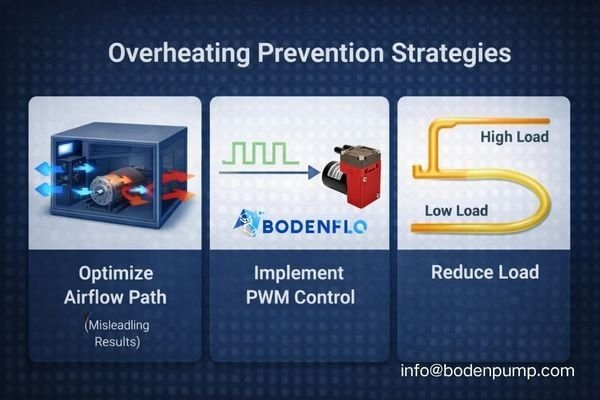
Preventing overheating is a balance of mechanical, electrical, and pneumatic design.
Optimize Control Strategy
You are the control board for the brushed motor. Since a standard brushed pump has no integrated controller, you have two primary paths:
- Duty-Cycle Control7: For intermittent tasks, you can manage heat by only running the pump when needed. This is a simple on/off logic controlled by your firmware. For high-pressure tasks, apply this with a staged operation: run at full power for a short burst to inflate, then turn it off until pressure drops below a threshold.
- Upgrade to a Brushless (BLDC) Pump8: This is often the superior engineering choice. Brushless pumps are more efficient (generating less heat) and feature integrated controllers, often with a dedicated PWM input pin. This allows you to easily and precisely control the pump’s speed, running it only as hard as necessary and dramatically reducing heat output.
Improve Thermal Design
This is non-negotiable. Your enclosure must have a clear ventilation path—an inlet for cool air and an outlet for hot air, positioned to create airflow across the pump motor. Isolate the pump from other heat-sensitive components.
Reduce System Load
Examine your pneumatic circuit. Every sharp bend or restrictive filter adds back pressure, generating more heat. Use smoother, larger-diameter tubes and low-resistance components to ease the load on the motor.
| Strategy | Effect on Temperature | Effect on Performance | Priority |
|---|---|---|---|
| Better Airflow Path | Strong reduction | Improves overall efficiency | High |
| Upgrade to Brushless/PWM | Strong reduction | Fully adjustable, higher efficiency | High |
| Thermal Isolation | Moderate reduction | No direct performance impact | Medium |
| Oversized Pump | Increases Heat | Risky, often counterproductive | Avoid |
Which Pump and System Design Is Best for Thermal Stability?
You understand the strategies, but how do you apply them? Which configuration should you choose for a compact medical device versus a fast-inflating industrial tool?
The ideal design depends entirely on the application’s thermal budget. For low-heat systems, a well-managed brushed pump may suffice. For high-performance or heat-sensitive systems, a brushless pump is the safer choice.
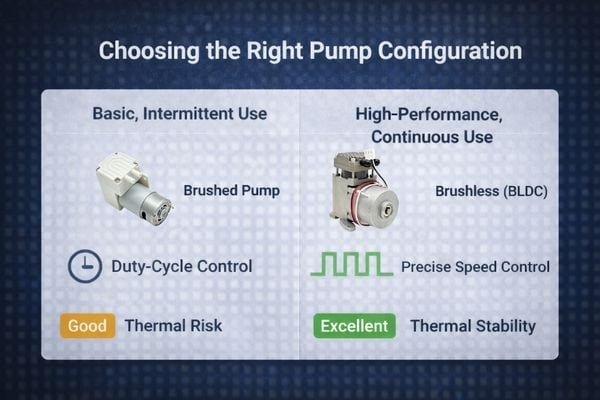
Thermal stability comes from matching the pump to the system, not from the pump alone.
Application-Based Selection Logic
- Low-Cost / Intermittent Use: A simple brushed pump with good ventilation and runtime limits can work if the device only runs for short periods.
- High-Performance / Continuous Use: A brushless (BLDC) pump is strongly recommended. Its higher efficiency and simple PWM speed control provide the best defense against overheating while maintaining a long operational life.
Engineering Comparison (Example)
| Configuration Type | Pump Technology | Thermal Behavior | Recommended Use |
|---|---|---|---|
| Basic Setup | Brushed | High heat risk, requires strict control | Intermittent, low-cost devices |
| Balanced Setup | Brushed | Controlled heat, requires good venting | General OEM with duty-cycle control |
| High-Performance Setup | Brushless (BLDC) | Low heat, efficient, easy to control | Continuous use, high-reliability apps |
Why Does System-Level Design Matter More Than the Pump Specification?
You’ve been focused on finding the "perfect pump." But even the best pump in the world will fail if the system around it is flawed.
Because real-world performance is not determined by a datasheet. It is the result of the synergy between the pump, the enclosure’s airflow, the control logic, and the pneumatic circuit. In a system with a brushed pump, you, the design engineer, are the protection circuit.
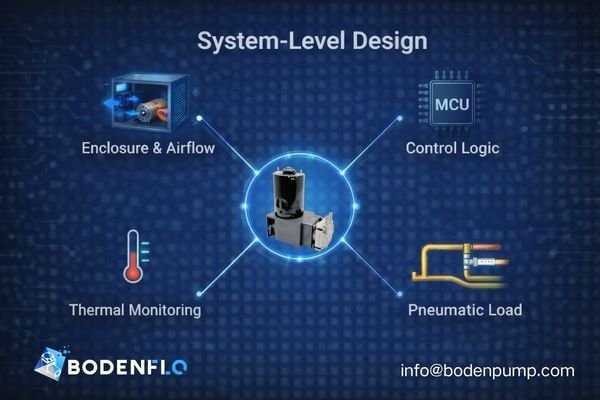
The final performance of your device is a function of the entire system. In OEM applications, the most reliable designs are not those using the most powerful pumps, but those with the most well-balanced and intelligent system integration. This is the absolute key to creating a successful, reliable product that won’t fail from predictable issues like overheating.
Conclusion
Overheating in brushed air pumps is a serious risk due to their lack of internal protection, but it is entirely preventable. Successful thermal management requires system-level engineering: direct temperature monitoring, smart power control, and optimized airflow design. For demanding applications, upgrading to a more efficient brushless pump is often the most reliable path.
If you are developing compact devices and facing these challenges, our engineering team can help. We specialize in evaluating pump selection—both brushed and brushless—along with thermal design and control strategies to build a reliable, stable system. Contact us at info@bodenpump.com to engineer your solution.
-
Understanding electrical losses is crucial for optimizing motor performance and preventing overheating. ↩
-
Exploring solutions for heat dissipation can enhance motor efficiency and longevity, preventing failures. ↩
-
Understanding the causes of performance degradation can help you prevent pump failures and maintain efficiency. ↩
-
Explore this link to understand the functionality and benefits of NTC thermistors in temperature monitoring. ↩
-
Learn about the advantages of current monitoring as a method for effective temperature control in devices. ↩
-
Exploring airflow optimization techniques can lead to more effective cooling solutions and improved device performance. ↩
-
Learn about Duty-Cycle Control to optimize your motor’s performance and manage heat effectively. ↩
-
Explore the advantages of Brushless pumps, including efficiency and heat reduction, to enhance your design. ↩