
When you start developing a medical device, selecting the right micro pump is rarely a simple decision. In real projects, I often see teams focus on specifications first—but the real challenge is understanding how the pump behaves inside the system.
A wrong choice doesn’t just affect performance. It can impact patient safety, device reliability, and regulatory compliance. So what should you actually do when you need a micro pump for a medical device? This isn’t just about picking a part; it’s about implementing a critical system component correctly.
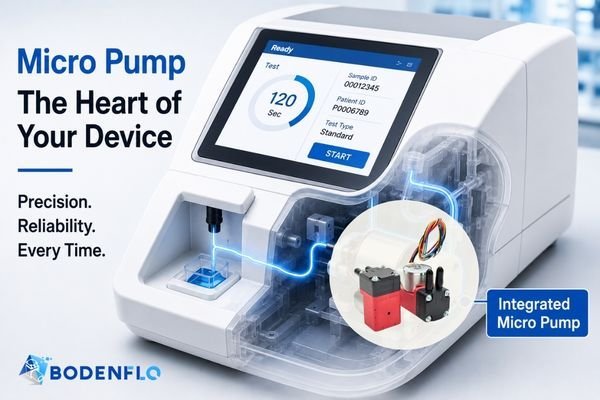
As a component partner for numerous medical device OEMs, I’ve been through this process countless times. The most successful projects are not the ones that find the cheapest pump, but the ones that follow a structured, risk-based selection process. Let’s walk through the exact steps our most experienced partners take to ensure they get it right.
What Is the First Thing You Should Clarify Before Selecting a Micro Pump?
You have a general idea of the pump you need. Stop. Before you even look at a single pump datasheet, you must precisely define your application’s requirements.
The very first step is clarifying the pump’s core function. Is it for suction, dosing, or sampling? Will it run continuously or intermittently? What is the medical device’s category (e.g., diagnostic, therapeutic)? Most pump selection problems I see come from unclear initial requirements.
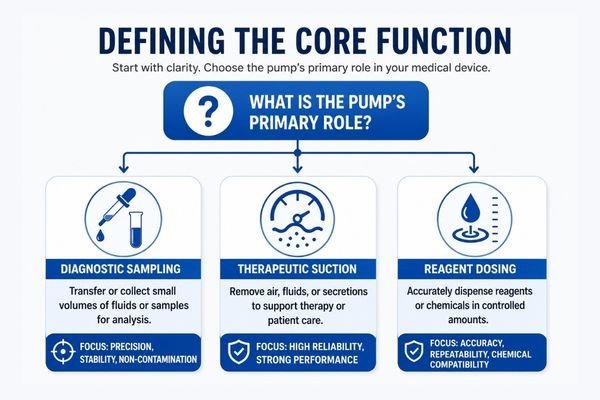
In our initial meetings with engineering teams, this is where we spend the most time. A pump for a diagnostic device that transfers a sample once per test has completely different requirements than a pump in a therapeutic device like a negative pressure wound therapy (NPWT) system that must run reliably for days. Writing down these top-level requirements—application type, duty cycle, and medical classification—creates the foundation for every technical decision that follows. Without this clarity, you’re essentially guessing.
How Do You Define Flow, Pressure, and Working Conditions?
You need 2 L/min and 1 bar. But is that in free air or under load? Is it continuous or for a 1-second burst? Vague specifications lead to failed tests and project delays.
You must define the exact operating point. This means specifying the working flow rate under your system’s actual back pressure, not the pump’s rated (maximum) flow. You also need to define the duty cycle (how long it’s on vs. off).
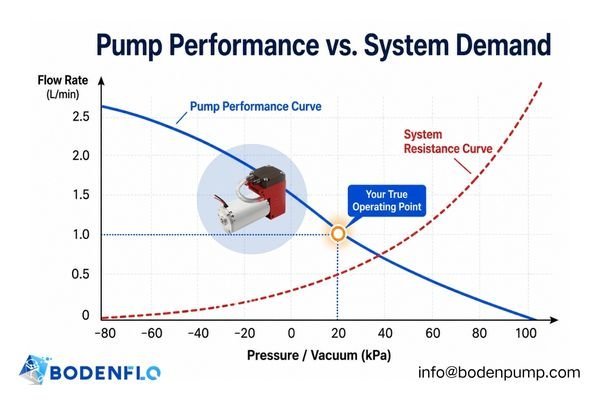
We always ask our engineering partners to fill out a table like this. It transforms a vague idea into a concrete engineering target.
| Parameter | Specification | Notes |
|---|---|---|
| Working Flow | e.g., 1.5 L/min | The actual flow rate needed during operation. |
| System Pressure | e.g., -40 kPa | The vacuum or pressure the pump works against. |
| Duty Cycle | e.g., 5 min ON / 10 min OFF | Defines the thermal load and motor requirements. |
| Ambient Temp. | e.g., 5°C to 40°C | Defines the operating environment. |
| Target Lifespan | e.g., 8,000 hours | Determines the necessary motor and bearing quality. |
A pump that works perfectly on a lab bench can fail miserably inside a product enclosure where temperatures are higher and pressure loads are real. Defining these parameters is the most critical technical step.
What Medical Scenario Are You Designing For?
Are you designing a lab analyzer or a portable suction unit? The pump you choose for one could be a catastrophic failure in the other, even if their flow rates are identical.
The medical context dictates the pump’s most important features. Diagnostic devices prioritize precision and non-contamination, therapy devices demand extreme reliability, and portable devices require low power consumption and quiet operation.

Thinking in terms of scenarios helps clarify trade-offs.
- Diagnostic Devices: For transferring samples or dosing reagents, flow stability and material inertness are key1. A small pulsation could throw off a reading, so a smooth-flow diaphragm pump is often ideal.
- Therapy Devices: In applications like NPWT or surgical suction, the pump cannot fail2. Here, a long-life brushless motor, robust construction, and alarms for pressure deviation are non-negotiable.
- Portable Devices: For wearable or handheld devices, every milliamp and decibel counts. The focus shifts to high-efficiency motors, low-vibration designs, and compact, lightweight construction.
Different medical scenarios require completely different pump strategies. A "one-size-fits-all" approach does not work here.
Why Is Material Compatibility Critical in Medical Applications?
The pump works perfectly… until the cleaning fluid cracks the housing. In medical devices, material compatibility goes beyond just the primary medium; it includes sterilization and cleaning agents.
Choosing the right wetted path materials (like EPDM, FKM, or PTFE) is a safety-critical decision. An incompatible material can leach chemicals into the fluid path, degrade from sterilization processes (like autoclave or gamma), or fail catastrophically after exposure to cleaning agents.

While a standard industrial pump might use basic EPDM, a medical device may require a higher-grade FKM for chemical resistance or even USP Class VI certified materials3 to meet regulatory standards. We always have a detailed discussion with our clients about every single fluid and cleaning agent the pump might encounter over its entire lifecycle. The stakes are simply too high in the medical field to make assumptions about material resistance.
How Does Pump Selection Affect Patient Safety?
A pump is just a component, so how can it impact patient safety? This is a dangerous misconception. A pump failure is a device failure, and in a medical context, that can have severe consequences.
The reliability and stability of a micro pump are directly linked to patient safety. A flow instability can lead to incorrect dosage, a leak can cause contamination, and a sudden pump failure can shut down a life-sustaining therapy device.
Let’s be very clear about the risks:
- Dosage Error: In a drug delivery or reagent dosing system, an unstable pump delivers the wrong volume. This can lead to incorrect diagnosis or ineffective treatment.
- Contamination: If a pump diaphragm or seal fails, it can create a leak path, potentially contaminating a sterile fluid path or exposing sensitive electronics to fluid.
- Therapy Interruption: In devices like ventilators or wound therapy systems, if the pump stops, the therapy stops. This can be a critical safety event.
Pump selection is directly linked to risk management and patient safety, not just device performance. This is a topic that should be part of your formal risk analysis from day one.
How Do You Choose Between Brushless and Brushed Pumps for Medical Use?
You need to save on your Bill of Materials (BOM), so a cheaper brushed motor seems tempting. But what is the hidden cost in terms of risk and long-term reliability?
For medical devices, the choice between a brushed and brushless (BLDC) motor is a strategic decision about lifespan and reliability. While brushed motors are cheaper, they are a known failure point. Brushless motors offer a lifespan that is often 5-10 times longer.
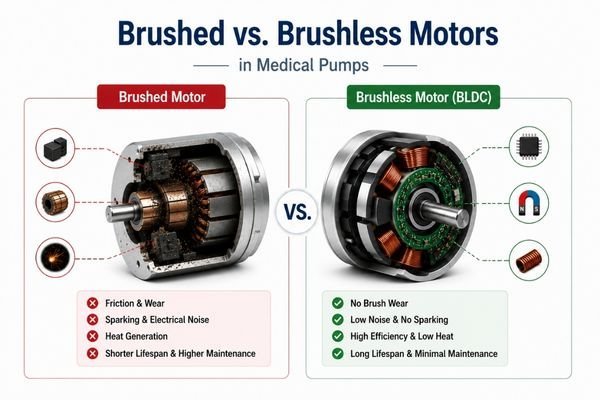
Here’s how we guide our partners on this crucial choice:
| Motor Type | Best Use Case in Medical | Risk Profile |
|---|---|---|
| Brushed | Single-use devices, very intermittent use (<1000 hrs total), prototypes. | High risk of failure in long-term or continuous use. Brush dust can be a contaminant. |
| Brushless | Continuous duty therapy devices, high-use diagnostics, any device requiring >3,000 hrs lifespan. | Low risk. The standard for any reliable, professional medical device. Higher upfront cost. |
For any device where pump failure could lead to a safety event or costly warranty return, a brushless motor is the only professionally responsible choice.
What Integration Issues Should You Consider Early On?
The pump meets all specs on the bench, but inside the device, it’s loud and vibrating. This is a classic integration failure. The pump doesn’t exist in isolation; it’s part of a larger system.
You must think about system integration from the very beginning. This includes the impact of tubing length and diameter, the back pressure from filters, and managing noise and vibration within the device enclosure.
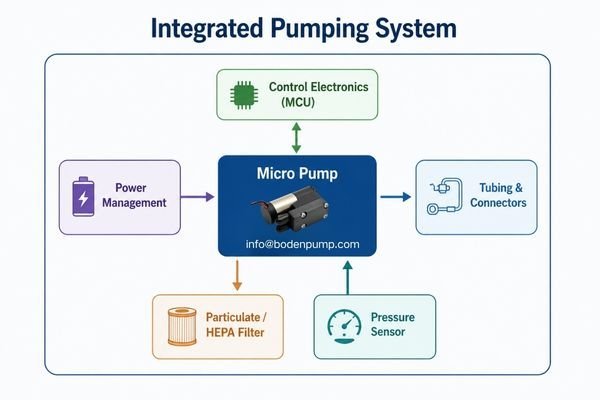
We often see teams select the perfect pump but connect it with long, narrow tubing that strangles its performance. Or they mount it directly to the housing without vibration dampeners, creating an unacceptably loud product. This is why we say it’s not about choosing a pump; it’s about designing a system. Thinking about the mounting, tubing, filtration, and power supply early in the design process will save you from major headaches and redesigns later4.
What Are the Most Common Mistakes in Medical Pump Selection?
Want to avoid the most common pitfalls that delay projects and compromise device quality? Learn from the mistakes we’ve seen other teams make. These errors almost always stem from prioritizing the wrong metric.
The most common mistakes are focusing only on price, ignoring lifespan requirements, overlooking material compatibility with cleaning agents, and underestimating the system’s real-world resistance.
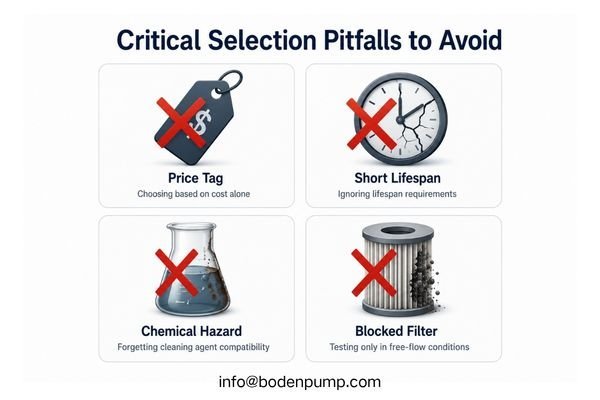
From our experience, here are the top four mistakes that lead to field failures:
- Price-First Selection: Choosing the cheapest pump that meets the flow spec, only for it to fail after 1,000 hours in a device that needs to last 10,000.
- Ignoring Lifespan: Using a brushed motor for a continuous-duty application. It’s not a question of if it will fail, but when.
- Forgetting Cleaning Protocols: Selecting a pump with materials resistant to the primary fluid but that are destroyed by the hospital-grade disinfectant used to clean the device.
- Underestimating System Load: Testing a pump in free air and assuming it will perform the same when connected to 2 meters of tubing and a 0.2-micron filter.
How Do You Validate a Micro Pump in a Medical Project?
The pump has passed all your bench tests. Does that mean it’s ready for production? Absolutely not. Lab conditions are not the real world, and this gap is where devices often fail.
Proper validation involves rigorous testing of the pump within the final device, under real-world conditions. This includes prototype testing, long-term life testing, and testing at the extremes of temperature and humidity.
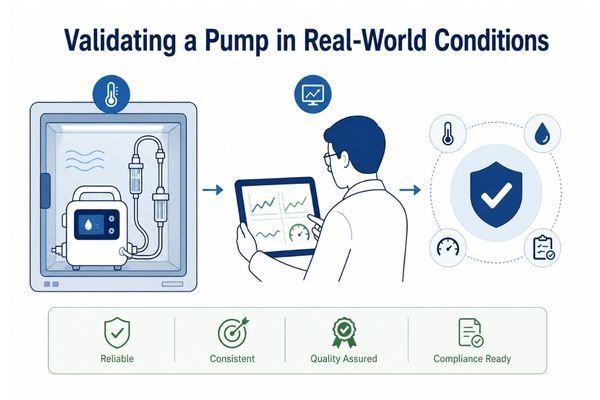
A robust validation plan we’ve seen work includes:
- Prototype Testing: Confirming that the pump delivers the required flow and pressure within the actual device enclosure with all its final components (tubing, filters, etc.).
- Long-Term Life Testing5: Running a statistically significant number of devices continuously for weeks or months to simulate years of use and identify any long-term failure modes.
- Worst-Case Testing: Operating the device at the maximum and minimum specified temperatures and humidity levels to ensure the pump performs reliably under all expected environmental conditions.
Remember, lab results prove a concept, but only real-world validation proves reliability.
How Can You Select the Right Pump Faster?
With so many factors, how can you streamline the decision-making process? Create a simple, four-point checklist to quickly shortlist potential candidates before diving into deep technical analysis.
To accelerate your selection, focus on these four core parameters first: Flow, Pressure, Medium, and Lifetime. Any pump that doesn’t meet these basic requirements can be immediately disqualified.
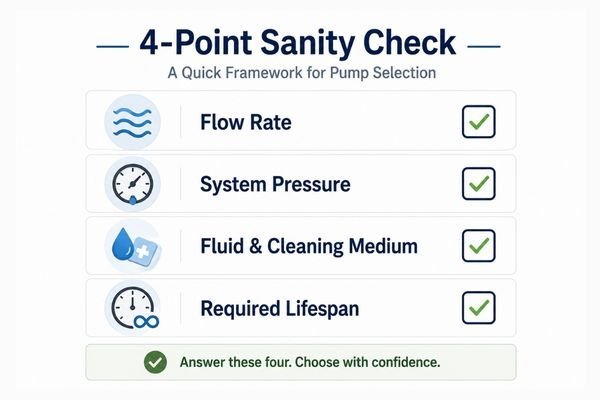
This simple framework acts as a powerful filter:
- Flow: What is your target working flow rate?
- Pressure: What is the system’s vacuum or back pressure?
- Medium: What fluid is being pumped and what is it cleaned with? (This defines material needs).
- Lifetime: What is the required operational lifespan in hours? (This defines motor type).
By answering these four questions, you can narrow down a catalog of hundreds of pumps to just a handful of viable options in minutes.
Which Micro Pumps Are Commonly Used in Medical OEM Projects?
What types of pumps are other medical device engineers actually using? Based on the projects we support, the choices usually fall into a few key categories based on their proven reliability.
For medical devices, the most commonly used pumps are high-reliability micro diaphragm pumps, often configured as a vacuum pump for suction or a liquid pump for fluid transfer, and almost always driven by a long-life brushless motor.
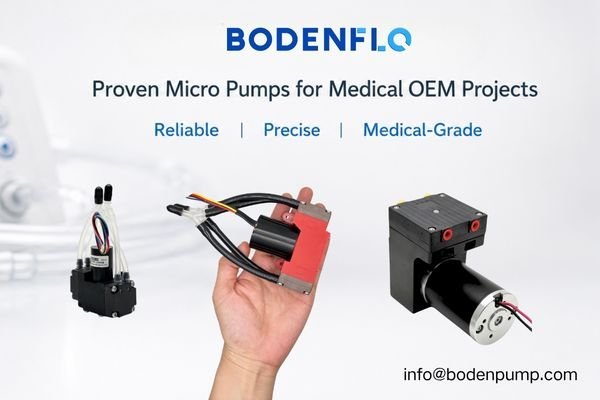
At BODENFLO, our entire portfolio for medical OEMs is built around this philosophy. We focus on providing:
- Micro Vacuum Pumps6: Engineered for stable, high-reliability suction in applications from surgical smoke evacuation to diagnostic sampling.
- Micro Diaphragm Pumps7: Both gas and liquid versions provide smooth, controllable flow perfect for dosing, transfer, and circulation.
- Brushless Motor Options: All our core medical-grade pumps are available with BLDC motors to meet the demanding 10,000+ hour lifespan requirements of professional medical equipment.
Conclusion: Why Is Pump Selection a Critical Decision in Medical Devices?
In summary, choosing a micro pump for a medical device goes far beyond a simple spec sheet comparison. It is a critical engineering decision that directly impacts device performance, patient safety, and total project cost.
Need Help Selecting a Micro Pump for Your Medical Device?
This process can be complex, but you don’t have to navigate it alone. Our team at BODENFLO has experience with hundreds of medical device applications and can help you select the right component for the job.
Let us help you de-risk your project. Provide us with your requirements for flow, pressure, medium, and lifetime, and we can quickly recommend a pump configuration that is already proven in the field. Let’s work together to build a safe, reliable medical device.
Contact our application engineering team at info@bodenpump.com to start your technical consultation.
-
"What is Stability and Why is it Important? | DwyerOmega", https://www.dwyeromega.com/en-us/resources/what-is-stability-and-why-is-it-important?srsltid=AfmBOoqo1l7nyEdRlsPITfFpdd7n5dgjgGEZL9gO46NZiN9217O8TwIh. A review of diagnostic devices highlights the importance of flow stability and material inertness in ensuring accurate sample transfer and reagent dosing, as minor pulsations can affect readings. Evidence role: mechanism; source type: paper. Supports: For transferring samples or dosing reagents, flow stability and material inertness are key.. Scope note: The review discusses general principles and may not address every diagnostic device type. ↩
-
"Consensus guidelines on negative pressure wound therapy for …", https://www.sciencedirect.com/science/article/pii/S2950575526000018. Clinical guidelines for negative pressure wound therapy and surgical suction emphasize the critical need for reliable pump operation, as device failure can compromise patient safety and treatment efficacy. Evidence role: expert_consensus; source type: institution. Supports: In applications like NPWT or surgical suction, the pump cannot fail.. Scope note: Guidelines focus on specific therapy devices and may not generalize to all medical pumps. ↩
-
"USP Class VI Silicone: A Guide to Medical-Grade Materials", https://acesanitary.com/resources/blog/guide-to-usp-class-vi-silicone/. USP Class VI certification is a standard for biocompatibility of materials used in medical devices, as defined by the United States Pharmacopeia, which includes requirements for toxicity and biological reactivity testing. Evidence role: definition; source type: institution. Supports: USP Class VI certified materials are required to meet regulatory standards in medical devices.. Scope note: USP Class VI certification addresses biocompatibility but does not guarantee chemical resistance for all applications. ↩
-
"System Integration – SEBoK", https://sebokwiki.org/wiki/System_Integration. Engineering design literature emphasizes that early consideration of system integration factors such as mounting, tubing, filtration, and power supply reduces the likelihood of costly redesigns and operational issues. Evidence role: expert_consensus; source type: education. Supports: Thinking about mounting, tubing, filtration, and power supply early in the design process will save you from major headaches and redesigns later.. Scope note: While this is a widely accepted principle, specific outcomes depend on the complexity and requirements of the system. ↩
-
"Accelerated life testing – Wikipedia", https://en.wikipedia.org/wiki/Accelerated_life_testing. Long-term life testing is a recognized method in reliability engineering for simulating extended use and identifying potential failure modes, as documented in engineering standards and literature; however, specific protocols and sample sizes may vary by industry and device type. Evidence role: expert_consensus; source type: education. Supports: Running a statistically significant number of devices continuously for weeks or months to simulate years of use and identify any long-term failure modes.. Scope note: Protocols and sample sizes differ across industries and device types. ↩
-
"Small Medical Vacuum Pump: Essential Technology in Healthcare", https://bodenpump.com/small-medical-vacuum-pump-essential-healthcare/. A review of medical device technologies confirms that micro vacuum pumps are commonly used for stable suction in surgical smoke evacuation and diagnostic sampling, though specific performance standards may vary by application. Evidence role: general_support; source type: encyclopedia. Supports: Micro Vacuum Pumps: Engineered for stable, high-reliability suction in applications from surgical smoke evacuation to diagnostic sampling.. Scope note: The source may describe typical uses but not endorse a specific manufacturer’s implementation. ↩
-
"Micro Diaphragm Pumps in Medical Devices", https://bodenpump.com/micro-diaphragm-pumps-medical-devices-non-invasive-diagnostics/. Micro diaphragm pumps are widely used in medical devices for their ability to provide precise, controllable flow of gases and liquids, as documented in engineering and medical equipment literature. Evidence role: mechanism; source type: encyclopedia. Supports: Micro diaphragm pumps provide smooth, controllable flow suitable for dosing, transfer, and circulation in medical applications.. Scope note: Support is general and may not address specific models or brands. ↩