
Your micro vacuum pump works flawlessly on the test bench, but inside the final device, it repeatedly trips the power supply and shuts down. This frustrating issue can halt development and wrongly suggest a pump failure.
The problem is often startup inrush current exceeding your power supply’s protection limit. Micro vacuum pumps can draw 2-3 times their normal running current for a moment at startup, a spike that many power systems incorrectly interpret as a dangerous fault, triggering a shutdown.
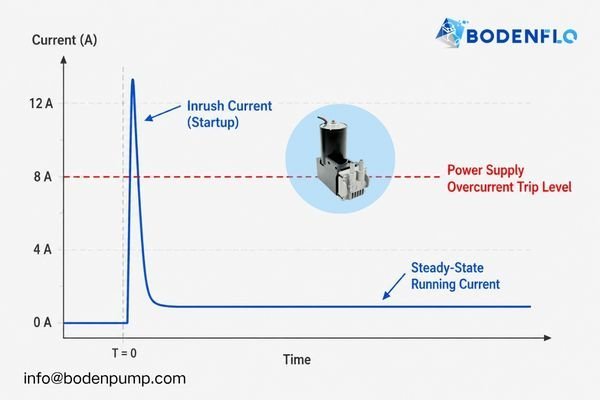
In my experience helping hundreds of OEM engineers, this is one of the most common and misunderstood integration challenges. The symptoms are always the same: intermittent startups, voltage drops, or the entire system getting stuck in a restart loop. In most cases, the pump itself is not defective. The system’s power delivery is simply unprepared for the physical reality of starting a DC motor. Let’s dig into exactly why this happens and how you can design a robust system that starts reliably every single time.
What Happens Electrically During Micro Vacuum Pump Startup?
You see a huge current spike on your meter, but why does a tiny pump draw so much power before it’s even moving? The answer lies in the fundamental physics of DC motors.
At the moment of power-on, the pump’s motor is stationary and its back-EMF (a counter-voltage created by a spinning motor) is zero. Without back-EMF to oppose the incoming voltage, the motor’s windings act like a simple resistor, drawing a massive inrush current.
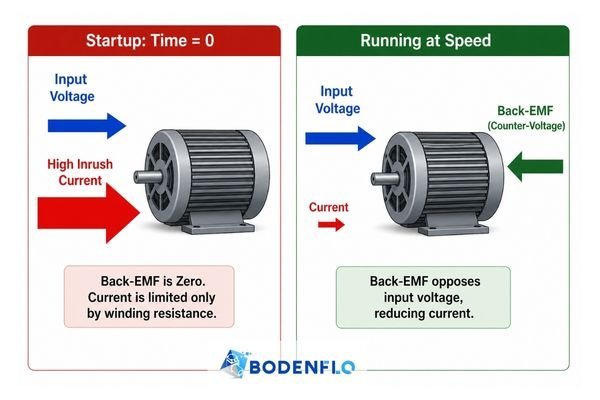
This initial surge is known as startup current, inrush current, or stall current. It is an unavoidable characteristic of all DC motors. This spike, which can be 2x, 3x, or even higher than the normal running current1, lasts for only a few milliseconds. The problem occurs when your power supply’s protection circuit sees this brief, high current as a dangerous short circuit or overcurrent fault and immediately shuts down power to protect the system.
| Current Type | When It Occurs | Typical Magnitude |
|---|---|---|
| Running Current | During steady-state operation. | The value on the pump’s datasheet. |
| Startup Current | For milliseconds at power-on. | 2x to 5x+ the running current. |
| Stall Current | When the motor is stuck but energized. | Identical to startup current. |
Why Do Micro Vacuum Pumps Require Higher Startup Current Under Load?
The pump starts fine on its own, but fails when connected to tubes and filters. Is that little bit of extra load really the problem? Absolutely. Any resistance makes the startup current demand even higher.
When a pump starts under load—for example, against a pre-existing vacuum, trapped outlet pressure, or a clogged filter—the mechanical resistance is far greater. To overcome this resistance, the motor needs significantly more torque, and higher torque demands higher electrical current.
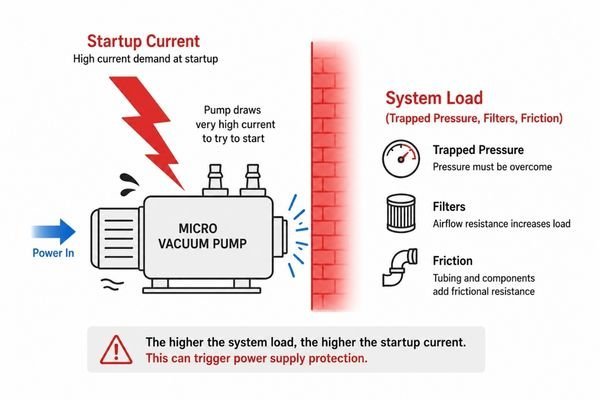
I frequently see this issue in devices that must restart quickly. The system stops, but residual pressure remains trapped in the lines. When the pump tries to restart, it isn’t starting against an open atmosphere; it’s pushing against a physical barrier. This "startup under vacuum" or "startup against pressure" condition requires the motor to draw its maximum stall current for a longer duration, making it much more likely to trip a power supply’s protection circuit. The core principle is simple: higher mechanical resistance requires higher startup torque, which demands higher startup current.
Why Does Power Supply Protection Often Trigger Unexpectedly?
Your power supply is rated for 10A, but it shuts down on a 5A spike. What’s going on? The nominal rating on a power supply’s label doesn’t tell the whole story about its protection behavior.
Many modern power supplies include sophisticated protection circuits like Overcurrent Protection (OCP), short-circuit protection, or foldback current limiting. These circuits are designed to react extremely quickly—often in microseconds—to prevent damage to the system.
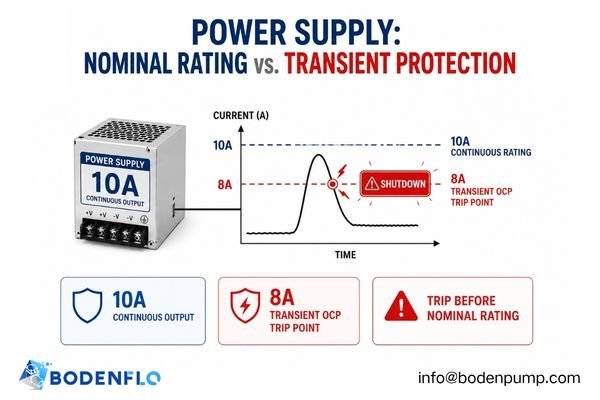
This is a critical engineering insight: a "10A power supply" does not guarantee that 10A is available for any duration or under any condition2. Its transient protection might be configured to trip at just 8A if the spike is fast enough. The protection circuit is not designed to distinguish between a dangerous short circuit and the normal, healthy inrush current of a motor. It just sees a high current that exceeds its predefined threshold and acts to shut it down. This is why a power supply that seems perfectly adequate on paper can fail to support your pump’s startup in the real world.
Why Can PWM Startup Often Cause System Protection Problems?
You’re trying to implement a "soft start" with a low PWM signal, but it’s making the shutdown problem worse. This counterintuitive result happens because you’re starving the motor of the torque it needs to get moving.
Starting a pump with a low PWM duty cycle (e.g., 20-40%) reduces the average voltage delivered to the motor. While this is great for controlling speed and noise during operation, it severely limits the available startup torque.
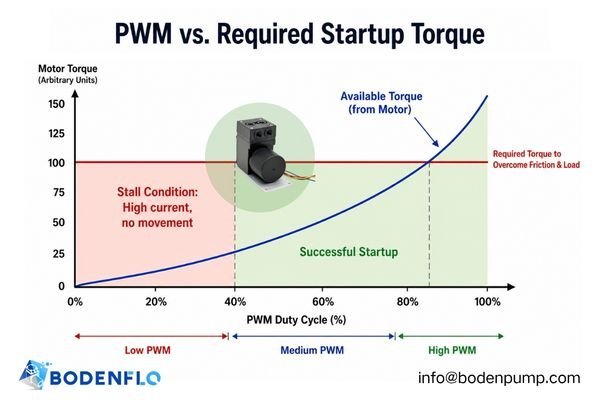
This creates a common failure sequence:
- The system sends a 30% PWM signal to the pump.
- The motor receives power but has insufficient torque to overcome its internal friction and the connected system load.
- The motor remains stalled, continuously drawing a high stall current as it struggles to move3.
- Unlike a brief startup spike at 100% power, this prolonged overcurrent condition gives the power supply’s protection circuit plenty of time to detect an "overcurrent fault" and shut down the system.
A stalled motor under insufficient PWM is one of the most reliable ways to trigger protection circuits.
Why Can Aging Pumps Trigger Startup Protection More Easily?
The system worked perfectly for the first six months, but now random units are failing to start. Is the pump quality degrading? No, the system is experiencing the predictable effects of mechanical wear.
As a pump operates for thousands of hours, its physical characteristics change. Bearing friction gradually increases, the diaphragm may stiffen, and valves can lose some of their initial flexibility. The motor’s own efficiency might also decrease slightly.
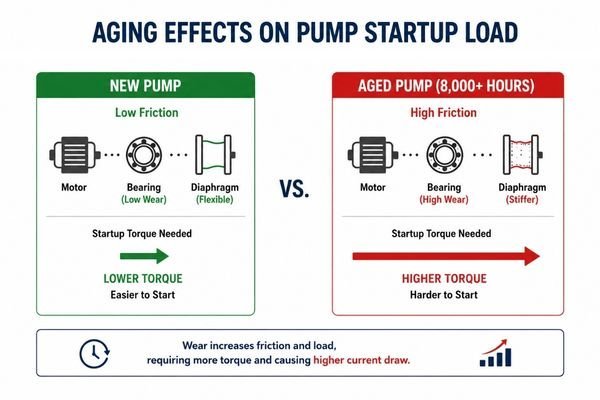
Each of these factors contributes to a higher overall startup load. The torque required to get the pump moving when it’s a year old is greater than when it was brand new. If your system’s power supply was designed with very little current margin, this natural increase in startup load can be enough to push the peak current over the protection threshold. This is a classic real-world OEM scenario: a system that passes validation with new components may begin to fail in the field after months of continuous operation due to aging, demonstrating why designing for margin is so critical.
Why Can Multi-Pump Systems Have Current Allocation Problems?
Your device has two pumps and a fan, and suddenly nothing will start. What happened to your power budget? You’ve likely fallen victim to simultaneous startup spikes.
In complex systems with multiple motors, heaters, pumps, and fans, the total current draw is not just the sum of their running currents. If multiple devices are allowed to start at the exact same moment, their individual startup spikes will add up.
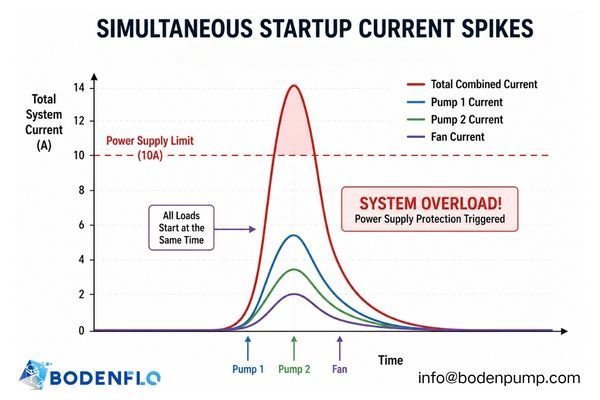
This cumulative transient current can easily exceed the limits of the main power supply, the current-carrying capacity of the PCB traces, or the rating of the power connectors. This leads to a catastrophic system power collapse where the voltage drops so low that nothing can operate correctly. This important engineering insight is often missed: system-level current budgeting must account for the worst-case transient load, which is often the simultaneous startup of all inductive loads4. A simple solution is to sequence the startup of each motor by a few hundred milliseconds, ensuring their peak currents don’t overlap.
What Are the Most Common Mistakes OEM Engineers Make During Pump Integration?
You’ve tried everything, but the pump still won’t start reliably. You might be repeating one of several common but easily overlooked integration mistakes.
These errors all stem from the same root cause: designing based on average-case datasheet numbers instead of worst-case, real-world transient conditions. I’ve seen even senior engineers fall into these traps.
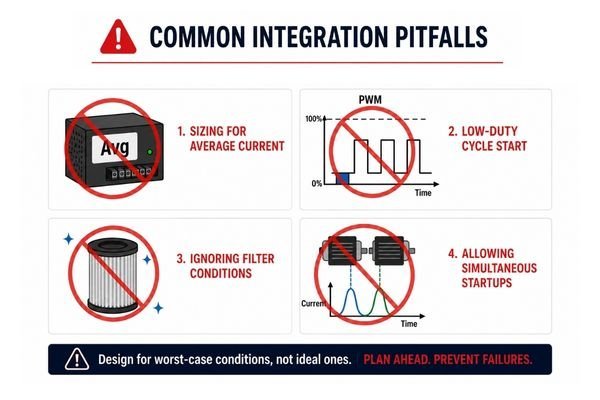
Here are the top mistakes I help engineers correct:
- Selecting Power Supplies by Average Current: Ignoring the 2-5x peak startup current5 and sizing the PSU based only on the running current.
- Starting at a Low PWM Duty Cycle: Trying to "soft start" in a way that actually stalls the motor and prolongs the high-current state.
- Ignoring Restart Conditions: Failing to account for the extra load of restarting against trapped pressure or vacuum.
- Underestimating Filter Loading: Designing for a clean filter, but failing to test with a fully loaded, high-resistance filter.
- Allowing Simultaneous Startups: Letting multiple motors start at the same time, causing a cumulative current spike.
- Mistaking Protection for Failure: Returning perfectly good pumps for "failure analysis" when the root cause is the system’s power supply.
How Do You Prevent Power Supply Protection During Startup?
You understand the problem; now how do you fix it without a major redesign? Fortunately, there are several effective engineering solutions you can implement to achieve reliable startup.
The goal is to either supply the current the pump needs or manage the startup sequence so the demand is less abrupt and within the power supply’s capabilities. You do not have to live with unreliable startup behavior.
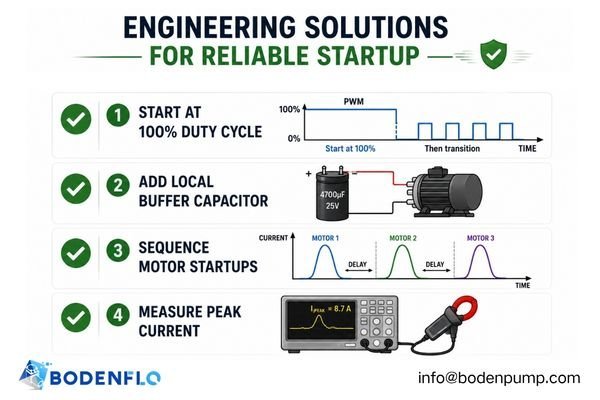
Here are the most common strategies we recommend to our OEM partners:
- Start at 100% PWM: The simplest fix. Always start the pump at full power for 100-200ms to overcome inertia quickly, then ramp down to your desired speed.
- Add Capacitor Buffering: Place a large electrolytic capacitor (1,000-4,700µF) physically close to the pump’s power input to supply the initial inrush current locally.
- Increase Current Limit Margin: If possible, adjust the power supply’s overcurrent protection (OCP) limit to be safely above the pump’s measured peak startup current6.
- Add Soft-Start Logic: Use a dedicated motor driver IC or a circuit that slowly ramps the voltage, actively limiting the peak current draw.
- Verify with an Oscilloscope: Stop guessing. Use an oscilloscope with a current probe to measure the actual peak current and its duration. This data is essential for proper design.
Conclusion
Power supply protection during micro vacuum pump startup is almost never a pump failure. It’s a system-level integration issue caused by the predictable interaction between motor startup current, system resistance, PWM control, and power supply protection logic. At BODENFLO, we specialize in helping OEM engineers troubleshoot these exact challenges, from startup instability and PWM issues to false pump failure diagnoses.
The most important engineering perspective is this: startup conditions, not average running conditions, often determine whether a system succeeds or fails. A robust design must account for the peak transient load under worst-case conditions. Our engineering team can help evaluate your startup current requirements, system power allocation, and PWM strategy to ensure your device is reliable from the very first moment it powers on.
Contact us at info@bodenpump.com to discuss your application with our engineering experts.
-
"Inrush current – Wikipedia", https://en.wikipedia.org/wiki/Inrush_current. Technical sources on DC motors report that startup (inrush) current can be several times higher than running current, often in the range of 2x to 5x, and typically lasts for a brief period (milliseconds) after power-on. This is consistent with standard motor operation principles, though exact values depend on motor design and load. Evidence role: statistic; source type: encyclopedia. Supports: This spike, which can be 2x, 3x, or even higher than the normal running current, lasts for only a few milliseconds.. Scope note: Exact ratios and durations vary by motor type and application; cited values are typical ranges, not universal. ↩
-
"Power system protection – Wikipedia", https://en.wikipedia.org/wiki/Power_system_protection. Technical standards and engineering literature explain that power supply current ratings often refer to maximum continuous current under ideal conditions, and actual available current may be limited by transient protection or other circuit features. Evidence role: definition; source type: education. Supports: a "10A power supply" does not guarantee that 10A is available for any duration or under any condition. Scope note: Most sources discuss general principles and may not address every power supply model or configuration. ↩
-
"Stall torque – Wikipedia", https://en.wikipedia.org/wiki/Stall_torque. Engineering literature and motor datasheets confirm that a stalled motor typically draws a high stall current, which persists as long as the motor remains unable to rotate, supporting the described electrical behavior. This is generally true for most electric motors, though exact current values depend on motor specifications. Evidence role: mechanism; source type: education. Supports: The motor remains stalled, continuously drawing a high stall current as it struggles to move.. Scope note: Exact current values depend on motor specifications and operating conditions. ↩
-
"System-Level Power Delivery Network Analysis and …", https://gtcad.gatech.edu/www/papers/08654735.pdf. Technical literature on power system design emphasizes the importance of accounting for worst-case transient loads, particularly those arising from simultaneous startup of inductive loads such as motors, as these can cause significant current spikes. This is generally recognized in engineering practice, though specific scenarios may vary depending on system configuration. Evidence role: expert_consensus; source type: education. Supports: system-level current budgeting must account for the worst-case transient load, which is often the simultaneous startup of all inductive loads. Scope note: The support is contextual and may not apply to all electronic systems; specific worst-case scenarios depend on system design. ↩
-
"What Is Motor Start Up Current and Why Is It So High? – CHINT Global", https://www.chintglobal.com/global/en/about-us/news-center/blog/what-is-motor-start-up-current-why-is-it-so-high.html. Authoritative engineering sources indicate that the startup current of electric motors can be several times higher than their running current, often in the range of 2-5 times, which supports the need to size power supplies accordingly. This range may vary depending on motor type and application. Evidence role: statistic; source type: education. Supports: Ignoring the 2-5x peak startup current and sizing the PSU based only on the running current.. Scope note: The exact multiplier depends on motor design and load conditions; not all motors exhibit the same startup current profile. ↩
-
"OVERCURRENT PROTECTION FOR MOTOR INSTALLATIONS", https://www.ecmag.com/magazine/articles/article-detail/codes-standards-overcurrent-protection-motor-installations-part-one. Motor control engineering textbooks and technical standards indicate that overcurrent protection should be set above the measured peak startup current to prevent nuisance tripping, but must remain within safe limits to avoid equipment damage. Evidence role: expert_consensus; source type: education. Supports: adjust the power supply’s overcurrent protection (OCP) limit to be safely above the pump’s measured peak startup current. Scope note: Recommended OCP margin varies by motor type and application; general guidance may not apply to all pumps. ↩