
Your project hits delays because the pump underperforms. You picked it based on flow and pressure, but now face redesigns and instability, threatening your launch timeline.
To avoid this, engineers must look beyond datasheets. A pump’s success depends on evaluating the true working point, system-wide resistance, media compatibility, and other real-world conditions often missed during initial selection, ensuring reliable performance from prototype to production.
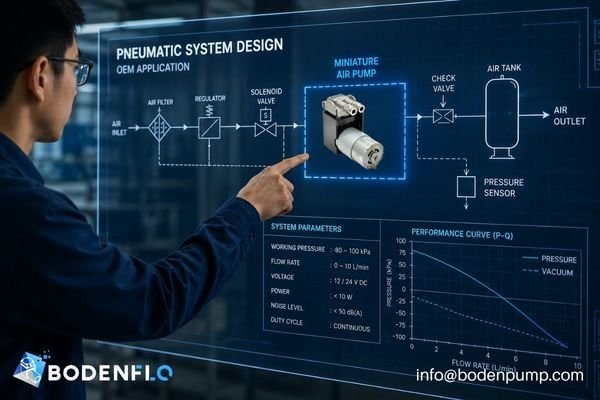
Most OEM engineers begin pump selection by comparing flow rate, pressure, voltage, and dimensions. While these specifications are important, many projects still experience unexpected redesigns, unstable performance, or production delays because several critical requirements were never considered during the early design stage. Based on my experience supporting OEM projects across medical devices, laboratory equipment, environmental monitoring, and industrial automation, here are ten commonly overlooked requirements that often determine whether a miniature air pump performs successfully in real-world applications—not just on the datasheet.
Why doesn’t a 10 L/min miniature air pump always deliver 10 L/min?
You chose a 10 L/min pump, but it only delivers 6 L/min in your device. This happens when you mistake "free flow" for real-world performance, causing a critical performance gap.
A pump’s flow rate always drops as backpressure increases. "Free flow" is the maximum rate with zero resistance. You must evaluate the pump’s P-Q curve to find the "working point"—the actual flow you’ll get against your system’s pressure.
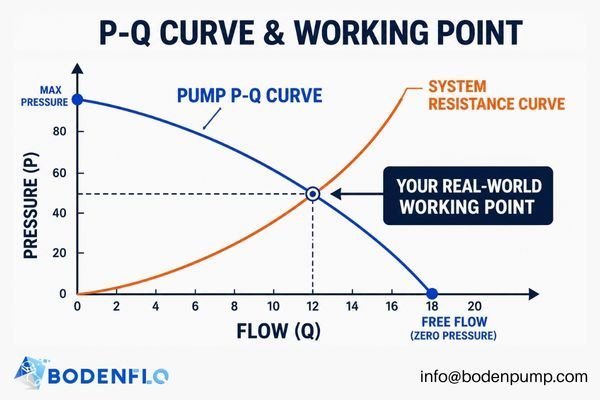
This is the most common mistake I see. A pump’s datasheet shows its P-Q (Pressure-Flow) curve, which is its performance fingerprint.
- Free Flow: This is the highest flow rate listed, measured with nothing attached to the pump’s outlet. It represents zero backpressure.
- System Resistance: Every component in your air path—tubing, filters, valves—creates backpressure.1
- Working Point: This is the intersection of the pump’s P-Q curve and your system’s resistance curve. It’s the actual flow and pressure you will see in your final product.
Relying on the free flow number is a recipe for disappointment. You must define your required flow rate at your actual working pressure to select a pump that will perform as needed in the real world. An experienced engineer always starts by defining their target working point.
Why can two identical pumps perform completely differently in different systems?
You tested a pump on the bench, and it worked perfectly. But inside your device, it’s underperforming. This happens when you forget the pump is only one part of a larger pneumatic system.
Every component in the air path, from tubing to filters, adds resistance. A restrictive system will "choke" the pump, reducing its output. The entire airflow path—not just the pump—determines the final performance.
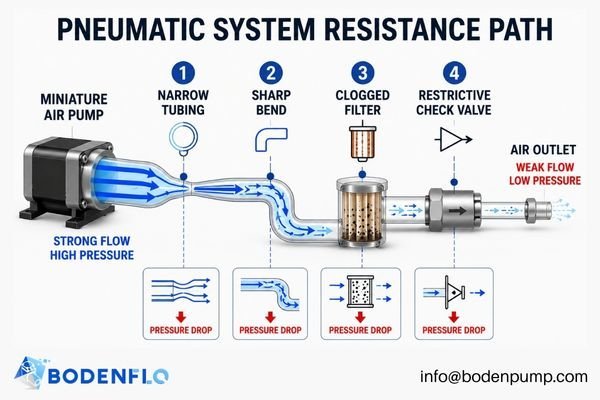
I often call this the "system effect." A pump doesn’t exist in a vacuum. Its performance is directly tied to the path air must travel. I have seen identical pumps show a 50% performance difference simply due to system design.
Key sources of system resistance include:
- Tubing: Long runs or narrow diameters dramatically increase backpressure.
- Filters: Clogged or overly dense filters starve the pump of air.
- Check Valves & Connectors: Every component with a small orifice acts as a bottleneck.
- Mufflers: While they reduce noise, they also add resistance.
- Leaks: Even small leaks can significantly degrade vacuum performance.
When a pump seems to underperform, the first thing I check is the system it’s connected to. Optimizing the air path is often more effective than simply buying a bigger pump.
Is "air" really the only medium your pump will handle?
You specified a pump for "air," but it’s failing prematurely in the field. This happens when unmentioned substances like humidity or vapor attack the pump’s internal materials.
The word "air" can hide many things that are aggressive to standard pump materials. Humidity, alcohol vapor, corrosive gases, dust, or even oxygen-enriched air can cause premature failure. You must define the true medium to select the right wetted materials.
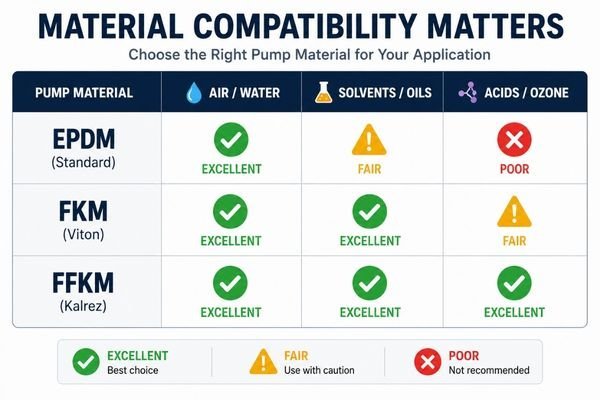
So many clients tell me they are just pumping "air." But then I ask more questions. Is it humid air? Does it contain traces of cleaning solvents? Is it oxygen-enriched for a medical application? The answers dramatically change which pump we can use.
Here’s why it’s critical:
- Humidity: Can cause corrosion and lead to material swelling.
- Alcohol/Solvents: May cause standard EPDM diaphragms to swell or degrade, leading to performance loss.
- Corrosive Gases: Ozone or acidic vapors require highly resistant materials like FFKM, as they will destroy standard rubbers.
- Dust/Particles: Can cause valves to leak or clog, requiring filtration.
Choosing the wrong materials is a silent killer. The pump works perfectly at first, but fails months later. Always be specific about what’s in your "air" to ensure long-term reliability.
Why do some miniature air pumps fail much earlier during continuous operation?
Your pump is rated for 5,000 hours but fails after 1,000 hours of continuous use. This happens when thermal management, not just rated hours, becomes the limiting factor for pump life.
A pump is a motor that generates heat. Pumps rated for intermittent duty will overheat and fail if run continuously. For 24/7 operation, you need a pump designed for it, which often means a brushless motor and better cooling.
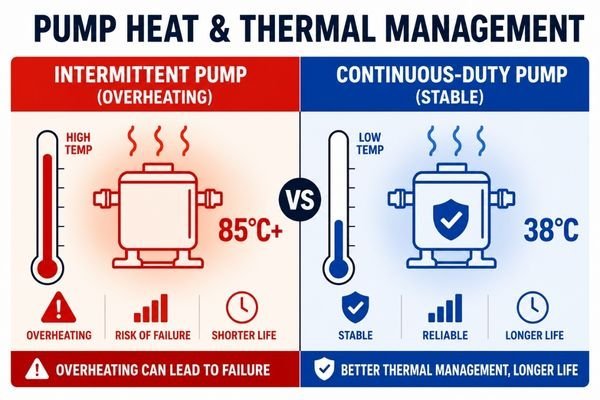
Lifetime specs can be misleading if you don’t read the conditions. A pump’s real-world lifespan is often a story about heat.
- Duty Cycle2: Intermittent-duty pumps are smaller and cheaper because they rely on "off" time to cool down. Continuous operation causes heat to build up, leading to failure.
- Heat & Wear: Elevated temperatures accelerate wear on bearings, demagnetize motors, and cause valve and diaphragm materials to harden or fatigue faster.
- Motor Type: Brushed motors are great for intermittent tasks but generate more heat and have shorter lives. Brushless (BLDC) motors are ideal for continuous duty due to their efficiency and longevity.
When a client needs a device to run 24/7, my first thought isn’t about the flow rate; it’s about thermal management. The pump’s ability to stay cool determines its true lifespan.
Why does the same pump sound quiet in one machine but loud in another?
Your pump’s 45dB rating looked great on paper, but in your device, it’s a noisy 55dB. This happens when vibrations from the pump cause the device’s own panels to resonate.
Noise is usually a system integration problem, not just a pump spec. Structure-borne vibration can be amplified by your device’s enclosure. The solution lies in proper mounting, isolation, and considerate enclosure design.
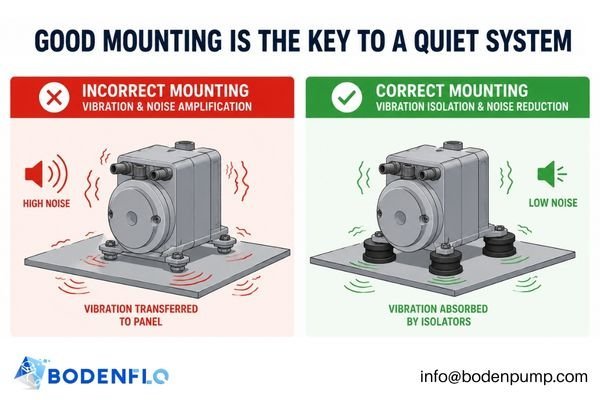
When a customer complains about noise, my first suspect is almost never the pump itself—it’s how the pump is mounted. I once saw a product where a quiet pump was bolted directly to a large, flat plastic panel. That panel acted like the skin of a drum, amplifying every tiny vibration into a loud hum.
Here’s how to manage noise in your system:
- Isolation Mounting3: Never bolt a pump directly to a large panel. Use rubber grommets or specialized mounts to absorb vibration.
- Structural Resonance: Avoid placing the pump in the center of a large, unsupported panel. Brace panels or add ribs to change their resonant frequency.
- Tubing: Flexible silicone tubing can both transmit and dampen vibration. Secure it so it doesn’t rattle against other components.
A quiet product is the result of good system design, not just a quiet pump.
Can your power supply really support the pump under real operating conditions?
Your battery-powered device fails to start, even with a fresh battery. The problem is often the pump’s startup current, which can trip the battery’s protection circuit.
A pump’s startup (inrush) current can be 2-3 times its rated running current. Power supplies, especially on battery or USB-powered devices, must be able to handle this brief peak. Otherwise, your device may fail to turn on.
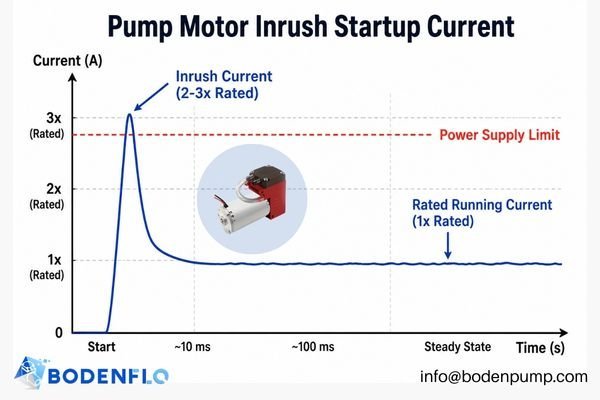
This is a classic trap for designers of portable devices. You design your power budget around the pump’s rated current, but forget about the startup spike.
- Inrush Current4: When a motor starts from a standstill, it draws a large amount of current for a few milliseconds.
- Voltage Drop: This current spike can cause the voltage from your battery or power supply to sag temporarily. If it drops too low, microcontrollers can reset, or the device will fail to boot.
- Power Limits: USB ports and many battery management systems (BMS) have over-current protection that will trip if the inrush current is too high.
A pump that works flawlessly on a powerful benchtop supply can easily fail in the final product. Always verify your power source can handle the peak startup current, not just the running current.
How should OEM engineers read a miniature air pump datasheet?
You’re comparing two pumps, and one has a higher max flow rate. But is it the better pump? Experienced engineers know that the maximum specs are often the least important numbers on the page.
A datasheet is a tool, but you must know how to use it. Look past the headline numbers and focus on the P-Q curve, continuous pressure rating, and lifetime test conditions to understand the pump’s true capabilities.
When I review a datasheet, I look for the story behind the numbers. Here is what I focus on:
- P-Q Performance Curve: This is the most important graph. Where does my required working point fall on this curve? Is it in a stable, efficient region, or is it near the pump’s absolute limit?
- Current Draw Curve: How much power will the pump consume at my working point, not just at free flow? This is critical for battery life calculations.
- Maximum vs. Continuous Pressure: A pump might be able to hit a high peak pressure but can only sustain a much lower pressure continuously without overheating. Which one do you need?
- Lifetime Test Conditions: A "5,000-hour life" is meaningless without context. Was it tested under no load or at the maximum continuous pressure? The conditions reveal the true durability.
Experienced engineers use datasheets to disqualify bad options quickly, then engage with application engineers to verify the best choice for their specific conditions.
Why does a successful prototype sometimes fail in mass production?
Your "golden sample" prototype worked perfectly. But when the first production batch of 1,000 units arrives, 10% fail quality control due to performance variations.
Prototype success does not guarantee mass production success. Manufacturing consistency, quality control, and supply chain stability are what separate a good sample from a reliable product. Passing a test once is easy; passing it 10,000 times is hard.
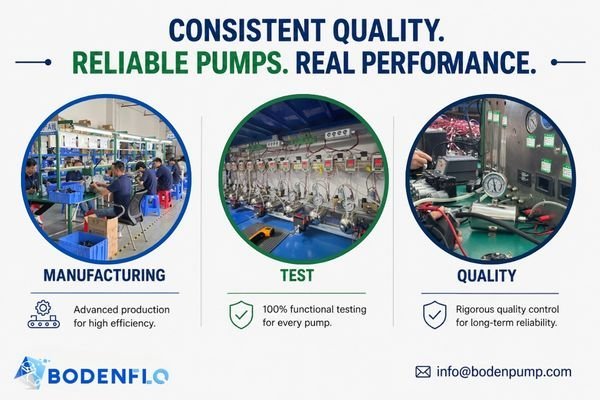
I’ve seen many promising products stumble at this step. It’s easy for any supplier to send you a hand-picked, perfect sample. The real test is whether their 10,000th pump performs identically to the first. This is where a supplier’s commitment to quality becomes your project’s biggest asset or biggest risk.
Before committing to a supplier for mass production, consider their:
- Batch Consistency: What are their manufacturing tolerances? How do they test and guarantee that every pump meets the spec?
- Quality Control: Do they have a robust quality management system like ISO90015? What is their end-of-line testing procedure?
- Traceability: If a problem is found, can they trace the batch back to the raw materials and assembly line to identify the root cause?
A reliable manufacturing partner is just as critical as a good design.
Is the lowest pump price really the lowest project cost?
You saved 20% by choosing a cheaper pump. But now you’re facing high warranty claims, costly field service calls, and damage to your brand’s reputation for quality.
The true cost of a component is its Total Cost of Ownership (TCO). This includes not just the purchase price, but also the costs of failure, maintenance, and redesign. The cheapest pump is often the most expensive decision in the long run.
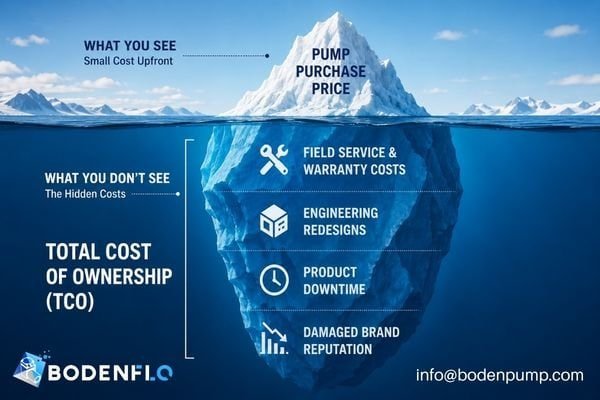
Short-term savings can create long-term disasters. The initial price of the pump is often a tiny fraction of the total cost associated with it over your product’s lifecycle.
Here’s what TCO includes:
- Purchase Price: The number on the invoice.
- Integration & Testing Costs: A cheaper, less consistent pump may require more engineering time to validate.
- Warranty & Service Costs: The cost to service a failed pump in the field can be 10-20x the cost of the pump itself.
- Downtime Costs: For industrial or medical equipment, downtime can have huge financial and safety consequences.
- Brand Reputation: Unreliable products damage customer trust, which is priceless.
When you factor in TCO, choosing a higher-quality, more reliable pump from a trusted supplier like BODENFLO is often the most financially sound decision.
What questions do experienced OEM engineers ask before selecting a miniature air pump?
You want to select a pump like an expert. It’s not about having all the answers; it’s about asking the right questions from the very beginning.
An experienced engineer’s mindset is to define the problem completely before looking for a solution. They treat the pump as part of an integrated system and design for real-world conditions, not just a datasheet spec.

Instead of starting with "What’s your best price for a 10 L/min pump?", a seasoned engineer thinks holistically. Their internal dialogue and questions to suppliers focus on defining the complete application.
Here is a checklist based on the mindset I see in the most successful OEM projects:
OEM Pump Selection Checklist
- Performance Requirements
- [ ] What is the required flow rate at our actual working pressure/vacuum? (Define the working point)
- [ ] Is continuous or intermittent operation needed? What is the daily run time?
- System & Environment
- [ ] What is the complete air path? (List all tubing, filters, valves)
- [ ] What is the true pumping medium? (Check for humidity, vapors, dust)
- [ ] What is the maximum acceptable noise and vibration level for the final product?
- Power & Control
- [ ] What is the power source? (Battery, USB, DC adapter)
- [ ] Can our power supply handle the pump’s startup (inrush) current?
- Longevity & Reliability
- [ ] What is the target product lifespan? How does this translate to pump operating hours?
- [ ] Have we planned for maintenance (e.g., filter changes)?
- [ ] Can the supplier guarantee batch consistency for mass production?
- Future-Proofing
- [ ] Have we left a reasonable design margin for future performance upgrades?
Conclusion
Small details often determine project success. Many OEM projects don’t fail because the pump specifications were incorrect—they fail because important engineering requirements were never defined at the beginning. By considering these factors early, you can avoid costly redesigns and build a more reliable product.
If you’re evaluating a miniature air pump for your next OEM project and would like engineering support beyond standard specifications, the BODENFLO team is ready to help. Whether you need assistance selecting the right pump, reviewing your pneumatic system, or developing a customized solution, we’re happy to work with you from concept through production.
📧 Contact us: info@bodenpump.com
-
"What is back pressure? : r/ChemicalEngineering – Reddit", https://www.reddit.com/r/ChemicalEngineering/comments/vlio0y/what_is_back_pressure/. Standard references in fluid dynamics and pneumatic engineering explain that each component in an air path, such as tubing, filters, and valves, introduces resistance and thus contributes to backpressure in the system. Evidence role: mechanism; source type: education. Supports: Every component in your air path—tubing, filters, valves—creates backpressure.. Scope note: This is a general principle and may vary with specific system designs or component types. ↩
-
"What is Duty Cycle? Learn Its Importance in Devices – Tameson.com", https://tameson.com/pages/duty-cycle. The concept of duty cycle is widely used in engineering to describe the proportion of time a device operates versus rests, and its impact on heat buildup and component longevity is well-documented in technical literature. Evidence role: definition; source type: encyclopedia. Supports: Duty cycle refers to the proportion of time a pump (or other device) is operating versus resting, and intermittent-duty pumps rely on off-time to cool down, whereas continuous operation leads to heat buildup and potential failure.. ↩
-
"Vibration Isolator – an overview | ScienceDirect Topics", https://www.sciencedirect.com/topics/physics-and-astronomy/vibration-isolator. Engineering handbooks and vibration control literature describe isolation mounting as a method where pumps or vibrating equipment are mounted using rubber grommets or specialized mounts to absorb and reduce the transmission of vibration to supporting structures. Evidence role: mechanism; source type: encyclopedia. Supports: Isolation mounting involves using rubber grommets or specialized mounts to absorb vibration and prevent noise amplification from pumps.. ↩
-
"Inrush current – Wikipedia", https://en.wikipedia.org/wiki/Inrush_current. Technical sources explain that inrush current refers to the initial surge of current drawn by an electric motor or device when it is first powered on, which is typically much higher than its steady-state operating current. Evidence role: definition; source type: encyclopedia. Supports: When a motor starts from a standstill, it draws a large amount of current for a few milliseconds.. ↩
-
"ISO 9001 – Wikipedia", https://en.wikipedia.org/?title=ISO_9001&redirect=no. According to the International Organization for Standardization, ISO 9001 is an internationally recognized standard for quality management systems, widely adopted in manufacturing to ensure consistent product quality and continuous improvement. Evidence role: definition; source type: institution. Supports: Do they have a robust quality management system like ISO9001?. ↩