
Choosing the wrong AC pump for your gas analyzer can cause system failure, inaccurate readings, and costly downtime. Every second your system is offline is a loss.
The right choice depends entirely on your gas temperature. For standard applications, the high-flow BD-05T0910LAC is a top choice. For hot, moist gases found in CEMS, the high-temperature BD-05T0610ACM is essential to prevent system failure.
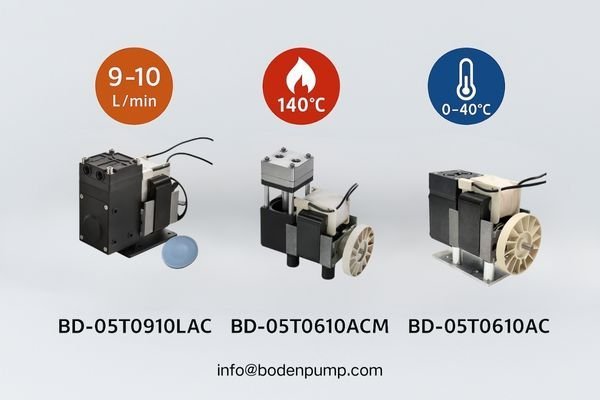
As an engineer at BODENFLO, one of the most common questions I get is about our AC-powered sampling pumps. Customers see three models with similar appearances but different specs, and they want to know which one is "best." The truth is, the best pump is the one that is perfectly matched to your specific application, especially the temperature and condition of the gas you are sampling. Making the wrong choice can be a costly mistake, so let's break down each model and its ideal use case.
What's the Core Challenge in AC Gas Pump Selection?
Your entire analytical system depends on one thing: a clean, representative gas sample. If the pump fails or alters the sample, your entire data stream becomes worthless.
The central challenge is matching the pump's capabilities to the gas stream's physical properties. The most critical factor is temperature, which dictates whether you need a standard pump or a specialized heated-head model to prevent corrosive condensation.
The decision-making process is a simple but critical fork in the road.
-
Is your gas sample hot and humid? This is common in Continuous Emission Monitoring Systems (CEMS)1 where you are pulling gas directly from a smokestack. If this gas cools, acidic condensation will form and destroy the pump. You have only one correct choice: a high-temperature pump2.
-
Is your gas sample cool and dry? This is typical in lab settings or after a gas conditioning system has cooled and dried the sample. Here, your decision is based on performance needs, primarily the required flow rate.
Understanding this single difference is the key to selecting the right pump and ensuring the long-term reliability of your analytical system.
When is High Flow the Top Priority? The BD-05T0910LAC Deep Dive
Your analyzer is far from the sample point, and you need the fastest possible response time. A low-flow pump creates unacceptable delays, making your data lag behind real-time process changes.
For rapid, high-volume sampling of pre-conditioned gases at ambient temperatures, the BD-05T0910LAC is the top performer. Its impressive 9-10 L/min flow rate is designed to purge long sample lines quickly.
This pump is all about speed and volume. It's the ideal choice when your gas sample has already been "conditioned"—meaning it has been cooled and dried before it reaches the pump. You are simply moving a clean, dry, ambient temperature gas from point A to point B as fast as possible.
This pump is the best choice when:
- You have very long sample transport lines.
- You need to minimize sensor response time3.
- You are sampling from multiple streams and need to purge the lines quickly between measurements.
It is purpose-built for applications where high flow4 is the most critical parameter.
How Do You Handle Hot, Corrosive Gases? The BD-05T0610ACM Solution
You are sampling hot, moist exhaust gas directly from a stack. If this gas cools inside the pump, corrosive acids will condense, destroying the pump and compromising your emissions data integrity.
The BD-05T0610ACM is a high-temperature specialist. Its heated pump head, capable of reaching 140°C, is specifically designed to keep hot gas samples above their acid dew point, preventing destructive condensation.
This is the most specialized pump of the three. It's built for the harsh environment of Continuous Emission Monitoring Systems (CEMS). In applications like power plants or industrial incinerators, exhaust gases (like SOx and NOx) are hot and full of moisture. If this gas cools, it forms sulfuric or nitric acid.
The BD-05T0610ACM solves this by using a heated head to ensure the gas sample stays hot all the way through the pump and into the analyzer. This prevents condensation, protecting both the pump internals and the accuracy of your emissions data5. It is not just an option for CEMS—it is a requirement for system integrity.
What's the Best Choice for Standard, Reliable Sampling? The BD-05T0610AC Explained
You need a durable, reliable AC pump for a standard gas analysis application. You don't need extremely high flow, and your gas sample is at ambient temperature, so a heated head would be unnecessary overkill.
The BD-05T0610AC is the versatile workhorse. It combines the robust, proven design of the CEMS pump with a standard temperature range, making it a cost-effective and highly reliable choice for general-purpose gas sampling.
Think of this pump as the perfect middle ground. It's built on the same reliable chassis6 as its high-temperature sibling, so it's incredibly durable and designed for continuous operation. However, since it's designed for standard, ambient temperature gases (0-40°C), it doesn't include the specialized heating element.
This makes it an excellent, cost-effective choice7 for many applications where reliability is key, but extreme temperatures are not a factor. It delivers consistent performance day in and day out for tasks like:
- Instrument air analysis
- Gas detection calibration benches
- General laboratory sampling
How Do I Compare These Three Pumps Side-by-Side?
You have seen the specific use cases, but a direct comparison can make the final choice simple. How do these three models stack up on the most important decision-making criteria?
Use this table as a quick reference guide. By identifying your primary need—High Flow, High Temperature, or Standard Reliability—you can immediately see which pump is the correct engineering choice for your system.
Quick Selection Guide
| Model | Primary Use Case | Max Flow Rate | Temperature Handling | Key Feature |
|---|---|---|---|---|
| BD-05T0910LAC | Long lines, fast response (pre-conditioned gas) | 10 L/min | Ambient (0-40°C) | Highest Flow Rate |
| BD-05T0610ACM | CEMS, hot & moist gas (e.g., stack gas) | 6 L/min | Heated to 140°C | Prevents Acid Condensation |
| BD-05T0610AC | General purpose, lab use (ambient gas) | 7.5 L/min | Ambient (0-40°C) | Robustness & Reliability |
Why Partner with BODENFLO for Your Gas Analysis Needs?
Your analytical system is a major investment. The pump is its heart, and you need to trust the manufacturer to provide a reliable component and expert support.
BODENFLO is more than a pump provider; we are specialists in miniature pump technology for analytical applications. We understand the demands of CEMS, process control, and laboratory analysis and design our products to meet them.
When you choose a BODENFLO pump, you are choosing a partner dedicated to quality and performance. Our UKAS ISO 9001:20158 certified quality management system ensures that every pump we build meets the highest standards of manufacturing and reliability.
Our team of engineers understands the challenges you face, from preventing acid dew point to ensuring rapid sample times. We don't just sell products; we work with you to select the precise pump that will guarantee the performance and longevity of your analytical system9. Trust BODENFLO to be the reliable heart of your gas analyzer.
Conclusion
The "most popular" pump is the one that matches your gas temperature and flow needs. BODENFLO offers a specific AC pump solution for every analytical system requirement.
📩 Contact BODENFLO today at info@bodenpump.com
to find the right AC gas analyzer pump for your system.
-
Explore this link to gain a deeper understanding of CEMS, their importance in monitoring emissions, and how they impact environmental regulations. ↩
-
Learn about high-temperature pumps, their features, and why they are essential for handling hot gas samples in various industries. ↩
-
Discover strategies to reduce sensor response time, ensuring faster and more accurate measurements. ↩
-
Explore this link to understand how high flow pumps enhance efficiency in gas sampling applications. ↩
-
Exploring emissions data collection methods can enhance your knowledge of environmental regulations and monitoring technologies. ↩
-
Understanding the importance of a reliable chassis can help you make informed decisions about pump durability and performance. ↩
-
Exploring this link will provide insights into how cost-effective choices can enhance operational efficiency and reduce expenses. ↩
-
Understanding UKAS ISO 9001:2015 certification can help you appreciate the quality assurance behind BODENFLO pumps. ↩
-
Exploring the components of an analytical system will enhance your knowledge of how BODENFLO pumps fit into your overall setup. ↩