
Your system needs better suction performance, but should you choose a high vacuum or a high flow vacuum pump? Making the wrong choice can lead to failed prototypes, wasted budget, and project delays.
The best choice depends on your application's primary goal. High vacuum pumps excel at creating deep negative pressure for sealing or analysis, while high flow pumps are designed to move large volumes of air quickly for rapid evacuation or holding force.

As a project manager at BODENFLO, I often see design teams get stuck on this exact question. They know they need a "vacuum pump," but the distinction between prioritizing vacuum depth (pressure) and flow volume is mission-critical. These two parameters exist in a trade-off. You can't maximize both simultaneously in a single micro pump. Understanding this fundamental principle is the first step to selecting a pump that doesn't just work, but excels in your specific application. Let's break down the engineering reality.
What Do “High Vacuum” and “High Flow Vacuum Pump” Actually Mean in Micro Pump Engineering?
Engineers use terms like "high vacuum" and "high flow," but their definitions can be inconsistent. This ambiguity leads to confusion during the specification phase and can result in ordering the wrong type of pump.
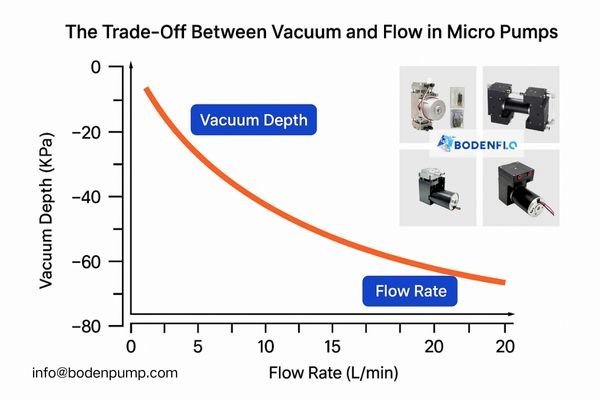
In micro pumps, "high vacuum" refers to deep negative pressure (typically below -85 kPa), while "high flow" means moving a large air volume (often >10 L/min). These two metrics are inversely related; a pump is optimized for one at the expense of the other.
Defining the Core Terminology
To select the right pump, we must first speak the same language. The relationship between vacuum and flow is the most important concept in pump physics.
How is vacuum level defined in micro vacuum pump and negative pressure pump systems?
Vacuum level is the measure of negative pressure relative to the surrounding atmosphere. In pump datasheets, you'll commonly see it expressed in kilopascals (kPa), millimeters of mercury (mmHg1), or millibars (mbar). A "high vacuum" pump is one that can create a very large pressure differential, approaching a near-perfect vacuum (e.g., -90 kPa, -98 kPa).
What flow rate range qualifies a pump as a high flow vacuum pump2?
"High flow" is relative to the pump's size. For micro diaphragm pumps, anything above 10 L/min is generally considered high flow, with some of our larger models reaching up to 70 L/min. This metric measures the volume of air the pump can move per unit of time.
Why can't vacuum depth and flow rate be maximized at the same time?
This is due to the pump's P-Q (Pressure-Flow) curve3. A pump's motor has a finite amount of power. This power can be used to either generate a high-pressure differential (deep vacuum) against a sealed load or move a large volume of air at a lower pressure differential. It cannot do both at maximum capacity simultaneously.
How Does a High Vacuum Micro Vacuum Pump Work and When Is It Required?
Your application requires holding a perfect seal or analyzing a tiny gas sample under negative pressure. You need a pump that can pull a deep, stable vacuum, but you're unsure what features enable this performance.
A high vacuum micro pump uses tight mechanical tolerances, multi-stage compression, and specialized valve/diaphragm materials to achieve deep negative pressure. It's required for applications where pressure differential is more critical than air volume movement.
When Pressure is Paramount
These pumps are specialists, optimized for depth over volume.
What mechanical features allow a DC vacuum pump to reach deeper negative pressure?
To reach levels like -90 kPa or beyond, pumps often employ advanced multi-head architectures, such as dual-head4 and quad-head5 designs. These configurations allow for multi-stage compression, where one stage pulls from the partially evacuated chamber of another to achieve a deeper ultimate vacuum. Additionally, high-precision machining, minimal dead volume in the pump head, and advanced valve systems are crucial for minimizing internal leaks.
Which OEM applications demand true high vacuum performance?
- Gas Analysis6 & Precision Sampling: Required to pull samples through restrictive filters or into analytical chambers.
- Negative Pressure Wound Therapy (NPWT): Needs a consistent, deep vacuum to promote healing.
- Leak Detection7: Must be able to create a significant pressure differential to identify microscopic leaks in sealed components.
What limitations should engineers consider?
The primary limitation is flow rate. A high vacuum pump will have a significantly lower flow rate at its maximum vacuum point compared to a high flow pump. They are not suited for rapidly evacuating large chambers.
How Does a High Flow Vacuum Pump Operate and When Is It the Right Choice?
Your pick-and-place machine needs to grip objects instantly, or your system needs to evacuate a chamber in seconds. You need to move a lot of air fast, where speed is more important than achieving a near-perfect vacuum.
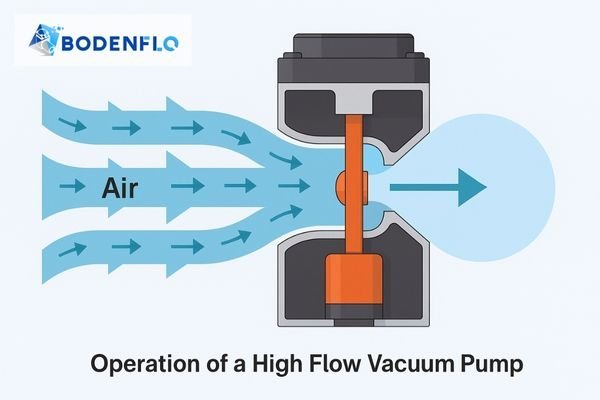
A high flow vacuum pump uses a larger diaphragm, an optimized head design for low air resistance, and a powerful motor to move the maximum volume of air per cycle. It is the right choice for rapid evacuation and suction-based holding applications.
When Volume is the Victor
These pumps are the workhorses of industrial automation and bulk air movement.
What internal design enables high flow performance in miniature pumps?
High flow vacuum pumps are designed with larger pump chambers and diaphragms to displace more air with each stroke. The internal air pathways are engineered to be as wide and non-restrictive as possible. Single-stage designs are common, as they are optimized for moving volume rather than building up multiple stages of pressure.
Why is high flow essential for suction systems, rapid evacuation, and automation?
In applications like vacuum gripping8 (suction cups), the holding force is a product of pressure and surface area. More importantly, high flow allows the system to overcome minor leaks at the suction cup seal and still maintain holding pressure. For rapid evacuation, the goal is to remove the bulk of the air from a chamber as quickly as possible.
What trade-offs come with selecting a high flow vacuum pump?
The main trade-off is the ultimate vacuum level. While a high flow pump can still generate a very useful working vacuum (e.g., -60 to -85 kPa), it typically won't reach the extreme negative pressure levels of a dedicated high vacuum pump.
What Real OEM Scenarios Highlight the Difference Between High Vacuum and High Flow?
You understand the theory, but need real-world examples to guide your decision. Seeing how other engineers have chosen between vacuum and flow for their specific problems can clarify your own path.
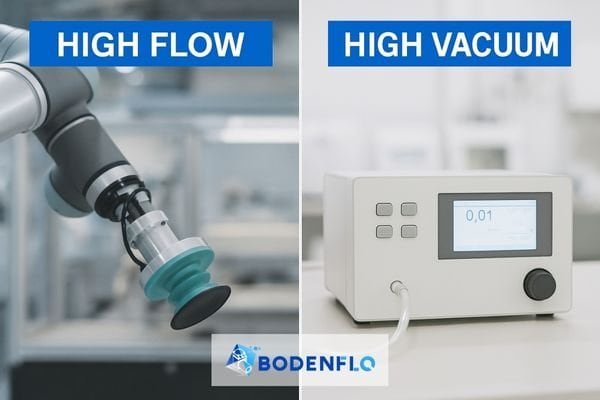
The choice is clear in practice: automation systems use high flow for gripping force and speed, while analytical devices use high vacuum for sample integrity and precision. Dual-head pumps offer a compromise for mixed-need applications.
Applying the Concepts to Real-World Designs
Let's look at how this plays out in actual engineering projects.
When suction-based systems need more flow instead of deeper vacuum
Consider a pick-and-place robot handling textured plastic parts. The suction cup seal will never be perfect; there will always be small leaks. A high flow pump can continuously remove the leaking air, maintaining a stable -60 kPa working vacuum and a secure grip. A high vacuum pump would struggle to keep up with the leak, and the part would drop.
When sampling or analytical devices require deep negative pressure
Imagine a portable gas detector sampling air through a very dense sorbent tube to test for trace chemicals. The flow rate might be very low (e.g., <1 L/min), but the resistance is immense. A high vacuum pump is needed to generate the -80 kPa or more required to pull the sample through the tube at a consistent rate. A high flow pump would stall against this high resistance.
How dual-head architectures support both vacuum depth and flow volume
Dual-head pumps are versatile. Connected in series, they act as a two-stage pump for higher vacuum. Connected in parallel, both heads work together to double the flow rate. This allows engineers to use a single pump model for multiple applications.
Who Is BODENFLO and Why Do We Manufacture Both High Vacuum and High Flow Micro Vacuum Pumps?
You need a reliable supplier that understands these nuances. You want a partner with a proven track record, a stable supply chain, and the technical expertise to guide you to the right solution.
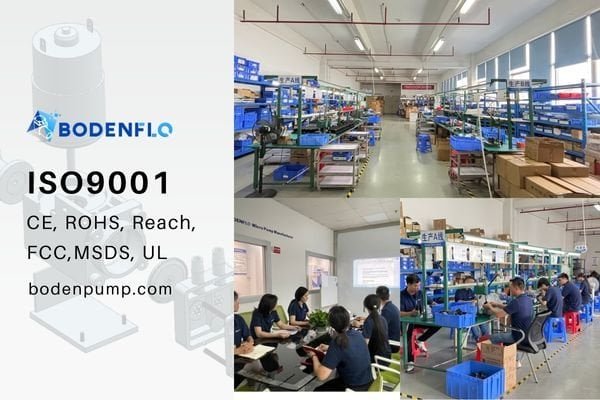
BODENFLO is a high-end Chinese manufacturer specializing in both high vacuum and high flow micro pumps. We offer a full range of DC vacuum pumps (0.3–70 L/min) to global OEM partners in the industrial, medical, and instrumentation sectors.
Your Expert Partner in Micro Fluidics
We built our company to solve these exact engineering challenges. Our mission is to make micro pump knowledge accessible and provide world-class products.
How BODENFLO delivers 0.3–70 L/min micro vacuum pump solutions to global OEM partners
Our product portfolio is intentionally broad, covering vacuum levels from -30 kPa to nearly -100 kPa and flow rates from 0.3 L/min to over 70 L/min. We manufacture our pump components using high-reliability materials like PPS, PTFE, and durable aluminum alloys to meet the demanding requirements of industrial automation, medical devices, and high-end analytical instruments.
Why do global engineers trust BODENFLO as a professional vacuum pump manufacturer9?
Engineers trust us because we deliver more than just a pump. They choose BODENFLO for:
- Stable Supply Chain: Our robust manufacturing process ensures consistent delivery for your production lines.
- Expert Technical Support: Our engineers work directly with yours to select and integrate the perfect pump.
- Customization Capability: We can tailor motor performance, materials, and connections to your exact needs.
- Proven Reliability: All our pumps undergo rigorous lifetime and performance testing.
- Long-Term Partnerships: We have a history of successful, multi-year collaborations with leading global OEMs.
Which BODENFLO Pump Models Represent High Vacuum and High Flow Performance?
You're ready to look at specific models. You need clear recommendations for pumps that are proven performers in either high vacuum or high flow applications, as well as flexible options.
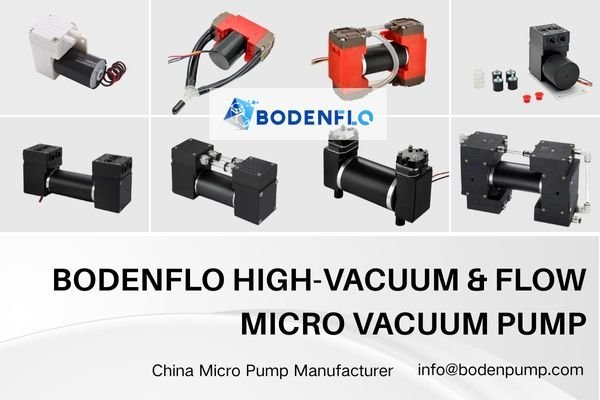
BODENFLO offers dedicated models for each category. Our high vacuum series is engineered for deep negative pressure, while our high flow vacuum pumps are designed for rapid air movement. Balanced models with PWM control provide flexibility for intelligent device integration.
Matching the Right Pump to Your Need
Here are some of our top performers, presented in tables for easy comparison.
High Vacuum Vacuum Pump Recommendations
These models are designed for deep negative pressure and precision, ideal for analytical instruments, medical devices, and leak testing.
| Model | Max Vacuum | Max Flow | Motor Type |
|---|---|---|---|
| BD-05TVB2 | -90 kPa (~675 mmHg) | 4.6 L/min | Brushless (12V/24V) |
| BD-05T055L5 | ≥-98 kPa (~735 mmHg) | 5 L/min | High-End DC Brushless |
| BD-05T0617L3 | -95 kPa (~712.5 mmHg) | 7 L/min | Brush Motor (12V/24V) |
| BD-05T068LFB6 | -100 kPa (~750 mmHg) | 8 L/min | Brushless (12V/24V) |
High Flow Vacuum Pump Recommendations
These models are built to move large volumes of air quickly, making them perfect for automation, suction handling, and rapid evacuation.
| Model | Max Flow | Max Vacuum | Motor Type |
|---|---|---|---|
| BD-04VB | 20 L/min | -85 kPa (~637.5 mmHg) | Brushless (12V/24V) |
| BD-07VB-M | 35 L/min | -85 kPa (~637.5 mmHg) | Brushless (12V/24V) |
| BD-05T1040DU4 | 40 L/min | -98 kPa (~735 mmHg) | High-End Brushed DC |
| BD-05T1045L | 45 L/min | -99 kPa (~742.5 mmHg) | High-End Brushed |
Balanced models with PWM control for flexible OEM integration
Many modern devices need a pump that can adapt. Models equipped with brushless DC motors offer PWM speed control and FG feedback signals, allowing you to dynamically adjust the pump's performance to balance vacuum and flow as needed. This is ideal for portable, battery-powered, and smart devices.
Conclusion: What Should Engineers Remember When Comparing High Vacuum and High Flow Vacuum Pumps?
When selecting a micro vacuum pump, remember that vacuum depth and flow volume exist in a trade-off. The correct choice is never the pump with the highest numbers, but the one whose performance curve best matches your real application demands.
BODENFLO is here to support you with accurate selection, reliable data, and a stable long-term supply. Contact our engineering team at info@bodenpump.com to ensure your project's success.
-
Understanding mmHg is crucial for interpreting vacuum levels accurately, ensuring optimal pump performance. ↩
-
Exploring high flow vacuum pumps can help you choose the best option for your needs, ensuring efficiency and effectiveness. ↩
-
Understanding the P-Q curve is crucial for optimizing pump performance and efficiency in various applications. ↩
-
Explore this link to understand how dual-head pumps enhance efficiency and performance in various applications. ↩
-
Explore this link to understand how quad-head designs enhance vacuum performance and efficiency in various applications. ↩
-
Explore this link to discover essential techniques and innovations in gas analysis that enhance accuracy and efficiency. ↩
-
Explore this link to understand effective leak detection methods crucial for ensuring system integrity and performance. ↩
-
Learn about vacuum gripping technology and its significance in automation, enhancing efficiency and precision. ↩
-
Check this resource to learn about the top vacuum pump manufacturers and their innovative products. ↩