
Your micro pump hits its target pressure, but the pressure keeps rising, risking safety. This guide explains how to achieve precise, reliable control.
Preventing pressure overshoot requires a systems approach. Use closed-loop feedback with a pressure sensor and PWM control to slow the pump near its target. Also, carefully consider system dynamics like tubing, valves, and chamber volume for accurate, repeatable pressure regulation.
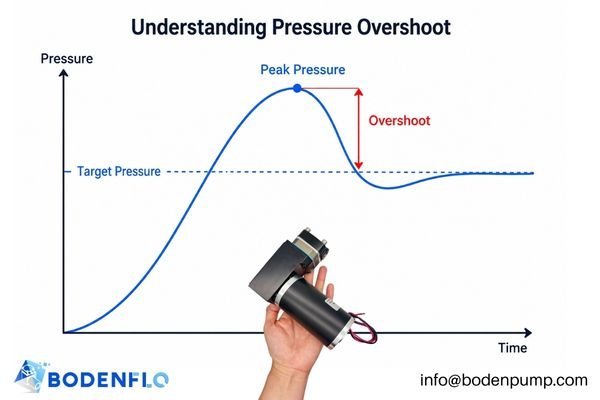
As an experienced project manager at BODENFLO, this is one of the most common—and critical—issues I help clients solve. In many applications, especially medical devices, pressure overshoot isn’t just an accuracy problem; it’s a safety risk. The goal is not simply to reach the target pressure—it is to reach it quickly, accurately, and without exceeding the allowable limit. Let’s break down how to achieve that.
What Is Pressure Overshoot in a Micro Air Pump System?
Your system has a specific pressure target, but it keeps blowing past it. What exactly is happening, and what are the terms we use to describe it?
Pressure overshoot is the amount by which the peak pressure exceeds the target pressure after the pump is commanded to stop. It’s a temporary spike that can compromise precision and safety.
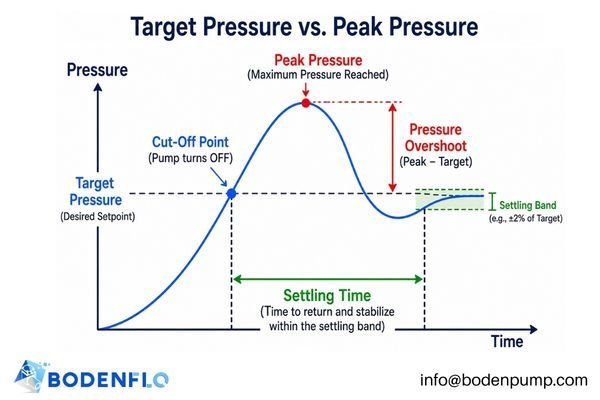
To get this right, we need to be clear on the terminology. I always start by defining these four key parameters with my clients:
- Target Pressure: The desired stable pressure for the application (e.g., 50 kPa).
- Cut-Off Pressure: The pressure at which the controller tells the pump to turn OFF. This is often the same as the target pressure in simple systems.
- Peak Pressure: The maximum pressure the system actually reaches after the pump shuts off (e.g., 55 kPa).
- Pressure Overshoot: The difference between the Peak Pressure and the Target Pressure (e.g., 55 kPa – 50 kPa = 5 kPa).
- Settling Time: The time it takes for the pressure to stabilize at the target after the overshoot event.
Understanding these terms is the first step to diagnosing and fixing the problem.
Why Does Pressure Continue Rising After the Micro Air Pump Stops?
You’ve commanded the pump to stop at 50 kPa. Why does the pressure reading climb to 55 kPa before it settles?
The pressure continues to rise because airflow does not stop instantly. Residual compressed air in the system expands into the chamber, and control delays give this process extra time.
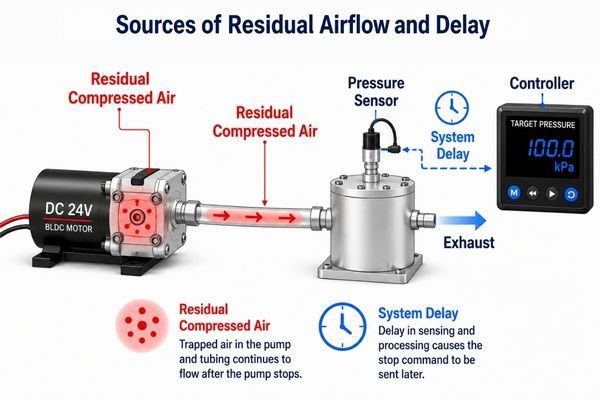
When I troubleshoot this for a client, I look at three primary causes. The overshoot is a system-level behavior, not just a pump issue.
Residual Airflow and Compressed Air
Even after the motor stops, the system is not static.
- Compressed Air: The air inside the pump head and the tubing between the pump and the chamber is at a higher pressure than the chamber itself. This pocket of compressed air expands, causing the chamber pressure to rise.
- Valve Delay: The internal valves of the pump don’t close instantly. There is a small but measurable delay that allows a final puff of air to enter the system.
Pressure Sensor and Controller Response Delay
The entire control chain takes time.
- Pressure rises in the chamber.
- The pressure sensor detects the change.
- The sensor’s signal is read by a microcontroller (MCU).
- The MCU’s algorithm decides to turn the pump off.
- The MCU sends a signal to the motor driver.
- The driver cuts power to the pump.
Each step introduces a tiny delay. In a system with a high-flow pump and a small chamber, the pressure rises so quickly that these small delays are enough to cause a significant overshoot.1
Chamber Volume and Air Bladder Elasticity
The same micro pressure pump will behave differently in different systems. A large, rigid chamber has more volume to absorb the residual airflow, so the pressure rises slowly and overshoot is minimal. A small chamber or a flexible air bladder means the pressure changes very quickly with even a small amount of extra air, making overshoot much more likely.
How Does Micro Air Pump Flow Rate Affect Pressure Overshoot?
You chose a high-flow pump to inflate your device quickly. Could that be part of the problem?
Yes, a high flow rate near the target pressure is a primary cause of overshoot. The pressure rises too fast for the control system to react in time.
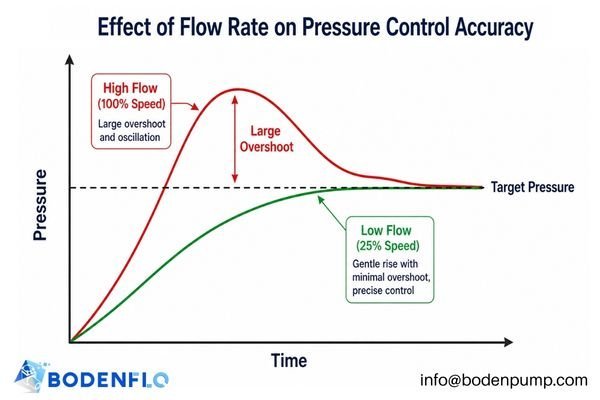
There is a direct link between flow rate, the rate of pressure rise, and the magnitude of the overshoot.
| Flow Condition | System Behavior | Overshoot Risk |
|---|---|---|
| High Flow at Low Pressure | Excellent. The chamber fills quickly, reducing overall inflation time. | Low |
| High Flow Near Target Pressure | Problematic. The pressure rises so rapidly that by the time the sensor and controller react, the pressure has already exceeded the target. | High |
| Low Flow Near Target Pressure | Ideal for control. The slow pressure rise gives the control system plenty of time to react and stop the pump precisely at the target. | Low |
High flow is useful for fast inflation, but excessive flow near the target pressure can make precise pressure control much more difficult. The ideal solution is to have high flow at the beginning and low flow at the end.
Can an Oversized Micro Pressure Pump Make Pressure Control More Difficult?
Your system needs to operate at 6 bar, so you chose a 10 bar pump to be safe. Is a bigger pump always better?
Not necessarily. Using a pump that is significantly oversized for the application can make overshoot worse and lead to inefficient operation.
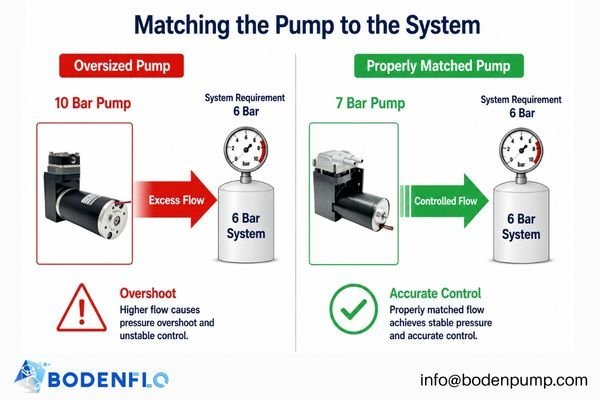
I often have to help engineers distinguish between three different pressure values:
- System Operating Pressure: The normal pressure required for the device to function (e.g., 6 bar).
- Maximum Allowable System Pressure: The highest pressure the system can safely tolerate without risk of damage or harm (e.g., 6.5 bar).
- Pump Maximum Pressure: The absolute maximum pressure the pump itself is capable of generating (e.g., 10 bar).
Choosing a 10 bar pump for a 6 bar system isn’t necessarily wrong, but it requires a very good control strategy. The 10 bar pump will likely have a very high flow rate at 6 bar, making the pressure rise extremely fast and difficult to control without advanced methods. Higher maximum pump pressure does not automatically mean better system performance.
Why Does the Pressure-Flow Curve Matter When Selecting a Micro Pressure Pump?
You know a 10 bar pump is stronger than a 6 bar pump. What else do you need to look at?
You must look at the entire pressure-flow curve. The most important number is the flow rate at your actual operating pressure, not the free flow or maximum pressure.
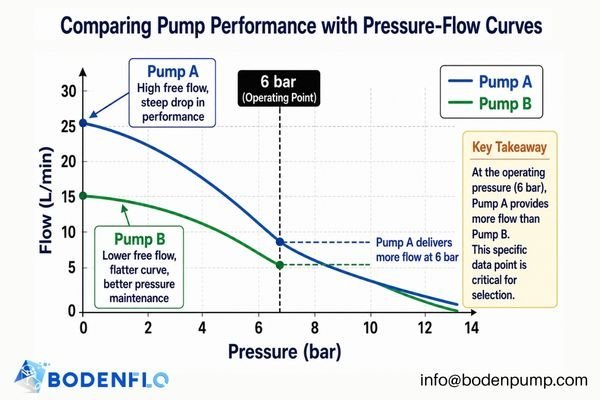
When we help a client select a pump, we don’t just look at the maximum pressure. We map the pump’s performance across the entire operating range. A pump’s datasheet can be misleading if you only look at the headline numbers.
| Pressure | Pump A (10 Bar Max) | Pump B (7 Bar Max) |
|---|---|---|
| 0 bar (Free Flow) | 15 L/min | 12 L/min |
| 2 bar | 12 L/min | 10 L/min |
| 4 bar | 9 L/min | 8 L/min |
| 6 bar (Operating Point) | 5 L/min | 4 L/min |
In this example, Pump A looks more powerful. But if your system only needs 3 L/min at 6 bar for fast inflation, Pump B might be easier to control and more efficient. The pressure-flow curve tells you how the pump actually performs on its way to the maximum pressure.
Should You Use a Miniature Diaphragm Pump or Micro Piston Pump?
Your application needs positive pressure. Which pump technology is the right choice to avoid these problems?
The choice depends on your pressure requirements and system constraints. Both pump types can be controlled effectively, but they are suited for different operating ranges.
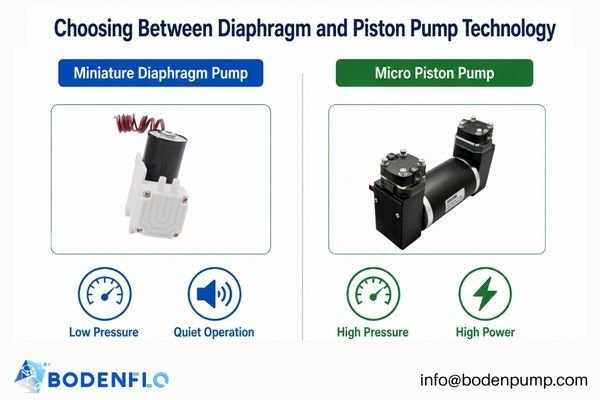
A miniature diaphragm pump is often ideal for compact, low-noise applications in the low-to-medium pressure range. A micro piston pump (often called a mini air compressor) is generally better for higher-pressure requirements.
| Factor | Miniature Diaphragm Pump | Micro Piston Pump |
|---|---|---|
| Pressure Capability | Low–Medium (typically < 3 bar) | Medium–High (can exceed 10 bar) |
| Flow Rate | Low–High | Medium–High |
| Noise & Vibration | Generally Lower | Generally Higher |
| High-Pressure Use | Limited by model design | Better suited |
| PWM Speed Control | Yes, with brushless DC motors | Yes, on suitable models |
For a medical device needing quiet operation at 50 kPa (0.5 bar), a miniature diaphragm pump is a great choice. For a shockwave therapy device needing 6 bar, a micro piston pump is necessary2. The final choice always depends on the complete system requirements, not just the pump structure.
How Can a Pressure Switch Control a Micro Air Pump?
You need a simple, reliable way to stop your pump at a set pressure. How does a pressure switch work?
A pressure switch is a simple mechanical or electronic component that acts as an ON/OFF trigger at a specific pressure, providing basic control for a DC air pump.
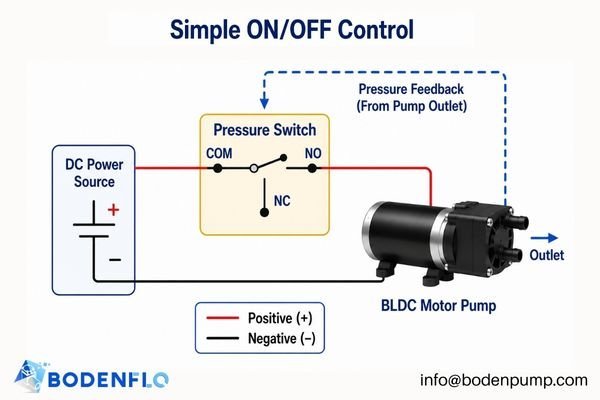
This is the most straightforward method of pressure control.
- Logic: The pump runs, pressure rises, and when it reaches the switch’s setpoint (e.g., 6 bar), the switch opens, cutting power to the pump. When pressure drops below a restart threshold, the switch closes, and the pump turns back on.
- Advantages:
- Simple and easy to integrate.
- Low cost.
- Very reliable for basic ON/OFF tasks.
- Limitations:
- It provides no information about the pressure before the setpoint is reached.
- The pump runs at 100% speed right up until the cutoff, which is a major cause of pressure overshoot.
A pressure switch is great for applications like filling a large tank where precision isn’t critical, but it offers limited options for overshoot reduction.
How Can a Pressure Sensor Improve Pressure Regulation?
A pressure switch isn’t precise enough. How does using a pressure sensor give you better control?
A pressure sensor provides continuous, real-time pressure data to a microcontroller, enabling intelligent, closed-loop pressure control.
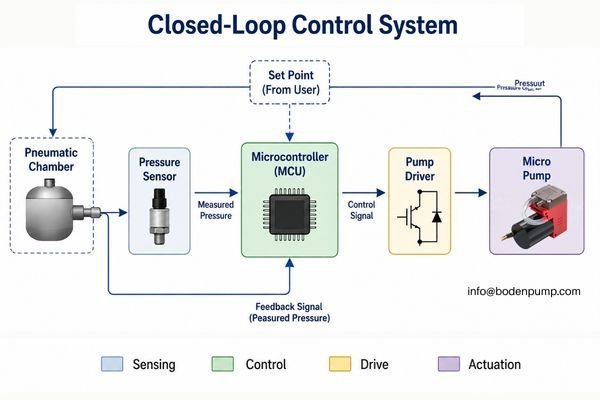
Upgrading from a switch to a sensor changes everything. Instead of a simple ON/OFF signal, the controller gets a constant stream of information about the pressure level. With this data, the controller can execute complex strategies:
- Run the pump at full speed to start.
- Reduce pump speed as it approaches the target.
- Stop the pump at the perfect moment.
- Open a small vent valve to correct an overshoot.
- Trigger an alarm if pressure rises unexpectedly.
This real-time feedback loop is the foundation of high-precision pneumatic pressure control.
How Can PWM Control Reduce Pressure Overshoot in a DC Air Pump?
You have a pressure sensor. How do you use it to actively prevent overshoot?
Use Pulse-Width Modulation (PWM) to dynamically control the pump’s speed. Run it fast when you’re far from the target and slow it down as you get closer.
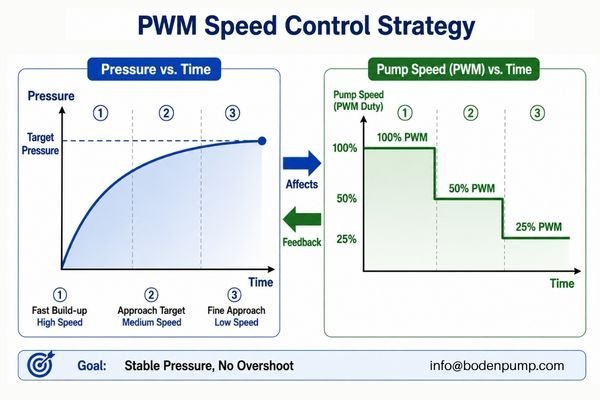
This is the most effective technique my team implements for precision applications. Instead of an abrupt ON/OFF, we create a sophisticated speed profile.
| Pressure Condition | Recommended Pump Control |
|---|---|
| Far below target (e.g., 0-80% of target) | High Speed (e.g., 100% PWM) for fast filling. |
| Approaching target (e.g., 80-95% of target) | Medium Speed (e.g., 50% PWM) to begin slowing down. |
| Near target (e.g., 95-100% of target) | Low Speed (e.g., 25% PWM) for a gentle approach to the final value. |
| Target reached | Stop (0% PWM). |
This strategy gives you the best of both worlds: fast initial inflation time and high accuracy with minimal overshoot. It’s far superior to running the pump slowly from the start3.
Can Early Pump Cut-Off Prevent Pressure Overshoot?
Besides slowing the pump down, is there another software trick to hit the target perfectly?
Yes, you can use a predictive or early cut-off. Command the pump to stop before it reaches the target, and let the system’s residual airflow carry the pressure to the final value.
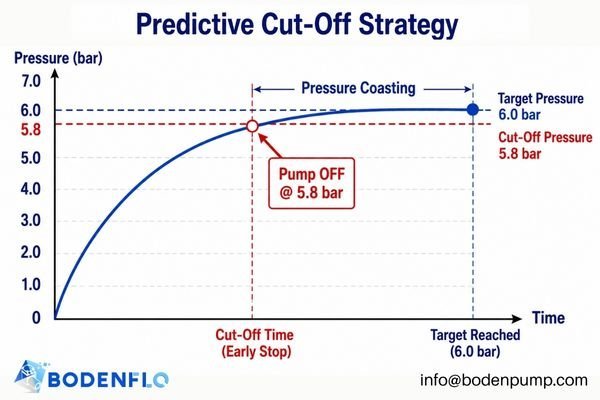
This technique requires testing and characterization of your specific system. For example, you have a target of 6.0 bar.
- You run a test and find that if you stop the pump at 5.8 bar, the pressure consistently overshoots by 0.2 bar.
- Therefore, your control algorithm is programmed to cut off the pump at 5.8 bar.
- The pump stops, the residual air expands, and the pressure coasts up to settle perfectly at 6.0 bar.
The exact cut-off point depends on the pump’s flow, chamber volume, and tubing, so it must be determined experimentally for your device.
Pressure Switch vs. Pressure Sensor: Which Is Better for Micro Pump Control?
You need to control pressure. Should you choose the simple switch or the advanced sensor?
The best choice depends on your system’s requirements for precision, complexity, and cost. A sensor offers far more control, but a switch is effective for simple tasks.
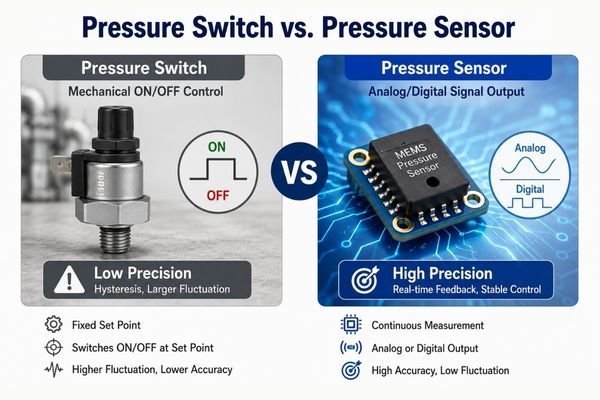
It’s a common question from clients. Here is the table I use to help them decide:
| Feature | Pressure Switch | Pressure Sensor |
|---|---|---|
| Detection | A single, pre-set pressure threshold | Continuous, real-time pressure measurement |
| Output Signal | Simple ON/OFF electrical contact | Analog voltage or digital data stream |
| Pump Control | Basic ON/OFF | ON/OFF, PWM, Variable Speed |
| Precision | Moderate | High |
| Overshoot Reduction | Limited (only by setting a low threshold) | Excellent (enables PWM and early cut-off) |
| Complexity | Low | Higher (requires MCU and software) |
| Cost | Lower | Higher |
| Best For | Basic pressure maintenance, non-critical applications | Precision pressure regulation, medical devices |
A pressure sensor isn’t always better4. For a simple workshop air compressor, a pressure switch is perfect. For a medical ventilator, a pressure sensor is non-negotiable.
How Can Pressure Feedback Improve Micro Pressure Pump Operating Efficiency?
You’re using a sensor and PWM. Are there benefits beyond just preventing overshoot?
Yes. Closed-loop control allows the pump to operate according to the actual system demand, reducing energy consumption, heat, and wear.
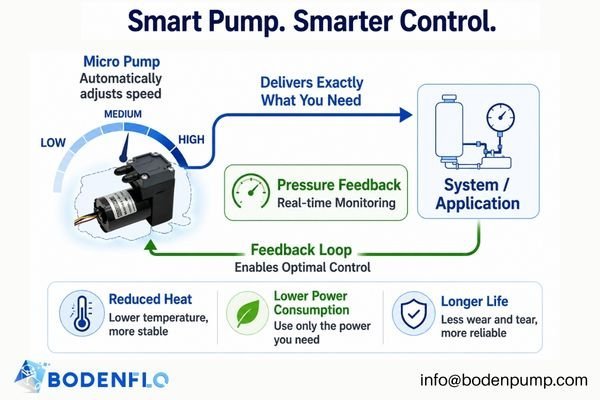
Let’s go back to the 10 bar pump in a 6 bar system. Without feedback, you might run the pump at 100% until a pressure switch clicks it off. The pump is working much harder than necessary. With a pressure sensor and PWM, the system is smarter:
- The controller knows the target is only 6 bar.
- It can run the pump at an optimized speed to reach 6 bar efficiently.
- It avoids the high current draw, heat generation, and mechanical stress associated with running against a higher pressure.
In short, pressure feedback helps the micro pressure pump operate according to actual system demand rather than continuously producing unnecessary output.
Why Is Pressure Overshoot More Critical in Medical Pneumatic Systems?
A little extra pressure doesn’t seem like a big deal. Why is this so important for medical equipment?
In medical applications, excess pressure can directly impact patient safety and treatment efficacy. Controlled, stable pressure is a clinical requirement, not just a performance metric.
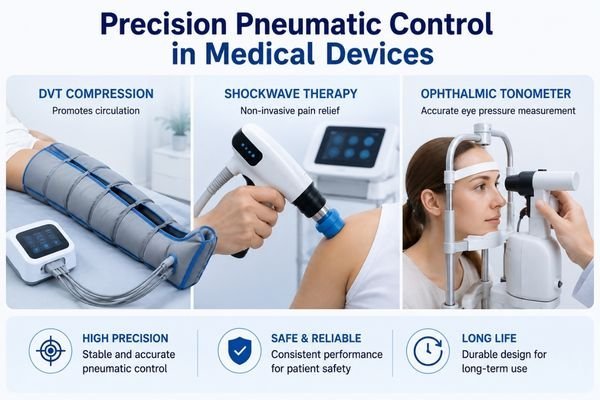
I work with engineers designing a wide range of medical devices, and for them, overshoot is a critical failure mode.
- Compression Therapy: Too much pressure in a pneumatic cuff could be painful or even harmful to a patient.
- Shockwave Therapy: The therapeutic effect is directly related to a specific pressure level; overshoot can alter the treatment.
- Diagnostic Equipment: Precise pressure control is essential for accurate measurements in devices like blood pressure monitors5.
In this field, the question isn’t just "Can the pump reach the pressure?" It’s "Can the system reach and maintain the required pressure safely and reliably without exceeding the defined limit?"
How Should Engineers Test Pressure Overshoot During Prototype Validation?
You’ve built your prototype. How do you properly test and validate its pressure control performance?
You need to go beyond a simple pass/fail test. Capture the entire pressure curve over time to measure the overshoot, rise time, and stability under various conditions.
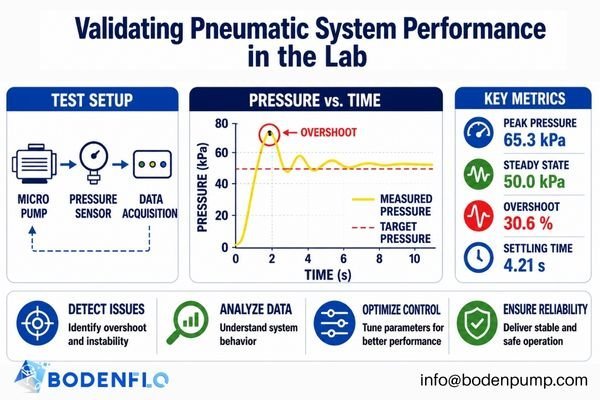
When my team validates a client’s prototype, we don’t just check if it hits 6 bar. We perform a full suite of tests to characterize the system’s dynamic behavior.
| Test | Key Measurement to Record |
|---|---|
| Pressure Rise Profile | Rise time, cut-off pressure, peak pressure (overshoot), and settling time. |
| Repeatability Test | Consistency of the peak pressure over hundreds of cycles. |
| Power Supply Test | Behavior at the lowest and highest expected supply voltages. |
| Temperature Test | Pressure drift as the system heats up or cools down. |
| Fault Condition Test | System response to a blocked outlet or a simulated sensor failure. |
Capturing and analyzing the pressure vs. time curve is the single most valuable test. It tells the complete story of your system’s performance.
What Information Should You Provide When Selecting a Micro Pressure Pump?
You’re ready to talk to a pump expert. What information do you need to provide to get the best recommendation?
To get the right pump, you need to provide a complete picture of your system’s requirements, including pressure, flow, volume, and control method.
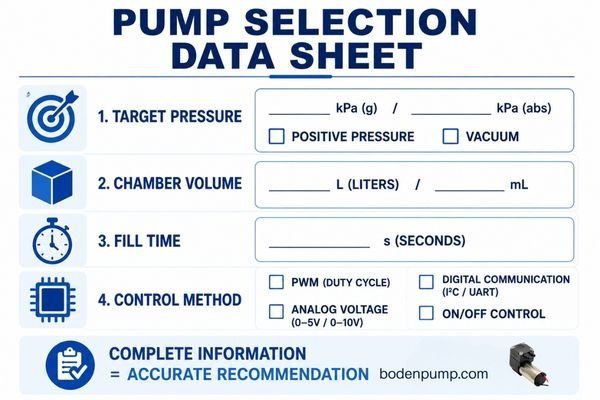
To help you most effectively, I need more than just "I need a 6 bar pump." Here is the checklist I give to clients:
- Target Operating Pressure: The pressure you want to maintain.
- Maximum Allowable Pressure: The safety limit for your system.
- Chamber/Bladder Volume: How big is the space you are pressurizing?
- Required Fill Time: How quickly do you need to reach the target pressure?
- Flow at Target Pressure: Do you know the required flow rate at your operating point?
- Control Method: Will you use a pressure switch, or a sensor with PWM control?
- Supply Voltage and Duty Cycle: What power is available and will the pump run continuously?
The two most important questions I always ask are: "What is your target operating pressure?" and "What is the maximum allowable system pressure?" The answers are often different, and that difference is key to designing a safe and reliable system.
Conclusion
Preventing pressure overshoot requires matching the pump to the real operating pressure and using system feedback to control its output—not simply choosing a pump with a higher maximum pressure rating.
For applications requiring precise pressure control, BODENFLO can help evaluate pump performance based on your target pressure, chamber volume, fill time, control method, and actual operating conditions. We provide micro pump solutions for medical devices, pneumatic systems, industrial equipment, and other OEM applications.
Need help selecting the right micro pump for your pressure control system?
Contact BODENFLO: info@bodenpump.com
-
"PID controller – Wikipedia", https://en.wikipedia.org/wiki/PID_controller. Engineering sources on control systems confirm that sensor and controller response delays can lead to overshoot, especially in fast-acting, high-flow pneumatic systems with small volumes. Evidence role: mechanism; source type: education. Supports: Delays in the control chain can cause significant pressure overshoot in high-flow, small-volume pneumatic systems.. Scope note: The degree of overshoot depends on the specific timing and system parameters. ↩
-
"Micro Piston Pumps FAQ | Applications, Benefits, and …", https://bodenpumpstore.com/blogs/news/micro-piston-pumps-faq-applications-benefits-technical-insights?srsltid=AfmBOooOQ_psby4_DnEENSUVwaY4JJnagXTfl_qaQ5-EQdBIeD8ZDs4P. Engineering sources confirm that micro piston pumps are capable of generating pressures exceeding 6 bar, making them suitable for applications such as shockwave therapy devices. Evidence role: statistic; source type: education. Supports: A micro piston pump is necessary for a shockwave therapy device requiring 6 bar pressure.. Scope note: Actual performance depends on the specific pump model and design. ↩
-
"How Do You Control The Flow Rate Of A DC Miniature Diaphragm Pump?", https://bodenpump.com/control-flow-rate-dc-miniature-diaphragm-pump/. A technical reference comparing variable speed and constant low-speed pump control can provide evidence that multi-stage or ramped speed profiles offer improved performance over always running the pump at low speed. Evidence role: general_support; source type: education. Supports: It’s far superior to running the pump slowly from the start.. Scope note: The comparison may be contextual and not universally true for all pump types or applications. ↩
-
"Digital vs Mechanical Pressure Switch: Pros & Cons – LEFOO", https://www.lefoo.com/news/digital-vs-mechanical-pressure-switches-pros-cons-and-applications.html. Technical sources explain that while pressure sensors offer higher precision and advanced control, pressure switches remain suitable for simple, non-critical applications due to their reliability and lower cost. Evidence role: expert_consensus; source type: encyclopedia. Supports: A pressure sensor isn’t always better than a pressure switch; the choice depends on application requirements.. Scope note: This support is contextual and may not apply to all use cases. ↩
-
"How Accurate Are Home Blood Pressure Devices in Use? A Cross …", https://pmc.ncbi.nlm.nih.gov/articles/PMC4889144/. Medical device standards and validation studies emphasize that accurate blood pressure measurement depends on precise control of cuff inflation and deflation pressures. Evidence role: mechanism; source type: institution. Supports: Precise pressure control is essential for accurate measurements in devices like blood pressure monitors.. Scope note: The requirement for precision may vary with device type and measurement method. ↩