
You picked the perfect micro pump based on its datasheet, but your device’s performance is unstable. This happens when you ignore the system; sensors are the solution.
Sensors provide real-time feedback on pressure, flow, and temperature, allowing the system controller to adjust pump speed via PWM. This creates a closed-loop system, enabling precise control, fault detection, and stable performance that a pump alone cannot achieve.
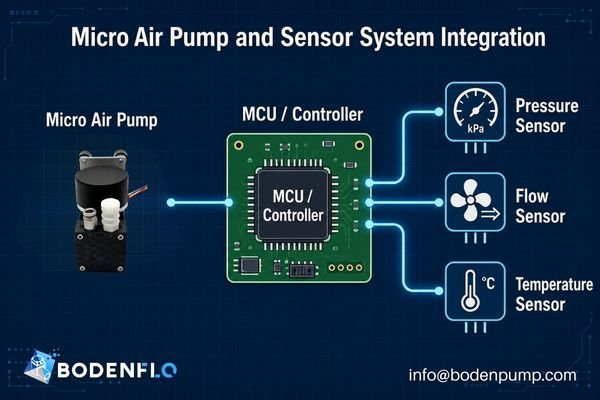
As a project manager at BODENFLO, I see it all the time: engineering teams become laser-focused on the pump’s datasheet. Yet, the projects that truly succeed are those where the engineers treat the pump and its sensors as a single, integrated system from day one. The analogy I always use is this: a pump provides the muscle, but sensors are the nervous system providing critical feedback. Without that system, your device is simply running blind. Let’s break down how to give your smart device the senses it needs to perform reliably.
Why Should Engineers Think About Sensors When Selecting a Micro Air Pump?
You focus on pump specs like voltage and pressure, but the final device fails its performance targets. The pump isn’t working in a vacuum; it’s part of a complex system.
Because sensors tell you what the system is actually doing, not just what the pump is capable of. They reveal real-world performance losses from tubing, filters, and leaks, which are invisible on a pump’s datasheet, ensuring your device works as intended.
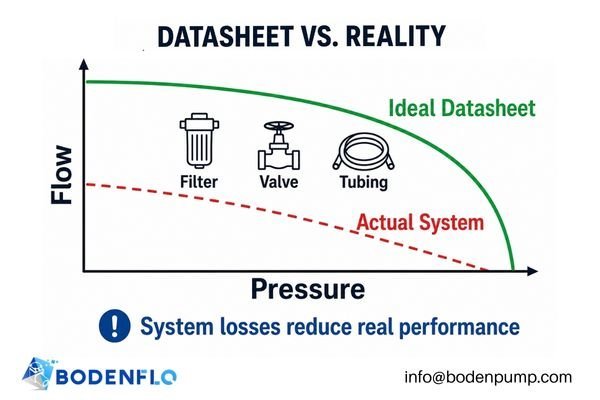
When I review a new project, I see engineers list out pump specifications: voltage, flow, pressure, size. That’s a great start. But a pump datasheet describes its performance on a test bench under ideal conditions. Your device is not a test bench. It has tubing that adds resistance, valves that can leak, filters that clog, and enclosed spaces that trap heat. A pump datasheet tells you what the pump can do, but sensors tell you what your system is actually doing. This is the critical difference between a prototype that works on a desk and a product that is reliable in the hands of a customer.
| Datasheet Spec | System Reality (Why Sensors Matter) |
|---|---|
| Rated Flow: 5 L/min | Filters and narrow tubing add resistance. A flow sensor will show the actual flow might only be 3.5 L/min. |
| Max Vacuum: -80 kPa | A tiny leak in a connector means the system only reaches -50 kPa. A vacuum sensor detects this failure. |
| Continuous Duty | The pump runs continuously under high back-pressure, causing it to overheat. A temperature sensor can prevent damage. |
| Stable Pressure Output | Fluctuations from diaphragm pulsation cause inconsistent user experience. A pressure sensor enables stable, closed-loop control. |
What Types of Sensors Are Commonly Used with Micro Air Pumps?
You know you need feedback but aren’t sure which sensor provides the right information. This uncertainty can lead to selecting the wrong component, wasting time and money on redesigns.
To build a smart pump system, you must match the right sensor to the right function. Pressure sensors handle compression, vacuum sensors verify suction, flow sensors measure volume, and temperature sensors protect the pump from overheating.
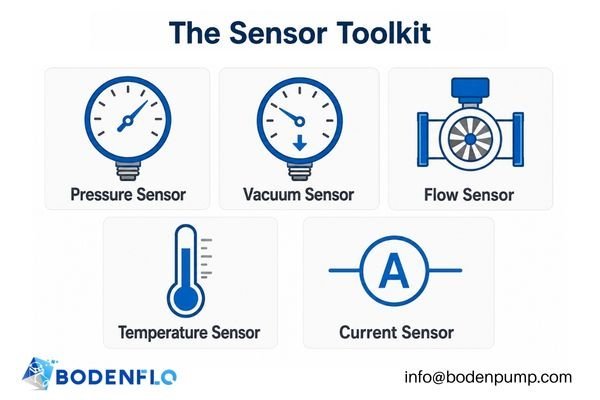
Building a smart device is like assembling a team of specialists. The micro pump is your star player, but it needs a supporting cast of sensors, each with a specific job. Choosing the wrong sensor is like asking a thermometer to measure pressure—it’s simply not going to work. As a system architect, your task is to understand what you need to measure and then select the specialist for that role. At BODENFLO, we often guide teams through this "sensor mapping" process to ensure their control system gets the exact feedback it needs to be effective. The table below outlines the most common players on the sensor team.
| Sensor Type | Main Function | Typical Use Cases |
|---|---|---|
| Pressure Sensor1 | Measures positive pressure | Compression therapy, pneumatic control, sealing tests |
| Vacuum Sensor2 | Measures negative pressure | Suction systems, gas sampling, vacuum grippers |
| Flow Sensor3 | Measures actual airflow rate | Gas analyzers, respiratory equipment, CEMS |
| Differential Pressure Sensor4 | Measures pressure drop | Filter monitoring, leak detection, flow estimation |
| Temperature Sensor5 | Monitors heat rise | Continuous operation, battery devices, enclosed systems |
| Current Sensor | Monitors motor electrical load | Stall detection, blockage detection, pump protection |
How Does a Pressure Sensor Help Control a Micro Air Pump?
Your device needs to inflate to a precise pressure, but it either over-inflates or fails to hold pressure. This leads to an inconsistent and potentially unsafe user experience.
A pressure sensor provides real-time feedback, allowing the controller to run the pump until the exact target pressure is met and then stop. It creates a closed-loop system for precision, safety, and efficiency.
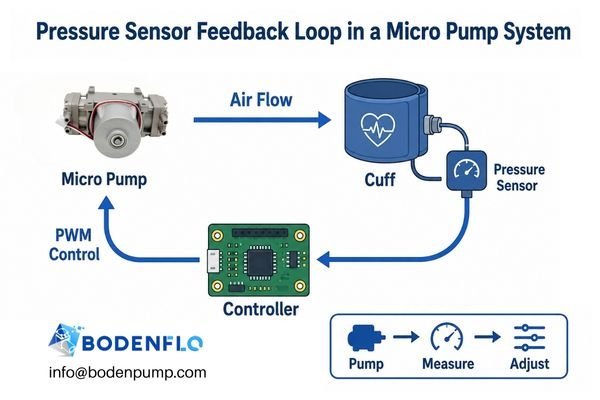
Think of a modern blood pressure monitor. It can’t just run the pump for a fixed amount of time. Instead, it uses a pressure sensor to create a simple but effective control loop. First, the controller starts the pump. As the cuff inflates, the pressure sensor constantly reports the rising pressure to the microcontroller. Once the sensor reading matches the target pressure value stored in memory, the controller immediately stops the pump. If it detects the pressure dropping due to a leak or relaxation, it can restart the pump to maintain the target. This logic is fundamental to thousands of smart devices, from compression therapy systems to leak testing equipment. The key is that the system responds to the actual state of pressure, not an estimated one.
How Does a Vacuum Sensor Improve Micro Vacuum Pump Performance?
Your vacuum gripper fails to pick up objects consistently, causing production line errors. You specified a strong pump, but leakage in the system is sabotaging its performance.
A vacuum sensor verifies that the target vacuum has been achieved at the point of application. It confirms a proper seal, detects leaks, and saves energy by stopping the pump once the task is complete.
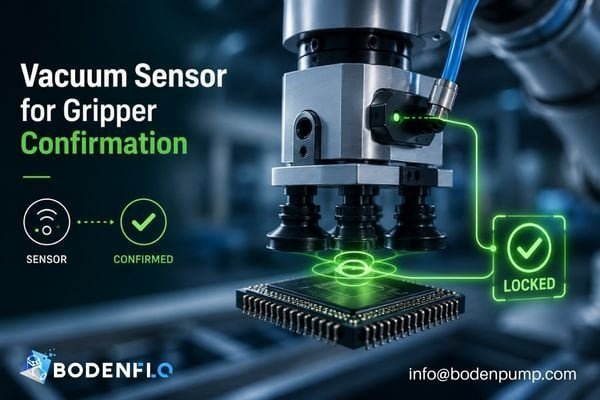
For vacuum applications, the pump’s maximum vacuum rating is often less important than the vacuum level you can maintain in your system. I’ve worked on many automation projects where a vacuum sensor was the key to reliability. For example, in a pick-and-place application, the sensor isn’t just measuring the pump; it’s confirming the gripper has successfully sealed against the object. If the target vacuum isn’t reached, the system knows not to lift, preventing a dropped part. This moves the sensor’s role from simple monitoring to critical process control. It’s often the most important component for verifying that the application’s goal—a secure seal—has actually been met.
| Function | How the Vacuum Sensor Helps |
|---|---|
| Pickup Confirmation6 | Confirms whether the vacuum pad has gripped the object. |
| Leak Detection7 | Identifies unstable vacuum, indicating a poor seal or a damaged suction cup. |
| Pump Stop Control | Stops the pump after the target vacuum is reached to save energy and reduce noise. |
| Energy Saving | Reduces unnecessary continuous running, which is critical in battery-powered devices. |
| Safety Alarm | Detects vacuum loss during operation and can trigger an immediate stop or warning. |
When Is a Flow Sensor Necessary in a Micro Air Pump System?
Your gas sampling device needs to collect an accurate volume of air, but you’re just running the pump for a set time. You are assuming, not measuring, the sample volume.
A flow sensor is necessary when the accuracy of the volume of air moved is critical to the device’s function. It allows the system to measure and control the flow rate directly, compensating for variables like filter resistance or battery voltage drop.
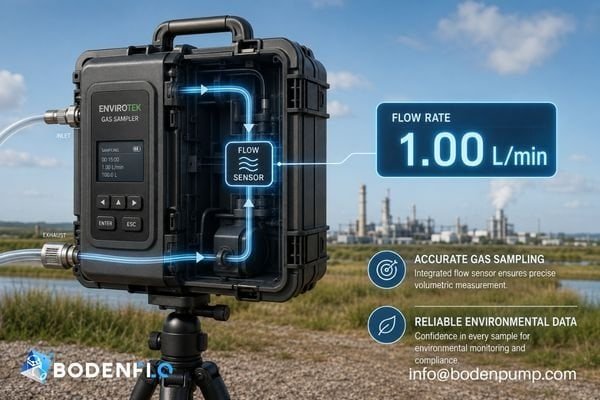
While not every system needs a flow sensor, for applications like gas analyzers or environmental monitors, it’s non-negotiable. In these devices, the flow rate is not just a pump parameter; it’s a fundamental part of the measurement itself. Imagine a CEMS (Continuous Emissions Monitoring System) that needs to sample exactly 1 liter per minute. If the pump’s inlet filter gets partially clogged, the system resistance increases and the actual flow rate will drop, even if the pump motor is spinning at the same speed. Without a flow sensor, the device would report incorrect concentration values because it sampled less air than it thought. A flow sensor detects this drop and allows the controller to increase pump speed (via PWM) to maintain a constant 1 L/min, ensuring measurement accuracy and reliability.
How Do Temperature Sensors Protect Micro Air Pumps During Continuous Operation?
Your pump passed testing on the bench, but it’s failing inside your final product’s small enclosure. The enclosed space is trapping heat, causing the pump to overheat and fail prematurely.
A temperature sensor acts as a vital safety mechanism. By monitoring the pump or enclosure temperature, the controller can take protective action like reducing speed, stopping the pump temporarily, or activating a fan, preventing heat-related damage.
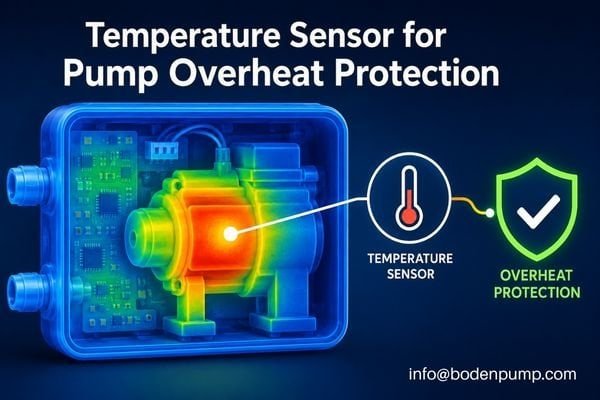
Heat is the primary enemy of long-term reliability for any electronic or mechanical component. Micro pumps are no exception, especially when running continuously under load. A pump that runs cool on an open test bench can quickly exceed its thermal limits when sealed inside a compact OEM device with poor ventilation. I always advise our clients at BODENFLO to place a temperature sensor near the pump or on the motor during validation testing. This provides real data about the operating temperature inside the final product. With this data, the software can be programmed with smart thermal management strategies, dramatically improving the device’s lifespan and safety. It’s a simple, low-cost way to protect a critical component.
How Does a Controller Use PWM and Sensors to Close the Loop?
You are using PWM to control your pump’s speed, but performance is still inconsistent. You are sending commands but have no way to know if the pump is achieving the desired outcome.
Combining PWM control with sensor feedback creates a "closed-loop" system. The controller uses the sensor to see the result of its PWM command and continuously adjusts it to maintain a stable target.
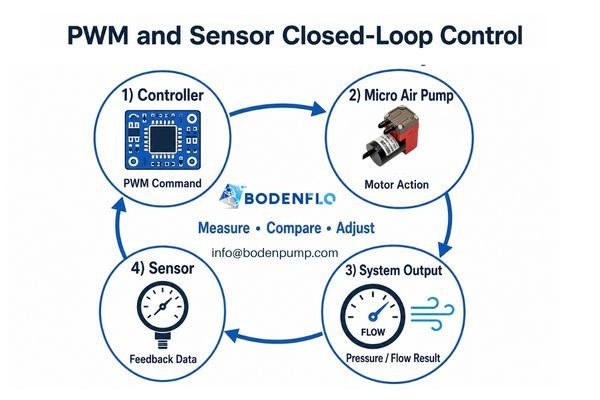
"Where should I put the sensor?" is one of the most important questions an engineer can ask. There is no single correct answer, only trade-offs. Placing a pressure sensor right at the pump outlet gives you a very fast response to pump changes, but it won’t tell you the true pressure in a chamber at the end of long tubing. Placing the sensor in that chamber gives you accurate application feedback, but there will be a time lag in your control loop. It’s a strategic decision based on your device’s goals. As a general rule, place the sensor as close as possible to the point where the performance is most critical.
| Sensor Position | Advantage | Risk / Disadvantage |
|---|---|---|
| Near Pump Outlet | Fast pressure response, good for pump health monitoring. | May not reflect the actual chamber pressure; susceptible to pulsation. |
| Near Final Chamber | Measures the true application pressure, which is best for user experience. | Slower system response time due to tubing/chamber volume. |
| Across a Filter | Directly measures filter clogging. | Requires a differential pressure sensor or two separate sensors. |
| Near Vacuum Pad | Provides the most accurate feedback for gripping confirmation. | Can add complexity with wiring and tubing routed to the end-effector. |
How Can BODENFLO Support Your Micro Pump and Sensor Integration?
You need to build a reliable smart device but are concerned about the complexities of integrating the pump, sensors, and controls. You need a partner, not just a component supplier.
At BODENFLO, we help you select the right micro pump and discuss the entire system. Our expertise in flow, pressure, and PWM control helps ensure your sensor integration project is successful.
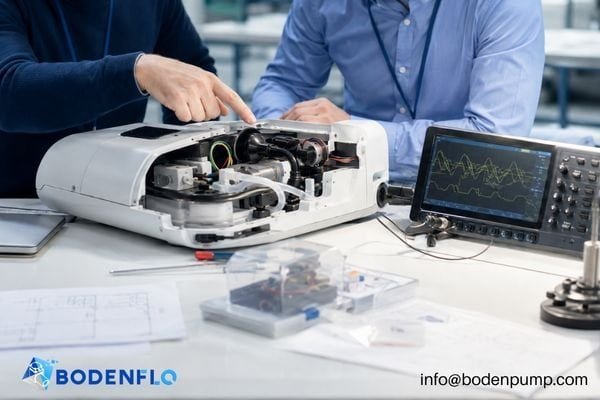
At BODENFLO, our role doesn’t end when we ship a pump. As a project manager, my goal is to see your project succeed in the market. We have extensive experience with applications in the medical, gas sampling, and smart automation fields. We can help you match the right pump performance curve to your system’s needs, advise on control strategies, and provide pumps with features like PWM control and FG speed feedback to simplify your integration. We believe in being a technical partner. If your OEM device requires stable and intelligent control of pressure, vacuum, or flow, we are here to support your team from concept to production.
Contact us to discuss your system integration needs.
📩 info@bodenpump.com
Conclusion
A micro pump provides airflow, but sensors give your device control and intelligence. Thinking about them as a single system is the key to creating a stable, reliable smart device.
Frequently Asked Questions
FAQ 1: Does every micro air pump system need sensors?
No. Simple on/off applications, like quickly inflating a non-critical object, may not require sensors. However, if the device needs stable pressure, accurate flow, safety protection, or fault detection, sensors are strongly recommended.
FAQ 2: What sensor is most important for a micro air pump?
It depends entirely on the application’s primary goal.
- Positive Pressure Systems: A pressure sensor.
- Vacuum Systems: A vacuum sensor.
- Gas Sampling Systems: A flow sensor or differential pressure sensor.
- Continuous Duty Systems: A temperature sensor for protection.
FAQ 3: Can a micro pump maintain constant pressure without a sensor?
Not accurately. Without a pressure sensor, the system has no feedback and cannot know the actual pressure. It can only estimate performance based on pre-programmed pump speed or runtime, which is unreliable as conditions like voltage, temperature, and leakage change.
FAQ 4: Why does sensor data fluctuate when using a diaphragm pump?
Diaphragm pumps, by their nature, produce a pulsating airflow (pressure pulses). Sensor readings may fluctuate rapidly if the sensor is positioned too close to the pump or if no damping elements (like a small buffer chamber or software filter) are used in the system.
FAQ 5: Can PWM control work without sensor feedback?
Yes, this is called "open-loop" control. You can use PWM to set the pump to run at, for example, 50% speed. However, without sensor feedback, the system has no way to confirm what pressure, vacuum, or flow rate that 50% speed is actually achieving. This can and will change with load and environmental conditions.
-
"Pressure sensor | Ultimate Pop Culture Wiki | Fandom", https://ultimatepopculture.fandom.com/wiki/Pressure_sensor. Encyclopedic sources such as Wikipedia and technical standards describe pressure sensors as devices used to measure the pressure of gases or liquids, supporting the claim that pressure sensors measure positive pressure. Evidence role: definition; source type: encyclopedia. Supports: Pressure Sensor measures positive pressure.. Scope note: Definition may vary slightly depending on sensor technology and application context. ↩
-
"Understanding What Is a Vacuum Sensor in Industrial Applications", https://bcstgroup.com/what-is-a-vacuum-sensor/. Vacuum sensors are widely used to measure negative pressure in applications such as suction systems, gas sampling, and vacuum grippers, as documented in technical encyclopedias and engineering literature. Evidence role: general_support; source type: encyclopedia. Supports: Vacuum sensors are used to measure negative pressure in applications such as suction systems, gas sampling, and vacuum grippers.. Scope note: Scope may vary depending on sensor technology and specific application requirements. ↩
-
"Flow Sensors: Types, Applications and Working Principles", https://www.ntchip.com/electronics-news/what-is-flow-sensor. Flow sensors are widely used to measure the rate of airflow in applications such as gas analyzers, respiratory equipment, and continuous emission monitoring systems (CEMS), as documented in technical literature and industry standards. Evidence role: general_support; source type: encyclopedia. Supports: Flow sensors are used to measure actual airflow rate in devices such as gas analyzers, respiratory equipment, and CEMS.. Scope note: This note provides general support for typical use cases and may not cover all possible applications or sensor types. ↩
-
"Differential Pressure Sensors | The Design Engineer’s Guide", https://my.avnet.com/abacus/solutions/technologies/sensors/pressure-sensors/measurement-types/differential/. According to technical references, a differential pressure sensor is designed to measure the difference in pressure between two points, which is commonly referred to as pressure drop. Evidence role: definition; source type: encyclopedia. Supports: Differential Pressure Sensor: Measures pressure drop. ↩
-
"How Do Temperature Sensors Work? | Atlas Scientific", https://atlas-scientific.com/blog/how-do-temperature-sensors-work/?srsltid=AfmBOooK5qC2tlUCu7TWRsaQChl5R3dxHMTvXF-6FxNJHe_umhMeOHnZ. Authoritative sources such as engineering textbooks and sensor technology encyclopedias confirm that temperature sensors are devices used to monitor heat rise or temperature changes in various systems. Evidence role: definition; source type: encyclopedia. Supports: A temperature sensor is a device that monitors heat rise.. ↩
-
"Vacuum Pick and Place Applications | Tameson.com", https://tameson.com/pages/vacuum-pick-place. Scholarly sources on industrial automation and robotics confirm that vacuum sensors are commonly used to verify successful object pickup by detecting whether a vacuum pad has securely gripped the item, thus preventing errors in pick-and-place operations. Evidence role: mechanism; source type: education. Supports: Vacuum sensors are used in pick-and-place applications to confirm whether the vacuum pad has gripped the object.. Scope note: Sources may describe general principles or typical use cases rather than specific brands or models. ↩
-
"Leak Detection Overview | Enabling Technology for a Better World", https://www.lesker.com/newweb/technical_info/vacuumtech/leakdetect_01_overview.cfm. Scholarly sources explain that vacuum sensors are commonly used in automation systems to detect leaks by monitoring vacuum stability, which helps identify poor seals or damaged suction cups. Evidence role: mechanism; source type: encyclopedia. Supports: Vacuum sensors help identify unstable vacuum, indicating a poor seal or a damaged suction cup.. Scope note: Sources may describe leak detection in general automation or industrial contexts, not only pick-and-place applications. ↩