
Your product works perfectly in the lab, but when it's used in a high-altitude location, it fails. The flow rate is too low, the pump runs hot, and performance is inconsistent.
This isn't a pump failure; it's physics. The lower atmospheric pressure and reduced air density at high altitudes directly impact how any diaphragm air pump performs. Understanding these effects is key to designing a reliable system for any environment.
I've had many conversations with engineers who are frustrated because a device that passed all tests at their facility in Shenzhen or Munich suddenly underperforms when deployed in mountainous regions like Denver or the Andes. They see a drop in flow rate, changes in vacuum levels, and pumps running longer and hotter than expected. My first reassurance is always the same: your pump is likely not broken. Instead, the air it's trying to move has changed. This article will explain exactly how altitude influences pump performance and, more importantly, what you as an engineer can do to design a robust system that works anywhere on Earth.
Why Does High Altitude Affect a Micro Diaphragm Air Pump?
A diaphragm pump works by moving a fixed volume of air with each stroke. But what happens when that volume of air contains fewer air molecules? The pump's performance inevitably changes.
High altitude affects a diaphragm pump because the air is less dense. This means each stroke of the diaphragm moves less air mass, reducing mass flow rate. The thinner air is also less effective at cooling the pump's motor, causing it to run hotter.
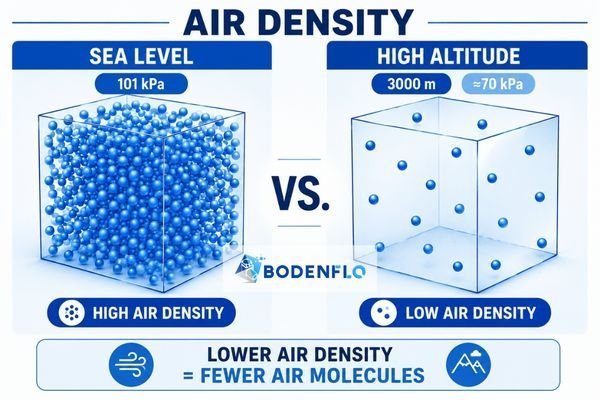
To understand the impact, we need to look at the fundamental physics. As you go higher in altitude, the column of air above you gets shorter, resulting in lower atmospheric pressure. According to the ideal gas law, this lower pressure causes the air to become less dense. For a micro diaphragm pump, this has two major consequences:
- Less Air Mass Per Stroke: The pump is a positive displacement device, meaning it moves a consistent volume of air with each cycle. However, since the air at high altitude is less dense, that same volume contains less mass of air. This directly impacts any process that relies on a specific mass of air, like gas sampling.
- Reduced Convective Cooling: Air pumps rely on the surrounding air to dissipate heat from the motor. Thinner air is less effective at transferring this heat away, causing the motor and pump body to operate at a higher temperature.
These two factors are the root cause of almost all performance changes seen at high altitudes.
Which Pump Parameters Change at High Altitude?
So, you know the air is thinner. But how does that specifically translate to the numbers you see on a datasheet or in your system's performance metrics?
Nearly every key performance parameter is affected. You can expect a lower flow rate, reduced positive pressure output, and higher motor temperatures. The pump's overall efficiency will decrease as it has to work harder for the same result.
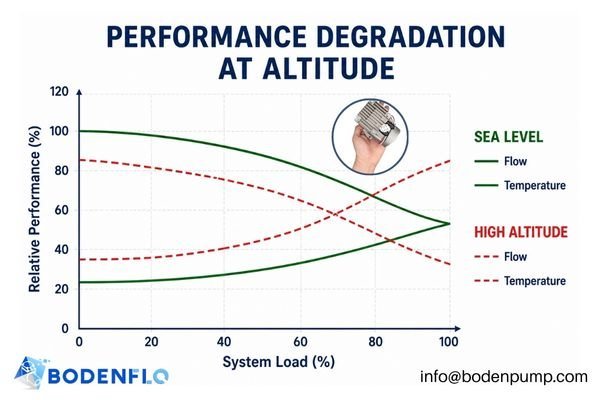
When my team helps engineers spec a pump for high-altitude applications, we always review how the key parameters will shift. It's crucial to understand that the pump isn't degrading; its operating environment has changed. Here is a summary of what you can typically expect:
| Parameter | Sea Level (Reference) | High Altitude Effect | Why It Happens |
|---|---|---|---|
| Volumetric Flow Rate | 100% | Decreases (↓) | Less dense air means each stroke moves less air mass. |
| Maximum Vacuum | -80 kPa (Gauge) | Slightly changes | Gauge value changes, but absolute vacuum capability is similar. |
| Maximum Pressure | 1.5 bar (Gauge) | Reduced (↓) | The pump is compressing less dense air. |
| Motor Temperature | Normal | Higher (↑) | Reduced air density leads to less effective cooling. |
| Current Draw | Reference | May increase | The pump may run longer to meet a target, increasing overall draw. |
| Overall Efficiency | 100% | Lower (↓) | More work is required to move the same mass of air. |
This table makes it clear: you cannot design a system based on sea-level data and expect it to perform the same in the mountains.
How Does High Altitude Affect Air Flow?
The pump is rated for 20 L/min, but at 3,000 meters, your system is only measuring 15 L/min. This discrepancy is one of the most common and critical issues faced in high-altitude applications.
The volumetric flow rate (L/min) stated on a datasheet is measured at sea level. At high altitude, the mass flow rate drops significantly because the air is less dense. This means fewer molecules are being delivered, which is what matters for applications like combustion or gas sampling.
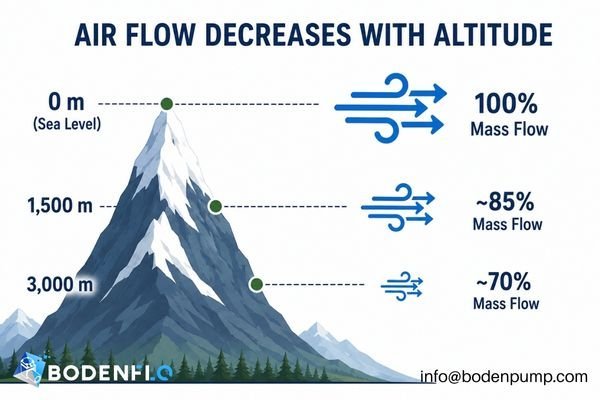
This is a point of confusion for many engineers. The pump is still displacing 20 liters of volume per minute, but the amount of air in that volume is much lower. It's the difference between volumetric flow (the space air occupies) and mass flow (how much stuff is actually there). For most engineering applications, mass flow is what truly matters.1 As a rough guide, here's how you can expect the effective mass flow to decrease relative to sea-level performance:
- At 1,500 m (approx. 5,000 ft): Flow may be reduced by ~15%.
- At 3,000 m (approx. 10,000 ft): Flow may be reduced by ~30%.
- At 5,000 m (approx. 16,400 ft): Flow may be reduced by more than 45%.
If your gas analyzer requires a specific number of molecules per second for an accurate reading, this reduction is a critical design constraint that must be accounted for.
Can a Micro Diaphragm Air Pump Still Reach the Same Vacuum?
This is a tricky question that often causes confusion. Many engineers expect vacuum performance to drop significantly, but the answer depends entirely on how you measure it.
A pump's ability to create a pressure differential remains largely unchanged. However, since the starting atmospheric pressure is lower at high altitude, the final absolute pressure will be lower than at sea level. Your gauge pressure reading might look different, but the pump is still pulling a strong vacuum.
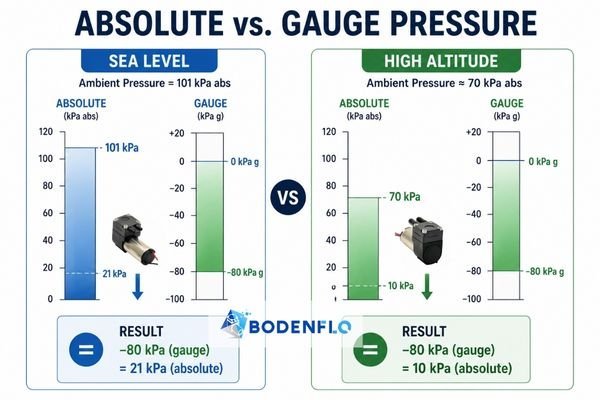
Let's break this down, as it's a key insight.
- Absolute Pressure: Measured relative to a perfect vacuum (0 kPa). Sea level atmospheric pressure is about 101 kPa (abs).2
- Gauge Pressure: Measured relative to the surrounding atmospheric pressure. This is what most vacuum gauges read.
Imagine a pump capable of pulling a vacuum of -80 kPa (gauge) at sea level. This means it reduces the pressure from 101 kPa (abs) down to 21 kPa (abs). It has created a pressure differential of 80 kPa.
Now, take that same pump to 3,000 meters, where the atmospheric pressure is only about 70 kPa (abs)3. The pump can still create a very similar pressure differential (let's say 79 kPa). So, the final absolute pressure it can reach is now 70 - 79 = -9 kPa (gauge reading). The final absolute pressure is now 70-79 which means the gauge reading is nearly the same! The final absolute pressure is 1 kPa. It can pull a deeper absolute vacuum, even if the gauge reading seems confusing. The pump's capability is intact.
Does High Altitude Increase Pump Temperature?
Your pump felt fine in the lab, but in the field, it's getting too hot to touch. This is a serious reliability concern and a direct consequence of operating in thin air.
Yes, a pump will almost always run hotter at high altitudes. The less dense air provides significantly less convective cooling for the motor. This effect is often made worse because the pump may need to run longer to compensate for lower flow rates, generating even more heat.
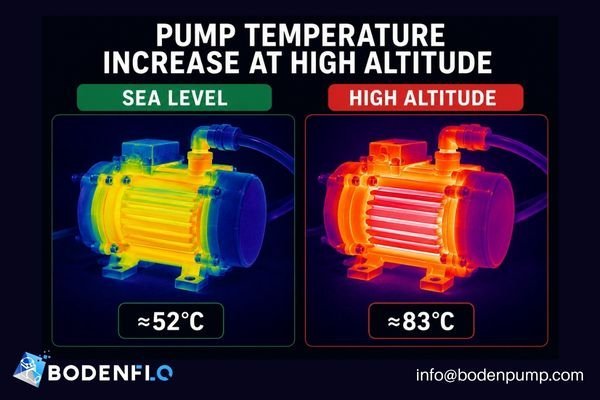
Heat is the enemy of reliability, especially for motors and electronics. At high altitudes, you face a double-whammy. First, the primary method of cooling—air flowing over the pump body and motor—is less effective because there are fewer air molecules to carry the heat away. I've seen pumps run 15-25°C hotter at high altitudes compared to sea level under the same load. Second, if the system is trying to move a specific volume or achieve a certain pressure, the pump has to work longer and harder, which generates more internal heat. This excess temperature can reduce the lifespan of the motor's bearings, brushes (if applicable), and windings, and can also heat up the entire device, affecting other sensitive components.
Which Applications Are Most Sensitive to Altitude?
While all diaphragm pumps are affected by altitude, the impact is much more critical in some applications than in others. If your product falls into one of these categories, altitude compensation is not optional—it's essential.
Applications that rely on precise gas measurement, operate in unpressurized aerial vehicles, or are used for life-critical medical support are extremely sensitive to altitude changes. Failure to account for altitude can lead to inaccurate data, mission failure, or patient risk.
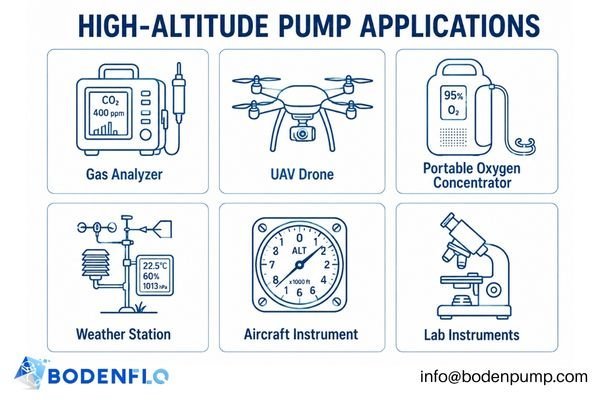
From our experience with OEM projects, these are the fields where altitude plays a critical role:
- Gas Sampling & Environmental Monitoring: Accuracy depends on drawing a known mass of air, which changes with density.
- Unmanned Aerial Vehicles (UAVs): Payloads on drones experience rapid and significant altitude changes.
- Portable Medical Devices: Oxygen concentrators or nebulizers used by travelers need to deliver consistent performance everywhere.
- Aviation Instruments: Any equipment used in unpressurized aircraft cabins or cargo holds must be designed for altitude.
- Laboratory Instruments: Calibrated instruments moved to high-altitude labs may need complete recalibration.
- Leak Detection: The sensitivity of pressure decay or vacuum decay tests is influenced by the starting atmospheric pressure.
How Can Engineers Compensate for Altitude?
Knowing the problem is half the battle. Now, what concrete steps can you take during the design phase to build a product that performs reliably at any altitude?
The key is to design with a margin of safety and use smart system-level strategies. Select a pump with a higher flow margin, choose an efficient brushless motor, optimize your pneumatic circuit to reduce losses, and validate your design at the target altitude.
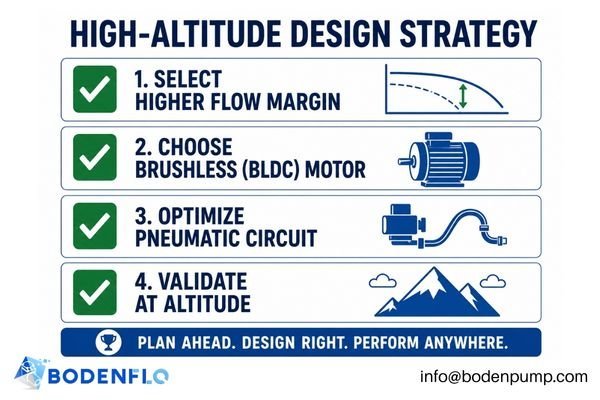
You can't change the physics of the atmosphere, but you can definitely design a more resilient system. Here is the engineering checklist my team and I run through for high-altitude projects:
- ✓ Select a Higher Flow Margin: If you need 10 L/min of mass flow at 3,000 m, you might need to select a pump rated for 14-15 L/min at sea level.
- ✓ Choose a Brushless Motor (BLDC): BLDC motors are more efficient and generate less waste heat, making them inherently better for poor cooling environments. They also offer longer life.
- ✓ Increase Operating Voltage (If Allowed): For some pumps, running at a slightly higher voltage can boost speed and compensate for some flow loss, but you must consult the manufacturer to avoid damage.
- ✓ Optimize Pneumatic Tubing: Use the shortest, widest tubing possible to minimize system pressure losses.
- ✓ Validate at Target Altitude: If possible, test your final design in a high-altitude location or an altitude simulation chamber. Never assume.
- ✓ Use Software Correction: For analytical instruments, use an onboard pressure sensor to measure local atmospheric pressure and apply a correction factor to your results.
Engineering Example: Sea Level vs. 3,500 m
Let's make this tangible. An engineer designs a portable gas sampler around a 10 L/min micro diaphragm pump. The device needs to collect a sample in 60 seconds.
This real-world example shows that a system designed at sea level will fail at altitude. The 15% flow reduction at 3,500 m leads to longer sampling times and a significant drain on battery life, impacting the product's core function and user experience.
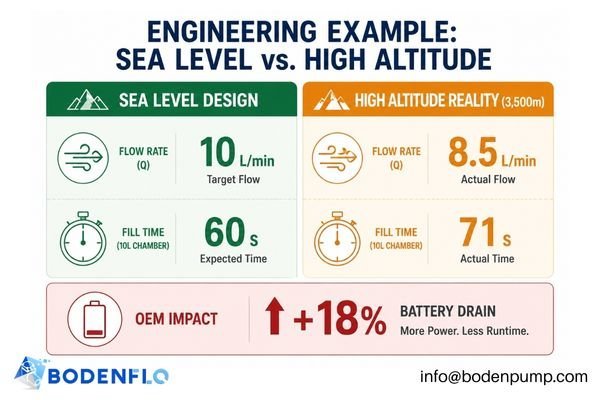
Here’s how the numbers play out, based on a real project I consulted on:
| Parameter | @ Sea Level | @ 3,500 m (approx. 11,500 ft) | OEM Impact |
|---|---|---|---|
| Pump Flow Rate | 10 L/min | ~8.5 L/min (15% reduction) | The core performance metric is missed. |
| Sampling Time | 60 seconds | ~71 seconds | User has to wait longer. |
| Energy Consumed | (Current x 60s) | (Current x 71s) | 18% higher battery drain per sample. |
The OEM impacts were significant. The longer sampling time was frustrating for users, and the increased battery consumption meant the device couldn't last a full workday on a single charge. The solution was to switch to a more efficient, higher-flow brushless pump that could meet the 10 L/min mass flow requirement even at altitude.
How to Select a Micro Diaphragm Air Pump for High-Altitude Applications
So, what should you look for when you know your product is headed for the mountains? The right choice goes beyond a simple flow rate number on a datasheet.
For high-altitude applications, prioritize pumps with high efficiency, durable brushless motors, and a healthy pressure and flow margin. Look for pumps from manufacturers like BODENFLO who test for these conditions and can provide performance data beyond sea level.
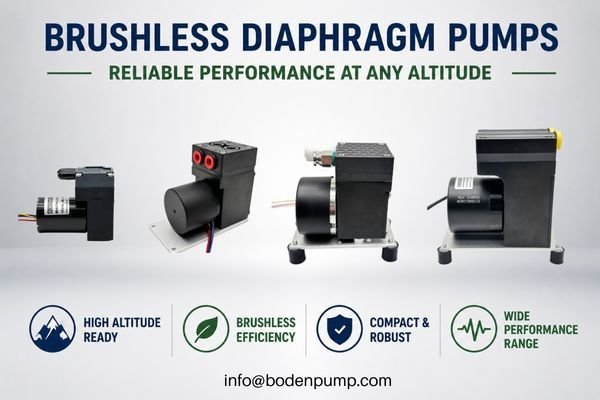
When selecting a pump for a demanding environment, you need a robust solution. Here are the features I strongly recommend prioritizing:
- High Efficiency: A more efficient pump converts more electricity into pneumatic power, generating less waste heat—a critical advantage in thin air.
- Brushless DC Motor (BLDC): The long life and lower heat generation of BLDC motors make them the default choice for reliable, high-altitude systems.
- Sufficient Performance Margin: Don't design right up to the limit. Choose a pump that can comfortably exceed your sea-level requirements.
- Stable Performance: Look for a quality pump that provides consistent flow and pressure across its operating range.
At BODENFLO, our high-flow miniature diaphragm pumps are engineered for these exact challenges, offering market-leading efficiency and reliability that you can count on from sea level to the summit.
FAQ
Does high altitude reduce pump flow?
Yes, absolutely. The volumetric flow rate in L/min might be the same, but the mass flow rate (the actual amount of air being moved) decreases significantly due to lower air density.
Can a micro diaphragm air pump work at 5,000 m altitude?
Yes, most high-quality pumps will function. However, the performance will be significantly reduced (e.g., ~45% less mass flow). You must select a pump with enough sea-level performance margin to compensate for this reduction.
Does altitude affect vacuum pressure?
It affects the gauge pressure reading, but the pump's absolute pressure capability remains similar. The pump can still create a strong pressure differential relative to the lower ambient pressure.
Why does my pump become hotter at high altitude?
Because the thinner, less dense air is much less effective at carrying heat away from the pump motor, a phenomenon known as reduced convective cooling.
Should I oversize my pump for mountain applications?
Yes, but "oversize" in a smart way. You need to select a pump with a higher sea-level flow and pressure rating to ensure it meets your actual performance requirements at your target altitude.
Conclusion
High altitude doesn't break the pump; it changes the environment it operates in. By understanding how lower atmospheric pressure impacts airflow, pressure, and cooling, engineers can design more reliable systems. At BODENFLO, we specialize in pumps that excel in these conditions.
If you're facing a high-altitude challenge, contact our team at info@bodenpump.com to find the perfect solution.
-
"Mass Flow vs Volumetric Flow", https://www.alicat.com/support/what-is-the-difference-between-mass-flow-and-volumetric-flow/. Engineering literature commonly emphasizes that mass flow rate is a critical parameter in thermodynamic and fluid systems, as it directly relates to the amount of substance being transported, which is essential for energy and material balances. This is a widely accepted principle in engineering practice. Evidence role: expert_consensus; source type: education. Supports: For most engineering applications, mass flow is what truly matters.. Scope note: While mass flow is generally prioritized, some applications may also require volumetric flow considerations. ↩
-
"Atmospheric pressure", https://en.wikipedia.org/wiki/Atmospheric_pressure. Standard atmospheric pressure at sea level is defined as approximately 101.3 kPa according to international standards. Evidence role: definition; source type: encyclopedia. Supports: Sea level atmospheric pressure is about 101 kPa (abs).. Scope note: The value may be rounded to 101 kPa for simplicity, but the precise standard is 101.325 kPa. ↩
-
"Pressure Altitude Calculator", https://www.weather.gov/epz/wxcalc_pressurealtitude. Atmospheric pressure at 3,000 meters elevation is typically around 70 kPa, as shown in standard atmospheric tables. Evidence role: statistic; source type: government. Supports: At 3,000 meters, the atmospheric pressure is only about 70 kPa (abs).. Scope note: Actual pressure can vary with weather and local conditions; 70 kPa is an approximate average. ↩