
Your robot design needs both inflation and suction, but space is tight. Using separate pumps for pressure and vacuum adds weight, complexity, and cost, compromising your entire design.
A single miniature air pump that generates both positive pressure and vacuum simplifies pneumatic robotic systems, reduces weight, saves installation space, and improves energy efficiency. This is why engineers prefer them for grippers, mobile robots, and quadruped platforms.
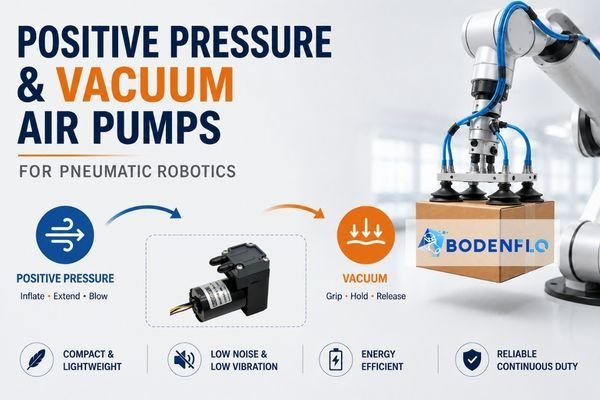
When I talk with robotics engineers, the conversation often shifts from motors and sensors to a surprising component: the humble air pump. As robots become more collaborative and versatile, pneumatic systems are making a major comeback. More importantly, the decision is no longer just about adding a pump; it’s about choosing the right architecture. This article explains why an increasing number of successful robotic platforms are being built around a single pump capable of generating both positive pressure and vacuum.
Why are pneumatic systems becoming popular in robotics again?
Aren’t modern robots built entirely from electric motors? This common view overlooks a major shift in robotics, where pure motor control is often too rigid, heavy, and complex for many tasks.
Pneumatic systems are re-emerging in robotics because they offer compliance, are lightweight, and are safer for interaction. Components like soft grippers and artificial muscles provide a gentleness and flexibility that electric motors struggle to replicate, making them ideal for delicate tasks.
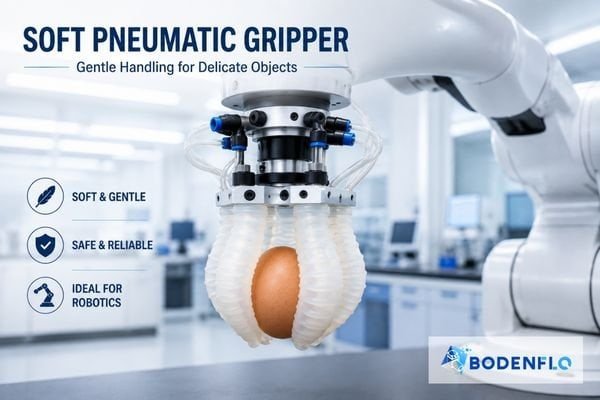
From my experience, many of the most innovative robots I see are hybrids. They use electric motors for large movements but rely on pneumatics for a "gentle touch" and specialized functions.
Here’s why pneumatic components are being integrated more frequently:
- Pneumatic Grippers & Soft Robotics: These use air pressure to create "soft" fingers that can conform to irregularly shaped or fragile objects without crushing them.
- Artificial Muscles: These actuators contract when inflated, mimicking biological muscles. They are lightweight and can produce powerful, smooth motions.
- Vacuum End Effectors: These use suction to pick up and hold flat or porous objects, a task that is difficult for mechanical grippers.
The core advantages are clear: pneumatic systems are inherently compliant, safer for human-robot collaboration, and often have a higher power-to-weight ratio than small electric actuators.
Why do pneumatic robots need both positive pressure and vacuum?
You might think of a pump as just blowing air. But what about picking things up or holding on? Relying only on positive pressure severely limits what your robot can actually do.
Pneumatic robots need both pressures for full functionality. Positive pressure is used to inflate actuators, extend grippers, and blow away debris. Vacuum (negative pressure) is essential for gripping objects, adhesion to surfaces, and providing controlled release of parts.
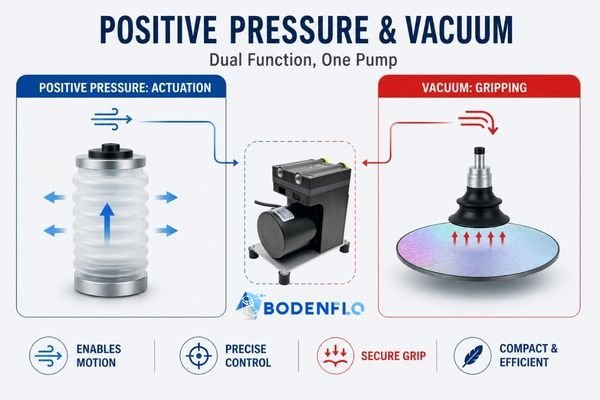
A truly versatile robot must be able to both push and pull with air. In my work with OEM engineers, we break down the tasks into two categories:
- Positive Pressure Tasks:
- Inflate: Powering soft robotic fingers or artificial muscles.
- Extend: Driving a pneumatic actuator or cylinder outward.
- Blow: Clearing dust or debris from a work surface before performing a task.
- Negative Pressure (Vacuum) Tasks:
- Gripping: Picking up delicate or flat objects like circuit boards or glass.
- Adhesion: Allowing a robot to stick to a wall or ceiling for climbing or inspection.
- Controlled Release: Gently placing an object by releasing the vacuum, which is often more controlled than releasing a mechanical grip.
Many advanced robots, like a quadruped robot that needs to both manage internal pressure and operate a vacuum gripper, will inevitably require both pressure modes.
Why is one dual-function pump better than two separate pumps?
If a robot needs both pressure and vacuum, why not just use two separate pumps? This seems like a straightforward solution, but it introduces significant system-level penalties that OEM engineers hate.
A single dual-function pump is superior because it drastically reduces weight, wiring, and the overall system footprint. It also lowers power consumption and simplifies the control logic, leading to a leaner bill of materials (BOM) and a more reliable, integrated design.
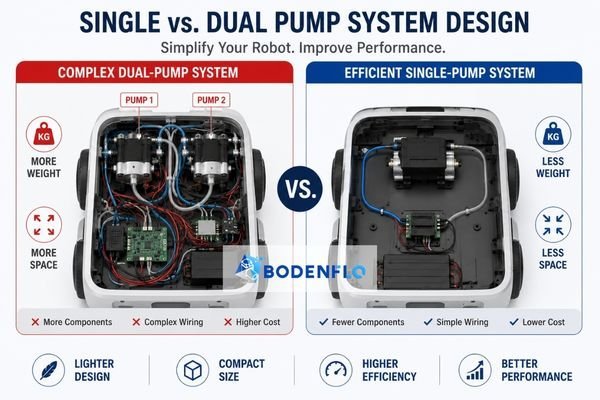
This is a conversation I have almost every week. The decision to use one pump instead of two is a classic OEM engineering choice focused on efficiency and cost reduction. Here are the clear advantages that drive this decision:
- Less Weight: In a mobile or quadruped robot, every gram counts. One pump is almost always lighter than two.
- Smaller Footprint & Less Wiring1: Space inside a robot is extremely limited. A single pump requires half the installation space and half the wiring.
- Lower Power Consumption2: Powering one motor is more efficient than powering two, extending battery life.
- Easier Control: Managing one pump with a reversing valve is simpler from a software and electronics perspective than coordinating two separate pumps.
- Lower Bill of Materials (BOM) Cost: Fewer pumps, drivers, and wires mean a lower total cost to build the robot.
For any OEM, these benefits are not just minor improvements; they are critical factors that can determine a project’s success and profitability.
What pump characteristics matter most in pneumatic robotics?
When selecting a dual-function pump, it’s easy to get lost in datasheets. However, for robotics, a few specific characteristics are far more important than just maximum pressure or flow.
The most critical pump characteristics for robotics are compact size, low weight, low noise, and low vibration. Because robots run for long periods, the pump must be rated for continuous duty and equipped with an efficient, controllable brushless motor.
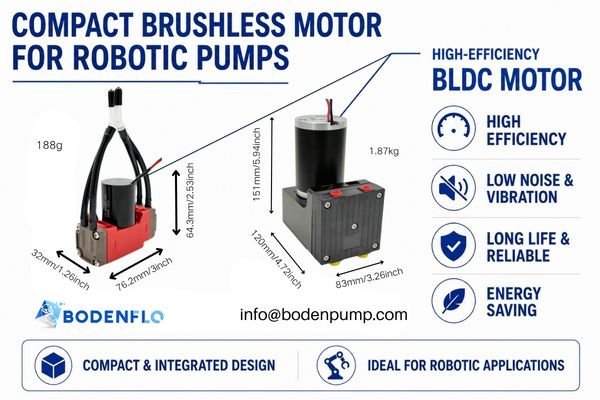
Based on challenges I’ve helped engineers solve, here is what truly matters:
- Compact Size & Low Weight: Essential for mobile robots and robotic arms where space and weight are at a premium.
- Low Noise & Vibration: Critical for robots operating near people or for inspection robots where vibration can interfere with cameras and IMU sensors.
- Continuous Duty: Robots don’t just run for 30 seconds. The pump must be designed to run for hours without overheating or failing.
- Brushless Motor: A brushless motor is a must-have. It provides a much longer lifespan, higher efficiency for better battery life, and allows for precise speed control via PWM signals.
- Positive & Vacuum Capability: The core feature. A pump designed to efficiently provide both pressure and vacuum in a single package is the key enabler.
Choosing a pump with this specific combination of features is fundamental to creating a reliable and effective pneumatic robotic system.
What are some typical pneumatic robotics applications?
Where are these dual-function pumps actually being used? They are becoming the standard in a wide range of robotic systems that require both actuation and gripping capabilities.
From pneumatic grippers that need to inflate and create suction, to quadruped robots that manage internal pneumatic balance and operate vacuum tools, dual-function pumps provide the versatility needed for complex tasks. This table summarizes common applications and their pressure needs.
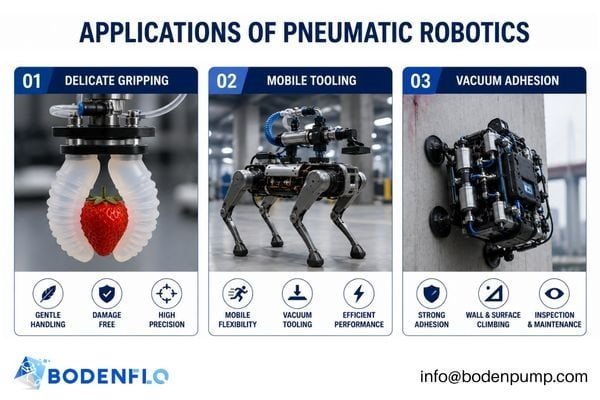
The versatility of dual-function pumps makes them suitable for an expanding list of robotic applications. Here is a breakdown of where they are most commonly found.
| Application | Positive Pressure | Vacuum |
|---|---|---|
| Pneumatic Gripper3 | ✓ | ✓ |
| Soft Robotic Finger4 | ✓ | — |
| Vacuum End Effector | — | ✓ |
| Quadruped Robot5 | ✓ | ✓ |
| Mobile Inspection Robot | ✓ | ✓ |
| Robotic Manipulator | ✓ | ✓ |
As you can see, many of the most advanced applications require both functions. This is why designing with a dual-function pump from the start is often a more future-proof strategy.
What are the recommended pump specifications for pneumatic robotics?
What numbers should you actually look for on a datasheet? While every robot is different, most applications fall within a well-defined performance range.
For typical robotic applications, engineers should look for a continuous-duty, brushless pump with a 12V or 24V motor. Key performance targets are often around 1 bar of positive pressure, -70 kPa of vacuum, and a flow rate of 2–5 L/min with PWM speed control.
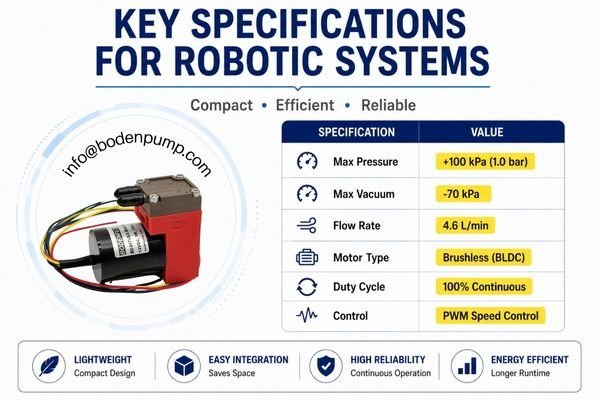
Instead of getting fixated on a single model number, it’s better to start with a target performance window. Here are the typical specifications that serve as a great starting point for most robotic projects I’ve worked on:
- Positive Pressure: ≈ 1 bar (100 kPa) is often sufficient for most soft actuators and grippers.6
- Vacuum Level: ≈ -70 kPa provides strong gripping force for most objects.
- Flow Rate: 2–5 L/min offers a good balance between speed (for inflation and vacuum generation) and power consumption.
- Voltage: 12V or 24V are standard in robotics and easy to integrate.
- Motor: Brushless (BLDC) is non-negotiable for long life and efficiency.
- Control: PWM speed control capability is essential for managing power and noise.
- Duty Cycle: Must be rated for 100% continuous duty.
Of course, a specific robotic manipulator arm might need higher flow, while a small inspection robot might prioritize lower power. These serve as a baseline for starting your design discussions. To give you a more concrete idea, here are a few popular brushless diaphragm pump models from our portfolio that are frequently chosen for pneumatic robotics projects:
| Model | Voltage | Flow Rate | Max Pressure | Max Vacuum | Weight |
|---|---|---|---|---|---|
| BD-05T033B | 24V | 2.3 L/min | 0.9 bar | -55 kPa | 56g |
| BD-05TVB-S | 24V | 4.6 L/min | 1.5 bar | -70 kPa | 148g |
| BD-05TVB-S.1 | 12V | 5.5 L/min | 1.5 bar | -70 kPa | 148g |
| BD-02AB | 12V | 3 L/min | 1.0 bar | -60 kPa | 72g |
| BD-03AB | 24V | 3 L/min | 2 bar | -65 kPa | 141g |
How does BODENFLO support pneumatic robotics OEM projects?
You now understand the architecture, but how do you get a pump that perfectly matches your design? This is where working with a specialized supplier becomes a major advantage.
At BODENFLO, we don’t just sell off-the-shelf pumps. We work with OEM engineers to provide customized solutions, leveraging our expertise in brushless motors, compact structures, and dual-function pump design to meet the specific demands of robotic applications.
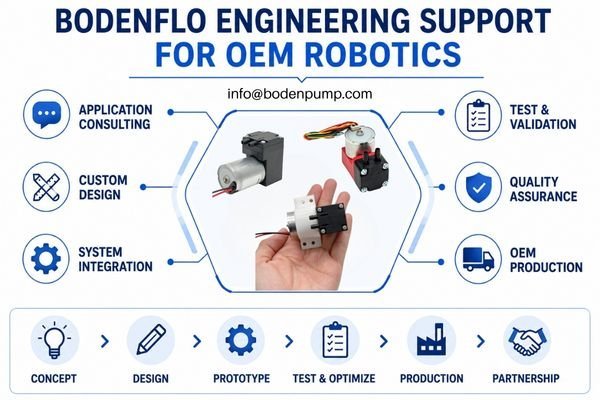
Our role is to help you build a better robot. We do this by focusing on what OEMs need most:
- Parameter Customization: We can fine-tune the pressure, flow, and power consumption to match your exact requirements.
- Positive & Vacuum Design Expertise: Our core strength is designing compact pumps that excel at providing both pressure modes efficiently.
- Advanced Brushless Motors: We integrate high-efficiency, long-life brushless motors with PWM control as a standard for our robotics-grade pumps.
- Compact & Lightweight Structures: We specialize in designing pumps that deliver maximum performance from the smallest and lightest possible package.
- OEM Integration Support: My team and I can help you with everything from initial selection to integration and testing, ensuring the pump works seamlessly within your system.
- Long-Life, Continuous-Duty Pumps: We understand that robots need to be reliable, and our pumps are designed and tested for long-term, continuous operation.
Conclusion
The right pneumatic architecture simplifies design and elevates performance. By choosing a single, dual-function air pump, robotics engineers can build lighter, smaller, and more efficient robots. It is a strategic decision that pays dividends in cost, reliability, and capability.
If you are developing a pneumatic robotic system and need help finding the right pump solution, my team at BODENFLO is here to support your project. Contact us at info@bodenpump.com to discuss your specific needs.
-
"What is the difference between a single diaphragm pump …", https://bodenpump.com/single-vs-double-diaphragm-pump/. Industry guidelines and engineering analyses indicate that using a single pump in robotic systems generally reduces installation space and wiring complexity compared to dual-pump configurations, though the exact savings depend on system design. Evidence role: general_support; source type: education. Supports: A single pump requires half the installation space and half the wiring.. Scope note: The degree of space and wiring reduction may vary based on robot architecture and component integration. ↩
-
"Pool Pump Comparison: Single vs. Dual vs. Variable Speed", https://store.igarden.ai/blogs/news/single-vs-dual-vs-variable-speed-pool-pump. Technical studies on robotic actuation systems show that operating a single motor typically results in lower overall power consumption than using two motors, which can contribute to longer battery life in mobile robots. Evidence role: mechanism; source type: paper. Supports: Powering one motor is more efficient than powering two, extending battery life.. Scope note: Actual efficiency gains depend on the specific application and duty cycle of the pumps. ↩
-
"What Is A Gripper? – Comprehensive Guide", https://soft-gripping.com/discover/a-comprehensive-guide-to-grippers/. Scholarly sources describe pneumatic grippers as robotic end effectors that use compressed air to generate gripping force, making them a common application of positive pressure in robotics. Evidence role: definition; source type: encyclopedia. Supports: Pneumatic grippers are robotic end effectors that use positive pressure (compressed air) to grip objects.. Scope note: Some pneumatic grippers may also use vacuum for certain tasks, but positive pressure is the primary mechanism. ↩
-
"Soft Pneumatic Actuators", https://armlab.gatech.edu/research-2/current/soft-pneumatic-actuators/. Scholarly sources describe soft robotic fingers as actuators that often utilize positive pressure to achieve flexible movement, supporting their classification in this context. Evidence role: definition; source type: paper. Supports: Soft robotic fingers commonly use positive pressure for actuation.. Scope note: Some soft robotic fingers may use alternative actuation methods, but positive pressure is common. ↩
-
"The Four-Legged Robot That Can Crawl, Crouch, Clean …", https://www.aau.edu/research-scholarship/featured-research-topics/four-legged-robot-can-crawl-crouch-clean-and-fight. Scholarly sources describe quadruped robots as four-legged robotic platforms that often utilize both positive pressure and vacuum systems for actuation, stabilization, and manipulation tasks, supporting their inclusion in dual-function pump applications. Evidence role: mechanism; source type: paper. Supports: Quadruped robots commonly use both positive pressure and vacuum functions, making them suitable for dual-function pumps.. Scope note: Some quadruped robots may use only one type of pneumatic system depending on their design and application. ↩
-
"Soft robotics", https://en.wikipedia.org/wiki/Soft_robotics. A review of soft robotics literature indicates that many soft actuators and grippers operate effectively at pressures around 1 bar (100 kPa), though specific requirements may vary by design and application. Evidence role: statistic; source type: paper. Supports: ≈ 1 bar (100 kPa) is often sufficient for most soft actuators and grippers.. Scope note: Pressure requirements can differ significantly depending on actuator geometry and material; this value is a common reference but not universally optimal. ↩