
Struggling to select a 3L/min pump for your project? The wrong choice can lead to device failures, budget overruns, and critical project delays—outcomes no project manager wants to face.
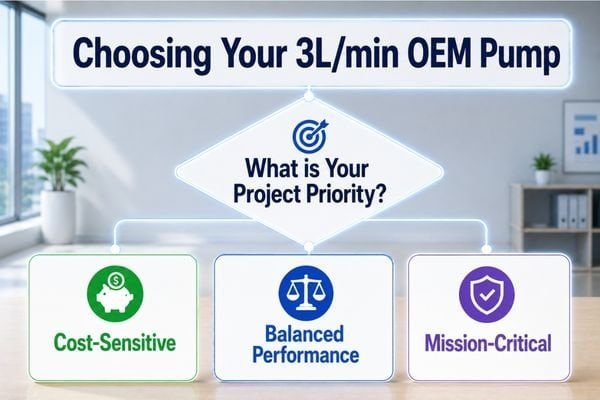
The best pump depends on your project’s specific goals. For compact, cost-sensitive designs, a balanced OEM pump is ideal. For mission-critical medical devices requiring 24/7 operation, only a high-end, continuous-duty pump will do.
As a Project Manager with over nine years in the miniature pump industry, my role is to help clients make smart decisions that protect their projects. The 3L/min pump is a key component, and understanding how to choose the right one is crucial. Let’s walk through the decision-making process I use with my clients every day.
Why is 3L/min a Popular Choice for New Miniature Pump Designs?
You’re starting a new device design and need to spec a pump. Choosing the wrong flow rate early on can force costly changes later, impacting size, power, and your project timeline.
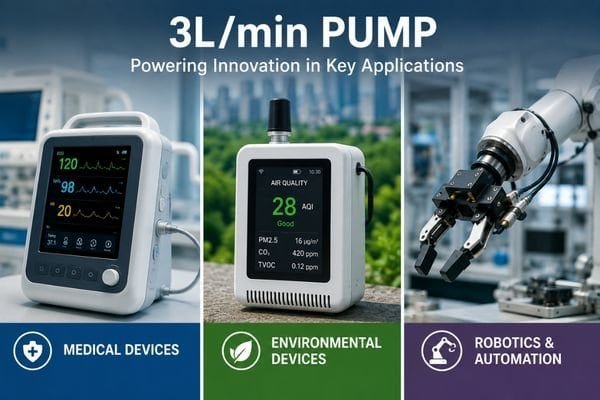
Based on dozens of recent OEM projects, 3L/min is emerging as the default starting point for new compact devices. It provides a "sweet spot" that balances performance, physical size, and power consumption for applications in medical, robotics, and environmental monitoring.
From my experience managing new OEM projects, a clear pattern has emerged over the last few years. The specification "3L/min flow rate" is no longer a special request but a standard starting point for a huge number of new portable and compact devices.
Across dozens of projects we’re tracking into 2026, especially in high-growth industries, this flow rate has become the go-to baseline. This isn’t a coincidence; it’s a market-driven decision rooted in solid engineering trade-offs. For product developers, designing around this benchmark offers a perfect balance. It delivers enough airflow to perform meaningful work quickly, but without forcing a jump to larger, more power-hungry, and more expensive pumps. For example, a 5L/min pump is often physically larger and consumes significantly more battery power, which can be a deal-breaker for a handheld device. A 1L/min pump, while smaller, might be too slow for the desired user experience. The 3L/min class hits the "Goldilocks zone."
What Types of Applications Actually Use 3L/min Pumps?
You know the flow rate, but how do you know if it’s right for your user’s needs? A pump is only as good as the problem it solves for the customer.
This flow rate is a workhorse in devices where stable, controlled airflow is critical. We see it in medical therapy, environmental sampling, and innovative automation systems.
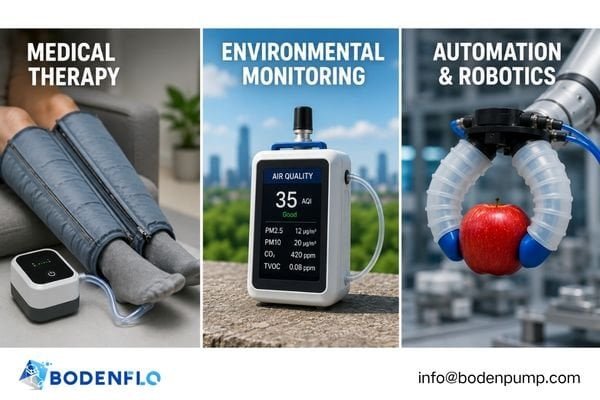
Instead of thinking in broad industries, I encourage my clients to think about the user scenario. What does the pump need to do?
- Medical Suction & Therapy: In this field, stability and reliability are paramount. A 3L/min vacuum pump is often the heart of a Negative Pressure Wound Therapy (NPWT) system, where it must maintain a consistent, gentle vacuum to promote healing. For rehabilitation devices like intermittent pneumatic compression (IPC) sleeves, a pressure pump is needed to inflate and deflate cuffs in controlled cycles. For any device used near a patient, low noise and minimal vibration are not just features—they are core requirements for user comfort and perceived product quality.
- Environmental Gas Sampling: To ensure accurate air quality data, monitoring instruments must pull a precise and constant volume of air through a sensor or filter. A 3L/min vacuum pump is ideal for this task in portable and fixed instruments that detect Particulate Matter (PM2.5) or Volatile Organic Compounds (VOCs). The key here is long-term, continuous operational stability. Any fluctuation in flow rate can skew the data, making the instrument unreliable.
- Soft Robotics & Automation: This is a fascinating area where pumps provide the "muscle." A 3L/min pressure pump can quickly inflate soft robotic grippers to gently handle delicate items like fruit or electronic components. Conversely, a vacuum pump can be used with suction cup end-effectors for pick-and-place tasks. In both cases, fast response time—the speed at which the pump can generate pressure or vacuum—is critical to the overall speed and throughput of the automated system.
| Application | Pump Type | Core Requirement for Your Project |
|---|---|---|
| Medical | Pressure / Vacuum | Stable, quiet, and highly reliable |
| Environmental | Vacuum | Continuous 24/7 operation |
| Automation | Pressure or Vacuum | Fast response time |
Why Is 3L/min Considered the “Safe Choice” in Most Projects?
As a project manager, your job is to manage risk. Why is choosing a 3L/min pump often the lowest-risk decision you can make at the start of a project?
It’s all about balancing trade-offs. Choosing a pump that’s too small introduces performance risk, while one that’s too large introduces cost and complexity risk. 3L/min sits in the middle.
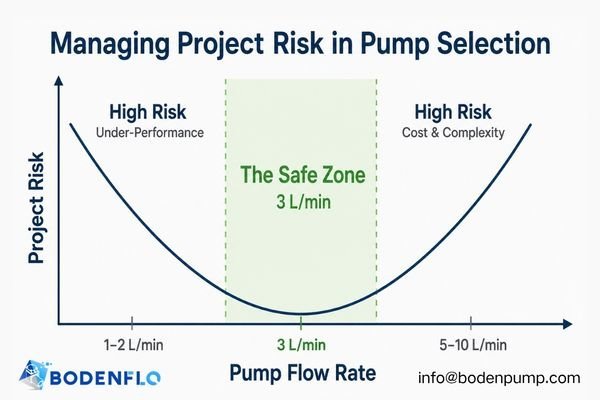
Here’s the decision logic I see play out in countless project kickoffs:
- Fear of Under-Performance: No one wants to select a 1-2 L/min pump only to find out it chokes under real-world system load. This would require a late-stage redesign, which is a project manager’s nightmare. So, a smaller pump is deemed too risky.
- Fear of Over-Spending: At the same time, specifying a 5-10 L/min pump from the start is also a bad idea. It’s more expensive, physically larger, requires a bigger power supply, and generates more noise. It adds unnecessary cost and complexity to the BOM.
So, where do you land? Right in the middle. 3L/min is not the best in theory, but the safest choice in real projects. It’s strong enough to handle most compact systems while being small and cost-effective enough to not blow your budget.
What Do Buyers Actually Compare When Selecting a 3L/min Pump?
Engineers look at performance curves, but what do project managers and purchasing departments really care about? When the pressure is on, the final decision often comes down to four practical questions.
Forget the complex datasheets for a moment. Most OEM buyers are trying to answer these simple but critical questions to de-risk their purchase.
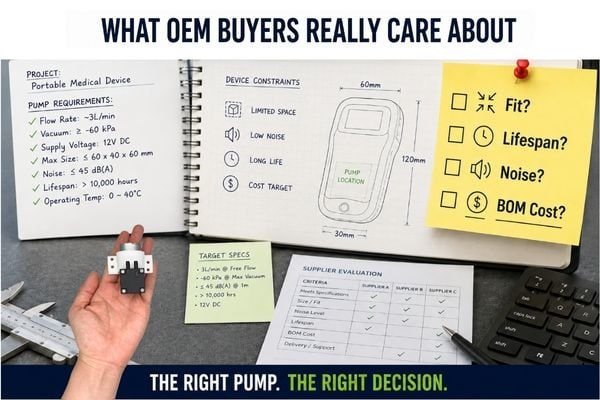
I spend my days on the phone with clients, and I can tell you that while the technical specs are important, these are the factors that truly drive their decisions:
- Will it fit? (Size): Can we actually integrate this pump into our compact product design without a major overhaul?
- Will it last? (Lifespan): Will this pump cause a flood of warranty claims and after-sales headaches a year from now?
- Will it annoy the user? (Noise/Stability): Will the pump be so loud or vibrate so much that it makes our expensive product feel cheap?
- Can we afford it? (Cost): Does this pump fit within our target BOM cost to maintain our product’s profit margin?
| Factor | What OEM Buyers Really Care About |
|---|---|
| Size | Does it fit into our compact device without a painful redesign? |
| Lifetime | Will this avoid costly after-sales service and warranty issues? |
| Noise | Will it provide a good user experience, or will it sound cheap? |
| Cost | Does it meet our project budget and target BOM cost? |
What Types of 3L/min Micro Diaphragm Pumps Exist in the Market?
The terminology can be confusing. To make a smart decision, you need to understand the different pump tiers available and what you’re really getting for your money.
In the industry, all these pumps are technically “micro diaphragm pumps.” But in real projects, we usually divide them into different categories based on their cost, mechanical structure, and performance. This helps clarify the trade-offs between price and reliability.

This framework helps you match the pump to your project’s budget and quality targets.
- 1. Low-Cost Rotary Diaphragm Pumps: This is the entry-level tier, built around a simple brushed motor. They are suitable for high-volume, cost-sensitive consumer devices where the pump is only used intermittently. They offer a very low initial cost but have a correspondingly short lifespan.
- 2. Mid-Range Eccentric Diaphragm Pumps: This is the mainstream OEM choice. Built with a more robust eccentric structure and options for both brushed and longer-life brushless motors, they offer the best balance of size, reliable performance, and cost. This is the sweet spot for the vast majority of commercial and industrial products.
- 3. High-End Eccentric Diaphragm Pumps1: These are for your mission-critical applications where failure is not an option. They use advanced coreless or high-performance brushless motors and superior construction to achieve very long lifespans, low noise, and stable continuous operation. They are often used to replace expensive European brands in medical and laboratory equipment.
| Pump Type | Motor Type | Cost | Lifespan (hours) | Best Use Case in a Project |
|---|---|---|---|---|
| Low-Cost Rotary Diaphragm Pump | Brushed | 1-4 USD | 200-500 | Cost-sensitive consumer devices |
| Mid-Range Eccentric Diaphragm Pump | Brushed/Brushless | 6-25 USD | 500-5,000 | The mainstream choice for most reliable OEM systems |
| High-End Eccentric Diaphragm Pump | Coreless/Brushless | >50 USD | 6,000-10,000+ | Continuous-duty systems where failure is not an option |
Which 3L/min Pumps Do Most OEM Customers Actually Choose?
Theory is great, but what are teams actually integrating into their products? I’ll share some common configurations that solve the most frequent project challenges.
Let’s look at the specific types of solutions that teams are actually buying and building with today. Your project will likely fall into one of these categories.
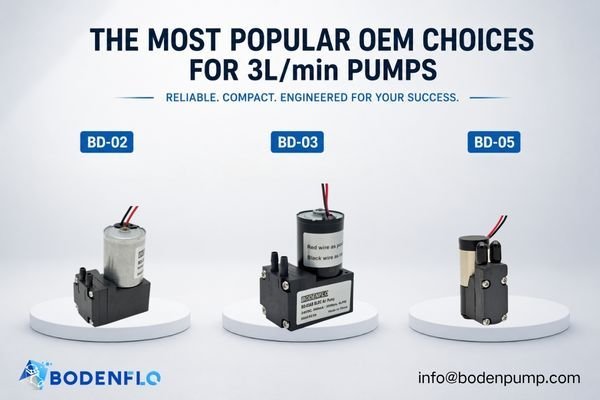
Below are examples of common 3L/min pump configurations available in the market, tailored for different project priorities.
| Model Series | Key Specs | Best For |
|---|---|---|
| BD-02AB/VB | Brushless/Brushed, 3-24V, 3L/min, +1.2 bar / -60 kPa, 53x24x40mm, 72g. | Best Cost-Performance & Compact Size |
| BD-03AB/VB | Brushless/Brushed, 6V-24V, 3L/min, +2.5 bar / -60 kPa, 64x30x49mm, 120g. | Higher Power & Force |
| BD-05T02.53000 | Coreless Motor, 5V, +70 kPa / -60 kPa, 43x29x16mm, 35g. | High-End Continuous Duty (Ultra-Compact) |
| BD-05T033B | Brushless Motor, 12V/24V, +90 kPa / -55 kPa, 35.5×24.5x41mm, 56g. | High-End Continuous Duty (High Power) |
How Do You Choose Between Pressure and Vacuum Versions?
Your pump arrived, and it has two nozzles. You know one is for pressure and one for vacuum, but which do you connect? A simple mistake here can make your prototype completely non-functional.
Most miniature diaphragm pumps are combination pumps with one inlet (vacuum) and one outlet (pressure). The choice isn’t about the pump, but about your application. You simply use the port that provides the function you need—pushing air out or pulling air in.
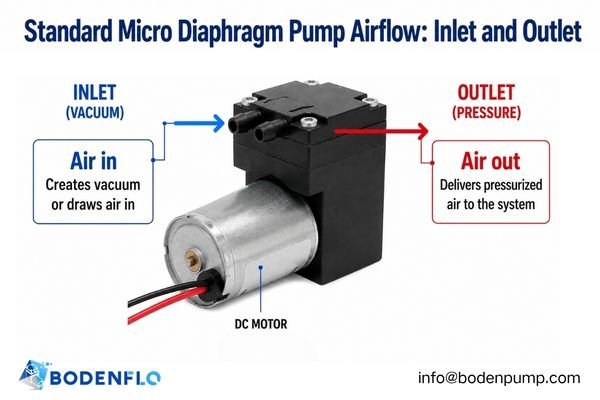
From my experience, this is a point of confusion for many teams new to miniature pumps. The fundamental operation of a diaphragm pump means it always does two things at once. The diaphragm moves, creating a low-pressure area to pull air into the inlet port. It then moves again, compressing that air and pushing it out the outlet port. Therefore, every standard pump is a pressure source and a vacuum source.
The real question is, how does your system use it? In most projects I see, the application only requires one of these functions.
-
Pressure Applications: If you are building a soft robotic gripper that uses air to actuate its flexible fingers, you connect your tubing to the outlet port. The inlet port is often left open to the atmosphere, sometimes with a simple filter to prevent dust from entering the pump. The vacuum created at the inlet is simply an unused byproduct of the pump’s operation.
-
Vacuum Applications: If you are building a gas sampling device or a small vacuum lifter, you connect your tubing to the inlet port. This draws air from your system. The exhaust air from the outlet port is typically vented away, often just into the equipment’s enclosure. Here, the pressure function is the unused byproduct.
There are also some advanced applications that use both functions simultaneously, like in a push-pull system for clearing a tube, but these are less common.
Now, sometimes a standard pump’s performance isn’t enough. In one project for a medical device, we needed to achieve a much higher pressure than the standard model could provide. In that case, we don’t just use a standard pump. We create a custom-optimized version. This might involve modifying the internal valves, the shape of the pump chamber, or the motor torque to boost performance for either pressure or vacuum, but not both.2 This is an engineering customization for a specific, demanding task. For most projects, however, a standard pump is the right starting point—you just need to connect your system to the correct port.
Can All 3L/min Pumps Run Continuously?
This is the most critical question I get from clients with demanding applications. A wrong assumption here will lead to guaranteed product failure.
Absolutely not. Continuous operation is a premium feature determined by motor quality and thermal design, not by the flow rate.
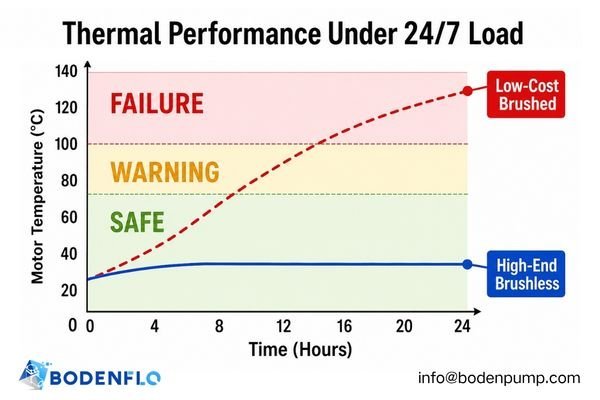
Here’s the simple rule:
- Low-Cost Pumps: Do not run them continuously. They will overheat and burn out.
- Mid-Tier Pumps: Check the specs. A brushless motor version is required for longer duty cycles.
- High-End Pumps: Yes. This is what they’re for. Models with advanced brushless or coreless motors are engineered for 24/7 operation.
The takeaway for your project: Continuous operation is not about flow rate, but pump quality.
Why Do Many Projects Start Cheap and Then Upgrade Later?
I see this all the time. A team chooses a low-cost pump to meet an aggressive BOM target. Six months after launch, the warranty claims start pouring in.
They fall into a classic cost trap. The initial savings from a cheap pump are wiped out by the much higher costs of field failures, customer support, and emergency redesigns.
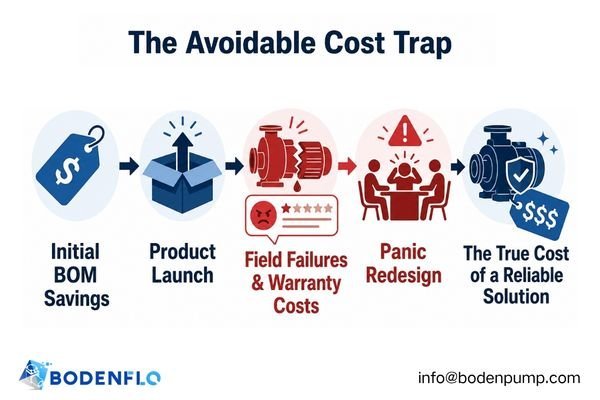
Here is the all-too-common story:
- The Launch: The product goes to market with a cheap pump to maximize initial profit margins.
- The Problem: After a few months, customers complain. The device is too noisy, it stopped working, it’s vibrating too much. The pump is failing.
- The Panic: The engineering team is tasked with urgently finding a drop-in replacement that actually works, while customer support deals with angry users.
- The Realization: They come back, now willing to pay for a reliable pump because the cost of failure was far higher than the initial savings.
This is one of the most common and avoidable cost traps in OEM development.
So, What Is the Best 3L/min Pump for Your Application?
Let’s bring it all together. A pump’s datasheet showing "3L/min" only tells you its open-flow potential. From my experience, one of the most common design mistakes is selecting a pump based on this number alone, without considering the system it will actually work in.
The best choice depends entirely on your system’s engineering requirements. To help you make a better decision, here is a decision matrix based on real-world application scenarios. Instead of focusing on products, let’s focus on the physics of the problem. This approach will help you avoid costly mistakes and select the right pump architecture from the start.
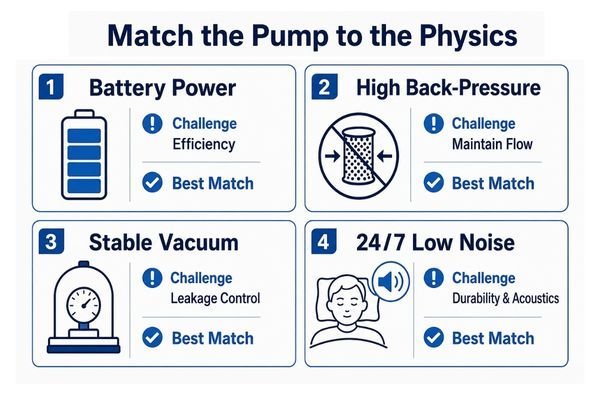
Your Final 3L/min Pump Decision Matrix
| If Your Application Involves… | The Key Engineering Challenge Is… | Then Your Best Choice Is a Pump with… | Because… |
|---|---|---|---|
| A Portable, Battery-Powered Device (e.g., portable gas detector) | maximizing runtime and minimizing size/weight. | a high-efficiency motor (like a coreless or quality brushless motor) and a low current draw. | it consumes less power for the same amount of work, directly extending battery life.3 The pump’s efficiency becomes one of the most critical system parameters. |
| Evacuating a Small, Sealed Canister (e.g., lab sample prep) | achieving and holding a stable vacuum level quickly. | a good sealing structure, responsive check valves, and a motor with stable torque. | the pump must overcome the initial air volume and then fight against its own internal leakage to maintain the target vacuum. A stable motor prevents pressure fluctuations. |
| Working Against High or Variable Resistance (e.g., inflating a cuff, pushing through a filter) | maintaining adequate flow even when system pressure (load) increases. | a high-pressure design, often with a stronger motor and more robust eccentric mechanism. | as back-pressure rises, the flow rate of all diaphragm pumps drops. A high-pressure model ensures you still get the performance you need when the system is under load, not just at open flow. |
| Precise Flow or Pressure Control (e.g., using a sensor and PID loop) | responsive and predictable performance. | a brushless motor with a reliable internal driver, often with a linear voltage-to-speed response. | brushless motors offer smooth speed control via PWM or analog voltage, allowing the control system to make fine adjustments to pump output and hit precise targets without overshoot.4 |
| Continuous 24/7 Operation with Low Noise (e.g., medical device, analytical instrument) | durability and minimal acoustic disturbance. | a high-endurance brushless motor, dynamically balanced mechanics, and a noise-dampening pump head design. | this combination minimizes wear on mechanical parts (bearings, eccentric) and reduces vibrations, which are the primary sources of noise and premature failure in continuous-duty applications.5 |
Conclusion
Selecting the best 3L/min pump means matching the right tier—cost-effective, mainstream, or high-end—to your project’s specific goals for performance, lifespan, and budget.
This guide provides the framework I use with my clients, but I know every project has its own unique challenges. Making the right choice early is the key to a smooth and successful product launch.
As an engineering partner, our team at BODENFLO is dedicated to helping you navigate these decisions. If you’re weighing these trade-offs for your device, let my experience work for you.
Feel free to send your project requirements to info@bodenpump.com, and we can help you select the ideal pump for your application.
-
"24V Brushless Diaphragm Pump Compact & Quiet For Medical BD …", https://bodenpumpstore.com/products/24v-brushless-diaphragm-pump-bd-05t033b-bodenflo?srsltid=AfmBOoqL4kBu2gn0ChyTLqavjApAWWDnvFDqAOeyh1CkVhX_mxtqUtMk. Technical reviews and industry publications indicate that high-end eccentric diaphragm pumps with coreless or brushless motors are preferred in medical and laboratory equipment for their extended lifespan, low noise, and reliable continuous operation. However, direct evidence of their use as replacements for specific European brands is limited to case studies and manufacturer reports. Evidence role: general_support; source type: research. Supports: High-End Eccentric Diaphragm Pumps use advanced coreless or high-performance brushless motors and superior construction to achieve very long lifespans, low noise, and stable continuous operation. They are often used to replace expensive European brands in medical and laboratory equipment.. Scope note: Direct replacement of European brands is supported mainly by case reports and may not be universally applicable. ↩
-
"Choosing the Right Diaphragm Pump Vacuum: Key Factors to …", https://bodenpump.com/choosing-diaphragm-pump-vacuum/. Engineering literature on diaphragm pump customization discusses how altering internal valves, chamber geometry, or motor torque can optimize performance for either pressure or vacuum, though such modifications often trade off one function for the other. Evidence role: mechanism; source type: education. Supports: modifying the internal valves, the shape of the pump chamber, or the motor torque to boost performance for either pressure or vacuum, but not both.. Scope note: Customization details depend on pump design and application; not all modifications yield the same results. ↩
-
"Powering Portable Devices – Balancing Battery Life & Performance", https://4dproducts.co.uk/insights/powering-portable-devices-the-balancing-act-of-battery-life-and-performance. Engineering references confirm that higher motor efficiency leads to lower power consumption for a given workload, which extends battery life in portable devices. Evidence role: mechanism; source type: education. Supports: it consumes less power for the same amount of work, directly extending battery life. The pump’s efficiency becomes one of the most critical system parameters.. Scope note: The actual impact depends on the overall system design and duty cycle. ↩
-
"BLDC Speed Control Using Pulse Width Modulation (PWM) – YouTube", https://www.youtube.com/watch?v=b5J5qkR7msc. Motor control engineering sources describe that brushless DC motors can be precisely controlled using PWM or analog voltage, enabling fine adjustments in speed and output. Evidence role: mechanism; source type: education. Supports: brushless motors offer smooth speed control via PWM or analog voltage, allowing the control system to make fine adjustments to pump output and hit precise targets without overshoot.. Scope note: Actual performance depends on the quality of the driver and feedback system. ↩
-
"Mini Diaphragm Pump Noise Troubleshooting", https://bodenpump.com/mini-diaphragm-pump-noise-troubleshooting/. Reliability engineering literature identifies mechanical wear and vibration as leading causes of noise and premature failure in pumps used for continuous operation. Evidence role: mechanism; source type: education. Supports: this combination minimizes wear on mechanical parts (bearings, eccentric) and reduces vibrations, which are the primary sources of noise and premature failure in continuous-duty applications.. Scope note: The relative importance of these factors may depend on specific pump designs and operating conditions. ↩