
You tested a micro air pump for your new project and got a wildly different flow rate than its specification. This is a frustrating spot to be in, making you question the pump’s quality and your project’s timeline.
Micro air pump flow results vary in testing mainly due to differences in flow meter type, system back pressure, and test setup. These factors change resistance and operating conditions, leading to inconsistent readings even with the same pump.
I’ve seen dozens of OEM projects hit a frustrating wall right here: a team selects a pump based on its datasheet, but once integrated into the final product, the performance seems to fall off a cliff. Their first thought is often, "We got a bad batch of pumps." But that’s rarely the case. The real issue is a classic lab-vs-reality measurement gap, a problem that can cause serious delays. Let’s break down how to avoid it.
Why Do Identical Micro Diaphragm Air Pump Models Show Different Flow Results?
You have one pump model, but you’re getting a bunch of different flow measurements. You start to wonder if the pump itself is unstable. What’s really going on?
Let’s get one thing straight: the issue is almost never the pump’s stability. It’s the measurement. A flow meter isn’t a passive window; it actively becomes part of the system it measures. This effect gets amplified with low-flow pumps, and it’s a common hurdle for many project teams.
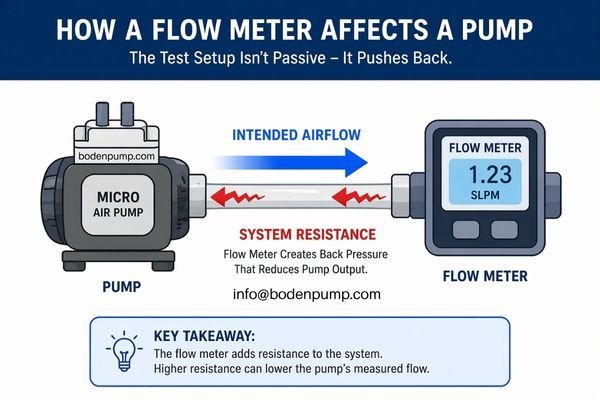
In many of my BODENFLO projects, especially for high-end applications like medical diagnostics or environmental monitoring, precision is non-negotiable. Clients are rightly concerned about getting an exact flow rate. The confusion starts when their test results don’t match ours, or even vary between their own tests using different meters. It’s not a faulty pump. It’s because every test setup—from the flow meter to the tubing—adds its own unique resistance, which changes the flow. For a tiny diaphragm pump, these "small" details are everything.
How Can Flow Meter Type Affect Measurement Results?
Your team used a flow meter and got a number. It should be accurate, right? Well, not so fast. The type of meter you use is probably the single biggest reason for seeing different results.
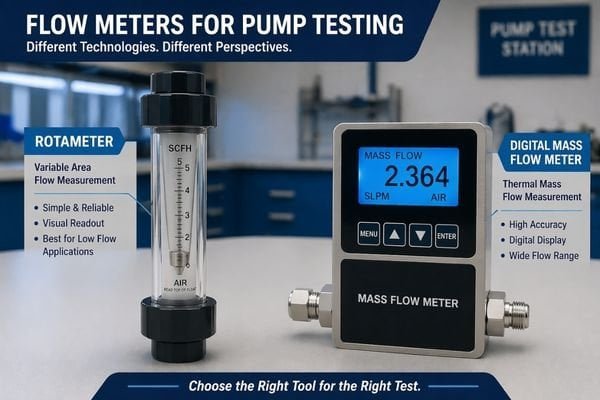
Different flow meters work on completely different principles and are designed for different jobs. A simple rotameter is not the same as a lab-grade mass flow meter. They won’t give you the same number.
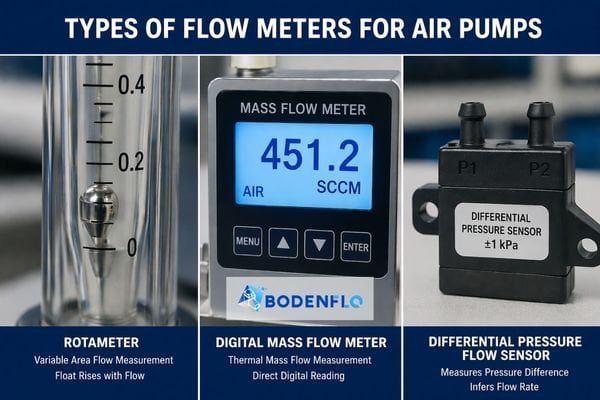
Understanding the right tool for the job is the first step. Here is a breakdown I often share with clients:
| Meter Type | Operating Principle | Typical Brands | Key Characteristics & Use Cases |
|---|---|---|---|
| Rotameter1 | A float rises in a tapered tube, showing volumetric flow. | Dwyer, Omega, Cole-Parmer | Use: Quick visual check. Characteristics: Cheap and simple, but adds resistance. Its accuracy depends heavily on system pressure and temperature. |
| Mass Flow Meter2 | A sensor measures heat transfer to calculate the gas’s mass, giving a standard flow rate (SCCM). | Alicat, TSI, Brooks, Sensirion | Use: Lab R&D, calibration. Characteristics: Very accurate, low resistance, fast response, but expensive. This is the engineering gold standard. |
| Differential Pressure | Measures the pressure drop across a built-in restriction to calculate flow. | Dwyer, Setra, Custom | Use: Integrated into systems (like ventilators) for control. Characteristics: Reading is only valid for the specific device it was designed for. |
Because these meters work so differently, you can’t expect them to give the same reading. A mass flow meter is the benchmark for engineering, while a built-in sensor is only calibrated for its own unique system.
How Does Back Pressure Affect a Miniature Diaphragm Pump’s Flow?
You tested the pump’s "free flow" and it was perfect. But when you hooked it up to your device, the performance tanked. What happened?
This is all about the fundamental relationship between pressure and flow: when one goes up, the other goes down. The flow rate you measure depends completely on the load (back pressure) the pump is fighting against in that moment.
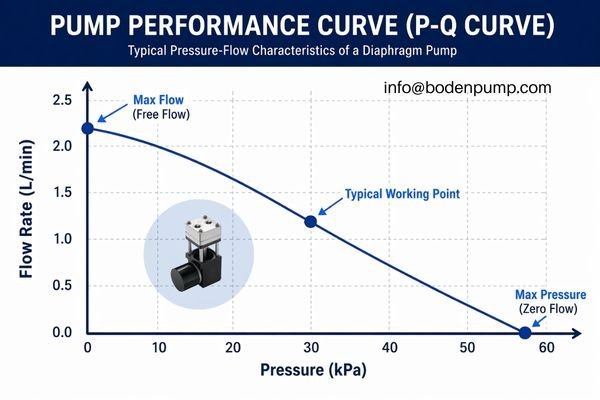
Every pump’s performance is defined by its P-Q (Pressure-Flow) curve. I always explain this curve as the pump’s unique fingerprint. It shows that a pump delivers its maximum flow only when there is zero back pressure—we call this "free flow3." As soon as you add a load—like tubing, valves, or pushing air into a tight space—the flow rate drops. If you keep adding pressure, you’ll eventually hit the pump’s max pressure point, where the flow stops completely.
The key takeaway for any project is this: Flow rate only exists under a specific load condition. Testing in open air tells you a pump’s potential; testing in your system tells you its actual performance.
How Do Test Setups Impact Micro Diaphragm Gas Pump Measurements?
What if your team and your supplier are both using the same model of mass flow meter, but your results still don’t match? This is a common situation.
The answer is that every single component between the pump outlet and the meter inlet adds resistance that impacts the final number. Your test bench is its own little system.
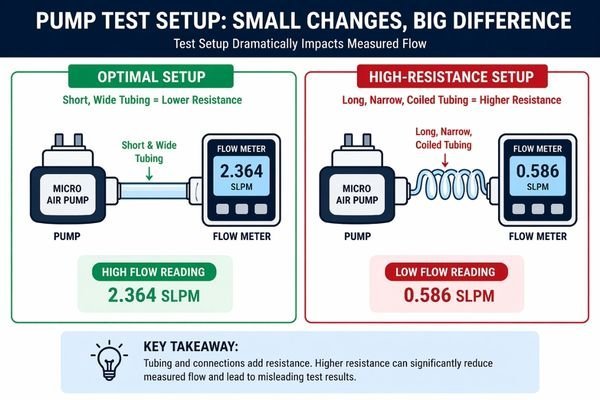
To get matching results, both test setups have to be nearly identical.
Tubing Length and Diameter
Longer tubing creates more friction. Narrower tubing creates significantly more resistance. A 2-meter-long tube will give you a lower flow reading than a 30-cm tube, period.
Connectors and Valves
Every connector, T-junction, or filter you add creates turbulence and back pressure. A direct connection from pump to meter will always show a higher flow than a setup with three extra fittings in between.
Air Path Design
Sharp 90-degree bends in your air path act like roadblocks for air, creating much more resistance than a smooth, gentle curve would.
So, comparing flow data is only useful when every one of these variables is the same.
Case Study: Why a 450 ml/min Pump Was Measured at 1.4 L/min
Let’s return to the medical ventilator project I mentioned. How did we solve this confusing data mismatch?
The root cause, as we discovered, was the measurement method. The 1.4 L/min reading came from the ventilator’s own internal flow sensor, which was calibrated to measure flow inside the ventilator’s complex pneumatic circuit.
My first step was to work with their team to align our testing conditions. I suggested a simple bench test. We had them disconnect the pump from the ventilator and connect it directly to a mass flow meter—the same kind we use for quality control—using about 30-40 cm of tubing. The result? The flow measured almost exactly 450 ml/min, closely matching our data.
The pump wasn’t wrong, and the ventilator wasn’t broken. Once we established a common testing ground, the data aligned, the team had confidence in the component, and they could move forward with development.
What Are the Most Common Mistakes in Micro Pump Flow Testing?
In my 9+ years of supporting clients, a few common hurdles appear in many projects when it comes to pump testing.
Focusing on the wrong metric or using inconsistent methods can lead to flawed design decisions. But these are easy to avoid once you know what to look for.
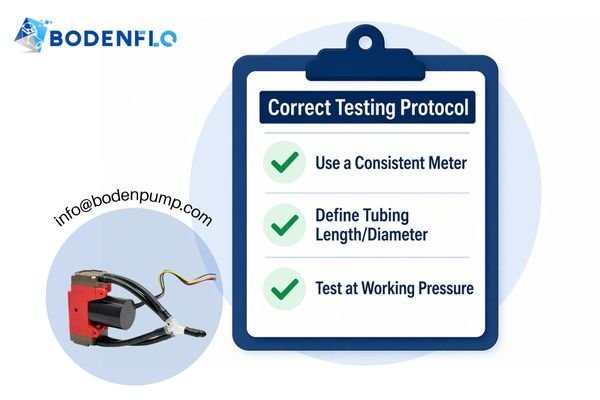
Here are the most common challenges I help project teams overcome:
| Common Mistake | The Correct Approach |
|---|---|
| Focusing only on "Maximum Flow." | Test and specify the flow rate4 at your product’s actual working pressure. |
| Using different flow meters for comparison. | Use the exact same model of flow meter (preferably a mass flow meter5) for all benchmark tests. |
| Ignoring your own system’s resistance. | Acknowledge that your tubing, connectors, and filters are part of the test and will reduce flow. |
| Not having a standard test procedure. | Document and use a consistent test setup (tubing length, diameter, etc.) for every test. |
Comparing flow data without identical test conditions leads to misleading conclusions.
How to Measure Micro Air Pump Flow Correctly?
Now that we understand the problems, what is the right way to get flow data you can actually trust?
The solution is all about consistency and context. My advice is always to adopt a standard method, test the pump in a way that truly mimics your application, and align your setup with your pump supplier.
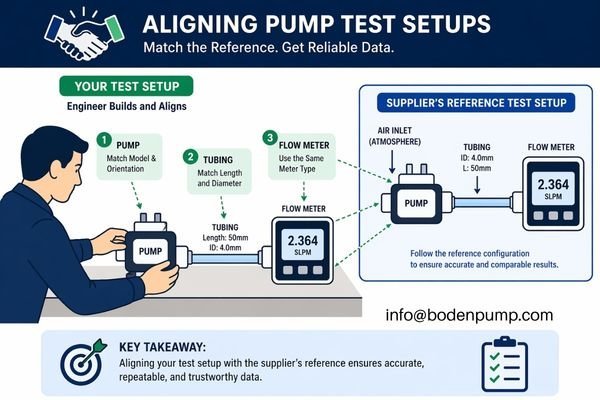
- Use a Consistent Measurement Standard: I recommend clients choose one high-quality meter (like a mass flow meter) as their "golden sample" for all benchmark tests. This creates a reliable internal standard.
- Test Under Real Operating Conditions: The best test is in your actual device. Measure the outcome you really care about, like "how long does it take to inflate this cuff?" This real-world data is far more valuable.
- Match the Supplier’s Measurement Setup: To verify a pump against our datasheet, just ask for our test diagram. Replicating it closely is the fastest way to align the data.
At BODENFLO, we recommend using professional mass flow sensors for calibration—results from these are typically consistent with our engineering test data.
What Should OEM Engineers Focus on Instead of Max Flow?
If "max flow" can be a misleading metric, what should your engineering team focus on to ensure you select the right pump?
I always guide clients to focus on the pump’s performance and reliability in their system. This means looking at the stable flow at your working load, its lifetime consistency, and unit-to-unit repeatability.
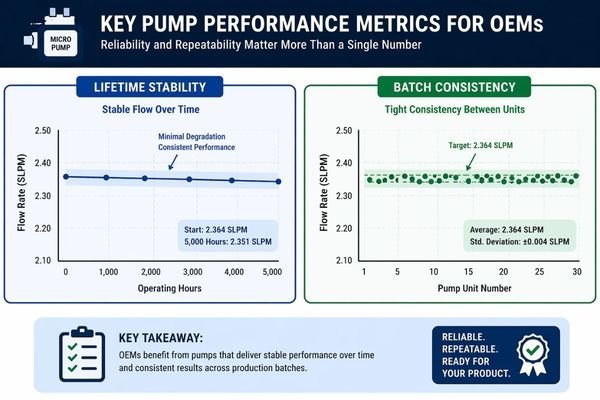
To accelerate product development and ensure long-term reliability, these are the questions your team should be asking:
| Performance Metric | The Engineering Question to Ask |
|---|---|
| Working Point Performance | What is the stable flow rate at my system’s actual working pressure? |
| Lifetime Reliability6 | How does the flow rate hold up over thousands of hours of continuous operation? |
| Unit-to-Unit Consistency | When we go to mass production, will pump #1 perform identically to pump #10,000? |
| System Efficiency | What is the pump’s real power consumption and heat output under our specific load? |
The real question is not ‘What is the maximum flow?’ but ‘What flow can the pump deliver reliably and consistently in your system?’
FAQ: Micro Air Pump Flow Measurement
Why is my measured pump flow higher than the rated spec?
You are likely measuring at a much lower back pressure (closer to free flow) than the specified working point on the datasheet.
Which flow meter is most accurate?
For engineering and R&D, a high-quality mass flow meter is the most accurate and repeatable tool for creating a reliable benchmark.
How do I compare pumps from different brands?
The only reliable way is to test them in the exact same test setup—ideally one that simulates your application’s load—and measure their performance at that specific working point.
What is the difference between "free flow" and "working flow"?
Free flow is the maximum flow rate at zero back pressure. Working flow is the flow rate at your application’s specific, real-world back pressure, which is always a lower value.
Conclusion
Inconsistent flow results stem from the test method, not the pump. For reliable data, standardize your measurement setup and test the pump under your actual system’s real-world load conditions.
Need Help Matching Your Pump with the Right Test Conditions?
Are you struggling to make sense of your test data and select the right pump? Don’t let measurement issues slow down your project. Let me help you align your testing with real-world performance.
Provide me and my team with your system diagram, target flow rate, and working pressure. We can help you match your test method with real system performance and ensure you have the right pump to accelerate your product development. Contact us at info@bodenpump.com to start the conversation.
-
Learn about Rotameters, their simplicity, and use cases, making them a popular choice for quick flow checks. ↩
-
Explore this link to understand the precision and applications of Mass Flow Meters, the gold standard in engineering. ↩
-
Exploring the concept of free flow helps clarify how pumps operate under different load conditions. ↩
-
Understanding flow rate at working pressure is crucial for accurate performance assessments in project teams. ↩
-
A mass flow meter ensures consistency and accuracy in measurements, leading to reliable test results. ↩
-
Understanding lifetime reliability is crucial for ensuring your pump’s long-term performance and reducing maintenance costs. ↩