
Your compressor performs perfectly on the bench but fails inside its enclosed device? Trapped heat is silently cooking your components, degrading performance and leading to premature system failure.
Ignoring temperature causes the micro compressor to overheat. This increases electrical resistance, dropping pump efficiency and lowering both flow and pressure. Materials age faster, leading to a drastically shorter lifespan and unexpected, catastrophic failures of your device in the field.
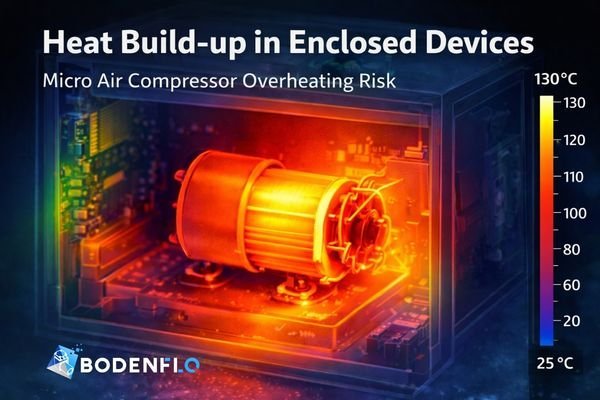
Let me guess: your portable device aces every lab test, but when it’s used continuously in the real world for 30 minutes, the pressure suddenly drops, or the unit shuts down. The problem isn’t a faulty compressor; it’s a thermal design flaw. A lab bench offers infinite free air for cooling. The inside of a compact plastic case does not. In enclosed systems, heat is amplified, not dissipated. Let’s dive into why this happens and what it means for your design.
Why Is Temperature a Critical Issue for Micro Air Compressors in Enclosed Devices?
You tested the compressor’s performance in an open-air lab and it met all specs. Now, inside the finished product, it’s failing. What did you miss?
The sealed environment of your device creates a thermal trap. High-pressure compressors generate significant heat, and with no airflow, that heat builds up, drastically changing the operating conditions and leading to performance degradation and failure.
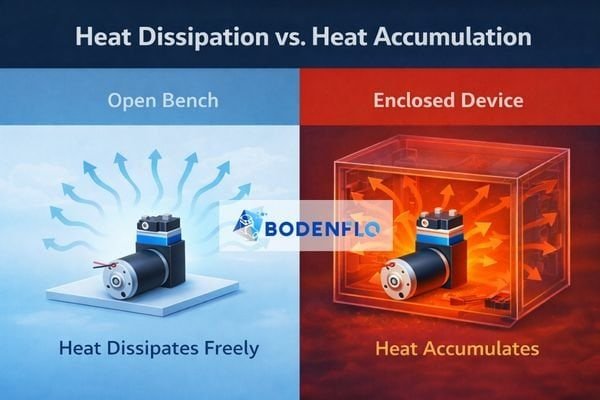
When I start a design consultation, I immediately ask about the operational environment inside the device. The difference between a lab bench and a finished product’s enclosure is night and day.
Let’s break down the core issues:
- Heat Accumulation: In a sealed, compact enclosure, there’s nowhere for the heat to go. The internal ambient temperature rises with every minute the compressor runs, creating a vicious cycle.
- Restricted Airflow: Unlike an open bench, the air inside a box is stagnant. There is no passive convection to carry heat away from the pump’s motor and head.
- High-Pressure Workload: Generating high pressure (e.g., 2-3 bar) is energy-intensive. This requires higher current draw for the motor, and per the laws of physics (Joule heating), higher current directly results in more heat generation.
The key takeaway I always emphasize to engineers is this: The problem isn’t just that the pump generates heat; the problem is that the system is designed in a way that it cannot get rid of that heat. Understanding this shifts the focus from blaming the component to solving the system integration challenge.
What Happens Inside a High-Pressure Micro Air Compressor as Temperature Rises?
You know the device is getting hot, but how exactly does that heat sabotage your compressor’s performance and lifespan? It’s not one single fault, but a cascade of failures.
As temperature rises, the compressor experiences a chain reaction of negative effects: the motor’s efficiency drops, mechanical friction increases, and critical materials like diaphragms and seals begin to degrade and fail exponentially faster than rated.
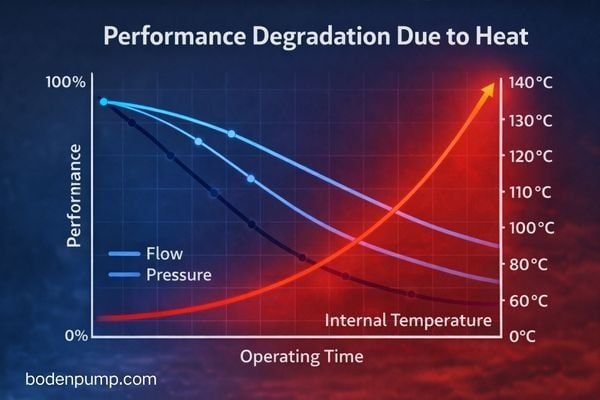
When a client sends me a pump that "failed" in the field, the signs of thermal damage are usually obvious. But the damage starts long before total failure. Here is a step-by-step breakdown of what’s happening inside that overheating pump, presented in a more structured way:
| Component Affected | Effect of Rising Temperature | Resulting Performance Impact |
|---|---|---|
| Motor Windings1 | Electrical resistance increases. | Efficiency drops; draws more current for less torque. |
| Bearings/Piston | Lubricants thin; parts expand. | Increased friction, higher noise, and accelerated wear. |
| Diaphragm/Seals2 | Material elasticity decreases (e.g., EPDM/PTFE). | Becomes brittle, leading to cracks, leaks, and failure. |
| Overall System | Slower motor speed & leaks. | Reduced flow rate and unstable pressure. |
It’s a vicious cycle: heat reduces motor efficiency, which reduces flow and pressure, while simultaneously destroying the very materials the pump relies on to function.
How Does Heat Build Up in Enclosed Equipment?
You’ve picked a great pump, but your system is still overheating. The pump isn’t the only culprit; it’s often a victim of its surroundings.
Heat build-up is a system-level problem. The compressor generates heat, but so do the power supply, the PCB, and the motor driver. In a compact design with no ventilation, all these heat sources compound, raising the internal ambient temperature for every component.
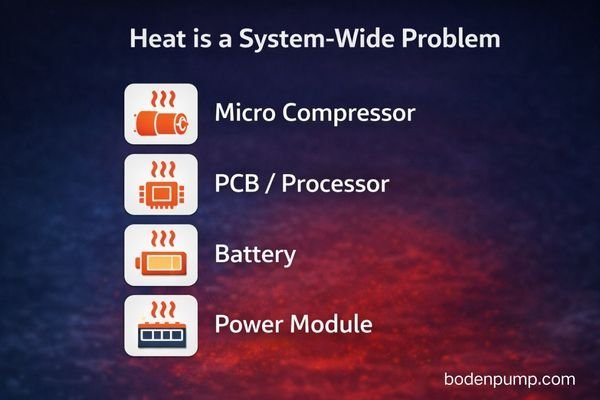
I always tell clients to stop thinking of the pump in isolation. You have to conduct a "thermal audit3" of your entire system. The heat inside your enclosure doesn’t just come from the compressor.
Identifying the Heat Contributors
Imagine your small, portable device. Where is the energy going?
- The Compressor: A primary heat source, especially under high pressure.
- The Power Module: Power conversion is never 100% efficient; waste is heat.
- The Main PCB: CPUs and other chips all generate heat.
- The Motor Driver: The chip controlling the pump also produces significant heat.
Compounding Factors
- Compact Design: No empty volume for air to circulate.
- No Active Cooling: No fans to save cost, space, and power.
- Continuous Duty Cycle4: Relentless heat generation with no cool-down period.
The critical realization here is that the pump isn’t heating itself up in a 25°C environment. It’s heating itself up inside a 50°C, 60°C, or even 70°C environment that the system itself created.
Real Application Cases: Where Temperature Problems Commonly Occur?
Wondering if your project is at high risk for thermal issues? Certain applications are particularly vulnerable due to their design constraints.
From medical devices to portable analyzers, thermal challenges appear wherever high performance is demanded in a compact, sealed space. Recognizing these patterns early can save your project from costly redesigns and field failures down the road.

Over my career, I’ve seen these issues repeatedly in specific industries. Here’s a summary of the most common scenarios:
| Application | Common Thermal Challenge5 | Typical Failure Mode |
|---|---|---|
| Medical Therapy | Sealed housing, long run times. | Pressure drops, inconsistent therapy. |
| Portable Analyzers | Battery-powered, no fan design. | Reduced sample flow, inaccurate readings. |
| Beauty Devices | High pressure, small handheld size. | Casing becomes hot, motor burnout. |
| Industrial Automation | Compact cabinet, continuous duty. | Premature pump failure, production downtime. |
If your application fits one of these profiles, thermal management should be a top priority from the very first day of your design process.
How to Design for Thermal Stability in Enclosed Compressor Systems?
You understand the risks, so how do you proactively design a system that stays cool and reliable? It requires a multi-layered strategy.
The solution isn’t just one thing; it’s a combination of choosing an efficient compressor, controlling its operation, designing smart airflow paths, and building in safety margins. This holistic approach turns thermal management from a problem into a solved design parameter.
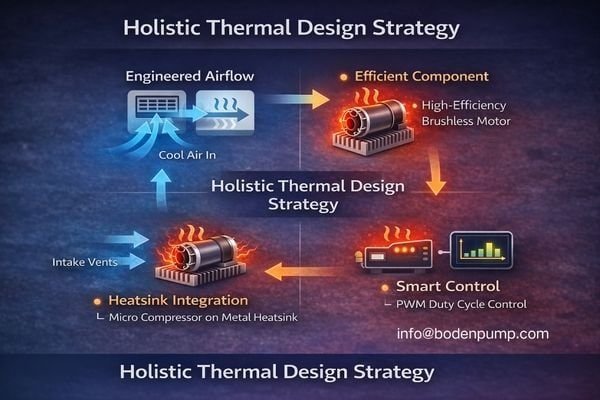
Here is the five-point plan I walk my OEM clients through to build thermally stable systems:
- Start with an Efficient Compressor6: This is your best defense. A pump with a high-torque brushless motor will generate less waste heat for the same amount of work.
- Control the Duty Cycle: Use Pulse-Width Modulation (PWM)7 to run the pump intermittently or at a lower average speed to reduce heat.
- Design a Path for Heat to Escape: Use a metal chassis as a heatsink, add vents, or ensure the pump body has physical contact with a component that can dissipate heat.
- Implement Monitoring and Protection: Include a temperature sensor (NTC) to allow software to slow down or shut off the pump before damage occurs.
- Design with Performance Margin: Select a compressor that is 15-20% more capable than you need. This allows you to run it slower and cooler.
How to Select a Micro Air Compressor for High-Temperature Environments?
You’re ready to choose a component, but how do you identify a compressor that won’t let you down when things get hot?
Look beyond the basic flow and pressure specs. A suitable compressor will have clear data on its thermal performance, use high-temperature tolerant materials, and be backed by a supplier who provides detailed test reports.
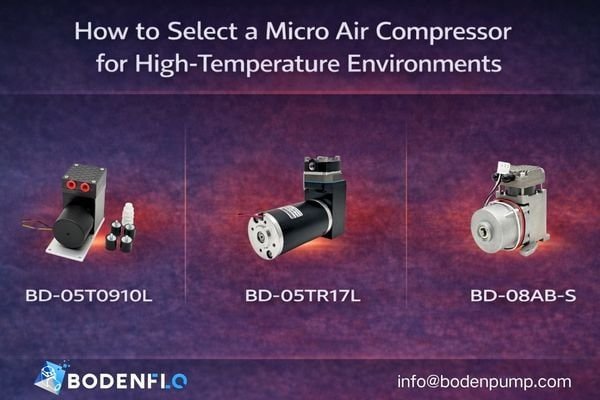
To put this into practice, here are a few examples from our BODENFLO lineup, engineered for thermal stability:
1. The High-Efficiency, Compact Choice: BD-05T0910L
This is ideal for portable devices where space and power are critical. The brushless motor8 is significantly more efficient than brushed counterparts, directly translating to less heat generation. A PPS head and customizable PTFE diaphragm ensure material stability at elevated temperatures.
- Max Pressure: 3 Bar
- Max Flow: 10 L/min
- Motor: Brushless
- Head: PPS
- Diaphragm: EPDM (PTFE option)
2. The High-Pressure Specialist: BD-05TR17L
When you need extreme pressure (up to 10 Bar), thermal management is non-negotiable. This model uses a full aluminum alloy head and body, which act as a natural heatsink to dissipate heat away from the motor and piston, ensuring stable performance under heavy, continuous load.
- Max Pressure: 8-10 Bar
- Max Flow: 17 L/min
- Motor: Brush
- Body/Head: Aluminum Alloy
- Piston Cup: PTFE
3. The High-Flow, High-Endurance Solution: BD-08AB-S
For demanding industrial automation or medical applications requiring high flow (45 L/min) and high pressure (6 Bar), this brushless model is built for endurance. Its aluminum alloy construction and high-temperature silicone valve are designed specifically to handle the heat from continuous, high-power operation.
- Max Pressure: 6 Bar
- Flow: 45 L/min
- Body/Head: Aluminum Alloy
- Piston Cup: PTFE
- Motor: Brushless
Conclusion
Temperature is a system problem, not just a pump problem. For any device with a high-pressure compressor in a sealed enclosure, thermal management must be a primary design consideration from the very beginning to prevent costly and frustrating failures late in the project.
Looking for a high-pressure micro air compressor that performs reliably inside enclosed devices? BODENFLO provides optimized solutions with thermal stability, high efficiency, and OEM customization support.
**📩 Contact us at info@bodenpump.com to review your thermal management strategy with our application engineers
-
Understanding the impact of heat on motor windings can help in preventing pump failures and improving efficiency. ↩
-
Exploring this topic can provide insights into material selection and maintenance strategies to enhance pump longevity. ↩
-
Understanding thermal audits can help optimize your system’s performance and reduce energy waste. ↩
-
Understanding duty cycle is crucial for optimizing thermal management and enhancing device performance. ↩
-
Understanding common thermal challenges can help you design better solutions and avoid costly failures. ↩
-
Explore this link to understand how an Efficient Compressor can significantly reduce waste heat and enhance system performance. ↩
-
Learn about PWM’s role in managing heat and improving efficiency in thermal systems by visiting this resource. ↩
-
Explore the benefits of brushless motors, including efficiency and heat management, to understand why they are preferred in many applications. ↩