
Thinking that a $5 micro air pump saves you money is a critical mistake. It’s a focus on the purchase price that can lead to catastrophic field failures and costs that are 10x higher.
The real cost of a micro air pump is not its purchase price, but its total cost of ownership (TCO). TCO includes lifespan, maintenance, energy use, and the cost of failure—making a low-cost pump potentially the most expensive choice in OEM applications.
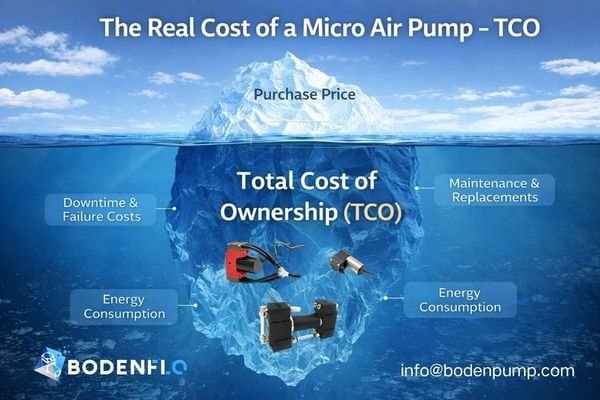
Focusing solely on the Bill of Materials (BOM) price is one of the biggest traps in OEM design. A pump is not a passive component; it is a dynamic system with a defined lifespan and failure rate. Understanding this difference is the key to building a reliable and profitable product. Let’s break down the true cost.
Why Is Unit Price a Misleading Metric in Micro Air Pump Selection?
Chasing the lowest unit price feels like a win for your BOM. But this mindset often leads to product recalls, as the pump is frequently the first point of failure in the field.
The pump’s unit price is misleading because it ignores system-level risk. A cheap pump can cause expensive failures, turning a small component cost into a major business liability. In many OEM designs, the pump is one of the lowest-cost components—but one of the highest sources of failure risk.
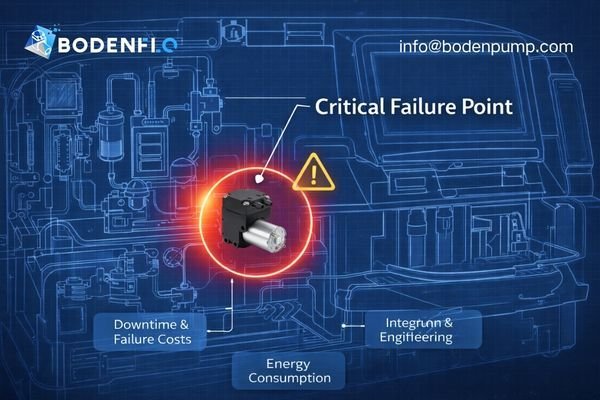
Engineers are often pressured to reduce the BOM cost1. This "BOM thinking" looks at the pump as a simple line item, like a resistor or a capacitor. But this is wrong. A pump is a mechanical system with moving parts, elastomers that age, and a motor that wears out. "System thinking2," on the other hand, evaluates the pump’s impact on the entire product lifecycle. A pump failure can take down a $10,000 medical device, require a $500 field service call, and destroy customer trust. This is why a $5 savings on the pump can end up costing you $5,000 down the line.
What Is the Typical Price Range of Micro Air Pumps Across Applications?
You see pumps listed for $2 and others for $400. This huge variation confuses many engineers and procurement managers, making it hard to budget or evaluate suppliers fairly.
The price of a micro air pump can range from under $2 for simple consumer applications to over $400 for high-end, continuous-duty industrial or medical systems. The price directly reflects the pump’s design, materials, motor type, and reliability specifications.
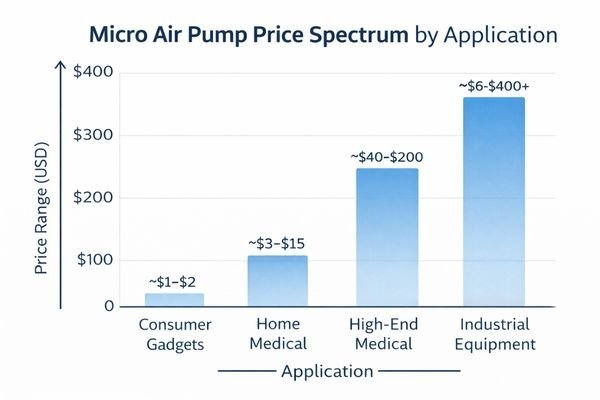
Micro Air Pump Price Ranges by Application
This table, based on our project experience, provides a general overview of typical single-unit pricing for OEM orders.
| Application Category | Typical Unit Price (USD) | Common Use Cases |
|---|---|---|
| Low-cost Handheld Commercial | $1 – $2 | Simple consumer gadgets, promotional items |
| Power Tools | $5 – $10 | Dust blowing, small pneumatic functions |
| Low-end Home Medical | $3 – $15 | Basic blood pressure monitors, nebulizers |
| Mid/High-end Commercial Medical | $40 – $200 | Diagnostic analyzers, therapy devices |
| Low-end Home Beauty | $5 – $15 | Facial misters, basic skin care devices |
| Mid/High-end Home Beauty | $40 – $100 | Advanced skincare systems, airbrush makeup |
| Low-end Industrial Equipment | $6 – $30 | Intermittent sampling, light-duty automation |
| Mid/High-end Industrial Equipment | $50 – $400+ | Continuous gas analysis (CEMS), robotics |
Why Do Prices Range from $1 to $400?
The price is a direct result of engineering and manufacturing choices:
- Materials: A cheap pump might use a standard EPDM diaphragm. A high-end pump will use specially formulated EPDM, FKM, or even PTFE for chemical resistance and longer life.
- Motor: A low-cost brushed motor is designed for hundreds of hours. A high-end brushless motor is engineered for tens of thousands of hours, with a complex electronic controller.
- Performance: Achieving high flow/pressure in a small size requires precision manufacturing, stronger motors, and better thermal management, all of which add cost.
- Production & Testing: A cheap pump may have minimal quality checks. A reliable pump undergoes 100% performance testing, batch traceability, and sometimes even multi-day burn-in testing.
What These Price Differences Really Mean
This is the most important part. The price gap isn’t just about cost; it’s about a different design goal. A $5 pump is designed to work for a short time at the lowest possible cost. A $150 pump is designed to work flawlessly for years under continuous load. The price difference reflects how much performance stability and risk reduction is built into the pump.
How Does Pump Lifespan Affect Total Cost of Ownership?
It’s easy to overlook a "lifespan" spec on a datasheet. But this single number can have a greater impact on your total cost than the unit price itself.
A pump’s lifespan directly determines its replacement frequency and associated service costs. A short-life pump may need to be replaced 10 or 20 times during the product’s operational life, dramatically increasing its TCO far beyond that of a long-life pump.
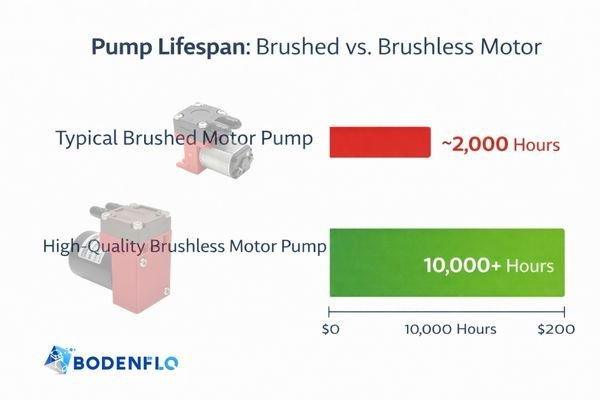
Typical Lifespan of Different Micro Pump Types
The lifespan is fundamentally tied to the pump’s core technology and build quality.
| Pump Technology & Quality Level | Typical Lifespan (Hours) |
|---|---|
| Low-end Circular Diaphragm Pump | 300 – 500 |
| High-end Circular Diaphragm Pump | 1,000 – 2,000 |
| Low-end Eccentric Diaphragm Pump | 500 – 3,000 |
| High-end Eccentric Diaphragm Pump3 | 5,000 – 20,000 |
| Low-end Piston Pump | 1,000 – 4,000 |
| High-end Piston Pump | 5,000 – 10,000 |
Why Lifespan Differences Change Everything
Consider a medical device intended to run for 5 years, operating 8 hours a day (~14,600 hours total).
- A pump with a 2,000-hour lifespan will need 7 replacements.
- A pump with a 10,000-hour lifespan will need 1 replacement.
If each replacement costs $200 in technician time and logistics, the "cheaper" short-life pump adds over $1,200 in hidden service costs. A 5× lifespan difference can easily result in a 10× difference in total cost.
Lifespan vs. Application Matching4
Of course, not every application needs a 20,000-hour pump.
- Single-use or disposable devices: A 500-hour pump is more than enough and the most cost-effective choice.
- Continuous-run equipment (e.g., gas analyzers): Here, lifespan is paramount. In continuous systems, even 2,000 hours may be considered short. The goal is to match the pump’s lifespan to the device’s service interval or expected operational life.
What Factors Define the Total Cost of Ownership (TCO)?
You’re convinced that price isn’t the whole story. So, what should you be calculating? Here are the key components of a pump’s true TCO.
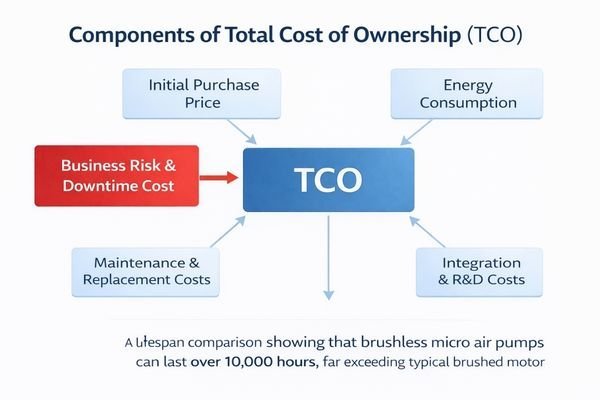
TCO is a comprehensive financial metric that includes every cost associated with the pump over its entire lifecycle. TCO is the accumulation of all performance-related risks over time.
Initial Cost
This is the simplest factor: the purchase price per unit. It’s the most visible cost but often the least significant in the TCO calculation for long-life equipment.
Lifespan & Durability
As we just discussed, this determines the replacement frequency. A pump that lasts twice as long can cut the TCO significantly, even if it costs 50% more upfront.
Energy Consumption
For battery-powered devices or systems where energy costs are a concern, a more efficient pump can lead to significant savings. Brushless motors are typically more efficient than brushed motors, offering longer battery life or lower power bills.
Maintenance & Replacement
This includes the cost of the replacement pump itself, the labor cost of the technician performing the replacement, shipping, and logistical overhead. For many OEMs, this is the largest hidden cost.
Downtime Cost
This is the most critical and often overlooked factor. What is the cost to your customer if your device stops working? For a medical device, it could be a health risk. For an industrial analyzer, it could mean shutting down a production line, resulting in thousands of dollars of lost revenue per hour.
Integration & Engineering Cost
A poorly documented or inconsistent pump requires more engineering time to design, test, and validate. A reliable supplier providing good support can reduce your R&D costs and time-to-market.
Price vs. TCO: Why Cheap Pumps Often Cost More
A direct comparison makes the financial trade-off clear. An upfront saving often turns into a major long-term expense. A low purchase price often leads to a high system-level cost.
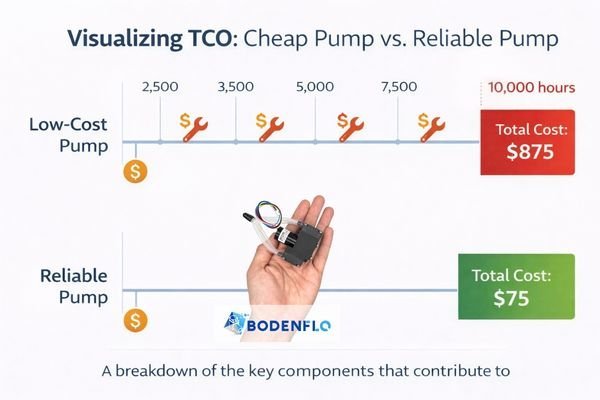
| Factor | Pump A: Low-Cost Brushed | Pump B: High-Quality Brushless |
|---|---|---|
| Unit Price | $15 | $75 |
| Lifespan | 2,000 hours | 10,000 hours |
| Replacements (over 10k hrs) | 4 | 0 |
| Maintenance Cost (@ $200/call) | $800 ($200 x 4) | $0 |
| Initial Pump Cost | $75 ($15 x 5 pumps) | $75 ($75 x 1 pump) |
| Risk of Downtime | High | Low |
| Total Cost of Ownership (excluding downtime) | $875 | $75 |
In this realistic scenario, the pump that was 5 times more expensive upfront ended up being over 11 times cheaper in total cost.
What Are the Hidden Costs of Choosing a Low-Cost Pump?
The financial model above is clean, but the real world is messy. The true costs of failure extend far beyond simple replacement calculations.
The real cost of a pump appears after it fails—not when it is purchased. These hidden costs can severely damage your business operations and brand reputation.

- Field Service & Logistics: The cost of dispatching technicians, managing RMAs, and shipping replacement parts is enormous.
- Inaccurate Data5: In an analytical instrument, a degrading pump provides false readings, potentially leading to incorrect scientific conclusions or failed environmental compliance.
- Customer Complaints & Churn6: Unreliable products lead to frustrated customers who will share their negative experiences and choose a competitor for their next purchase.
- Brand Damage: Product recalls and widespread reports of failure can permanently damage your brand’s reputation for quality, making it harder to sell any product in the future.
How Design and Manufacturing Quality Impact Long-Term Cost
Why does one pump last 10,000 hours and another only 500? The answer lies in deliberate engineering choices and manufacturing discipline. Reliability is engineered and manufactured—not advertised.
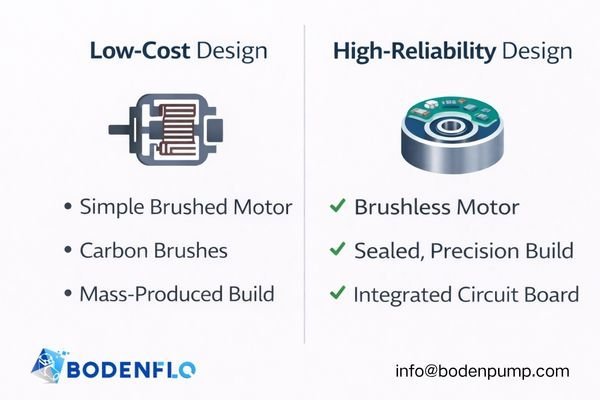
- Diaphragm/Valve Material: High-end pumps7 use advanced elastomers like FKM or PTFE coatings that resist chemical attack and mechanical fatigue far better than standard EPDM.
- Motor Technology: A coreless brushless DC motor8 has no brushes to wear out, offering an inherently longer lifespan than a brushed motor. The quality of the bearings and electronics further enhances this.
- Thermal Management9: A pump running continuously generates heat. Superior designs incorporate better airflow, heat sinks, or more efficient motors to manage this heat, preventing premature failure of electronics and elastomers.
- Manufacturing & Testing: A reliable manufacturer invests in tight-tolerance molding, automated assembly, and 100% end-of-line testing for flow, pressure, and current draw. This ensures that the 10,000th pump you receive performs identically to the first.
How to Evaluate Micro Air Pump Cost in OEM Projects
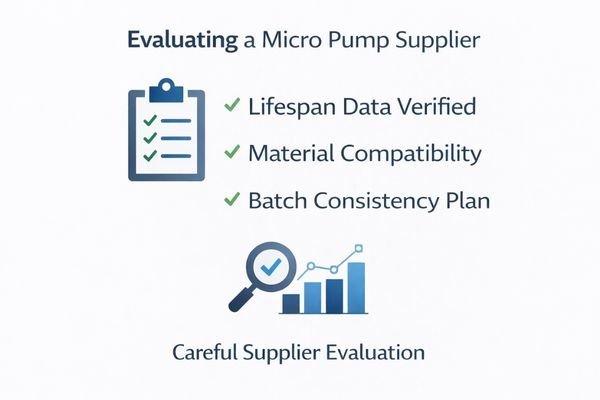
You are now equipped with the TCO framework. How do you apply this in your supplier evaluation process? The goal is not to find the cheapest pump, but the lowest-risk solution.
Key Questions to Ask Suppliers
- "What is the tested lifespan of this pump under my specific operating conditions (pressure, temp)?"
- "Can you provide the long-term performance degradation data (e.g., flow rate after 2,000 hours)?"
- "What is the motor type, and what is its MTBF (Mean Time Between Failures)?"
- "What quality control processes are in place to ensure batch-to-batch consistency?"
- "What are the diaphragm and valve materials? Why were they chosen?"
Warning Signs (Red Flags)
- The supplier cannot provide long-term life test data.
- They focus the entire conversation on unit price.
- They don’t ask detailed questions about your application.
- Datasheets lack detailed specifications on motor type or materials.
- Inconsistent performance between samples.
In Which Applications Does TCO Matter Most?
While TCO is always relevant, its importance becomes critical in certain applications where reliability is non-negotiable.
The more critical the application, the more important TCO becomes. In these areas, pump failure results in significant financial, safety, or operational consequences.

- Gas Sampling & Environmental Monitoring: System uptime and data accuracy are paramount for regulatory compliance.
- Medical Devices: Patient safety and therapeutic efficacy depend directly on the pump’s consistent performance.
- Portable Analytical Instruments: Equipment failure in the field is extremely costly in terms of wasted time and project delays.
- Industrial Automation & Robotics: Downtime on an automated line can halt production, with costs accumulating every minute.
FAQ: Micro Air Pump Pricing, Lifespan, and TCO
Here are some direct answers to the most common questions we hear.
What is the average price of a micro air pump?
There is no meaningful "average" price due to the vast range ($1 – $400). Instead, pricing should be evaluated within an application category. A good home medical pump might be $10, while a good industrial gas sampling pump might be $150.
Why do pump prices vary so much?
Prices vary based on motor type (brushed/brushless), materials (EPDM/FKM), performance capabilities, and the level of quality control and testing invested by the manufacturer. A higher price reflects more built-in reliability and a longer intended lifespan.
How long should a good micro air pump last?
It depends on the technology. A high-quality brushed pump might last 2,000-3,000 hours. A high-quality brushless pump should last 5,000 to 10,000+ hours under continuous load. Always verify the lifespan under your specific operating conditions.
Is a brushless motor worth the extra cost?
For any application requiring long life, continuous operation, or high reliability, the answer is unequivocally yes. The extended lifespan and lower failure rate mean the TCO of a brushless pump is almost always lower than a brushed pump.
How can I reduce the total system cost?
Paradoxically, you can often reduce total system cost by choosing a more reliable, slightly more expensive pump. This minimizes or eliminates future costs from field service, replacements, and downtime, leading to a lower TCO.
Need Help Evaluating the Real Cost of Your Pump?
Making the right component choice is a complex trade-off between cost, performance, and risk. We understand that pressure.
Choosing the right pump is not about minimizing price—it’s about minimizing long-term risk. At BODENFLO, our engineering team specializes in providing TCO-optimized solutions that protect your product’s performance and your budget.
Send your application requirements and key operating parameters to our engineers at info@bodenpump.com. We will help you analyze the TCO and select a reliable BODENFLO pump for your project. Don’t gamble on your product’s success—let’s engineer a reliable solution together.
-
Understanding BOM cost is crucial for engineers to make informed decisions that impact overall product pricing and profitability. ↩
-
Exploring system thinking can enhance your approach to product design, ensuring long-term reliability and customer satisfaction. ↩
-
Explore the advantages of high-end eccentric diaphragm pumps for long-lasting performance and cost efficiency in various applications. ↩
-
Learn how to effectively match pump lifespan to application needs, ensuring optimal performance and cost savings. ↩
-
Understanding the effects of inaccurate data can help improve product reliability and customer satisfaction. ↩
-
Exploring strategies to minimize complaints can enhance customer loyalty and improve brand reputation. ↩
-
Explore this link to understand how high-end pumps can enhance efficiency and durability in various applications. ↩
-
Discover the benefits of coreless brushless DC motors, including longevity and performance, to make informed decisions for your projects. ↩
-
Explore this resource to understand effective thermal management techniques that enhance pump performance and longevity. ↩