
Should You Design Your Product Around a Micro Pump or Customize the Micro Pump for Your Product?
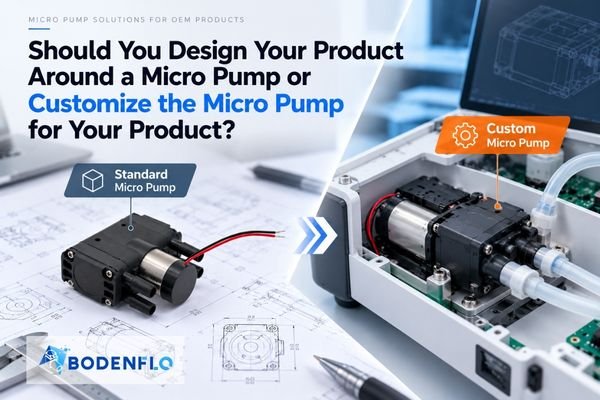
Struggling between a standard miniature pump and a custom one? The wrong choice can kill your project’s budget, timeline, and performance, trapping you in a costly redesign loop. The best path depends on your project’s constraints. Use standard pumps for prototyping and flexible designs. Pursue customization when size, performance, or control requirements are strict and […]
How Much Vacuum Do You Actually Need from a Mini Vacuum Pump?
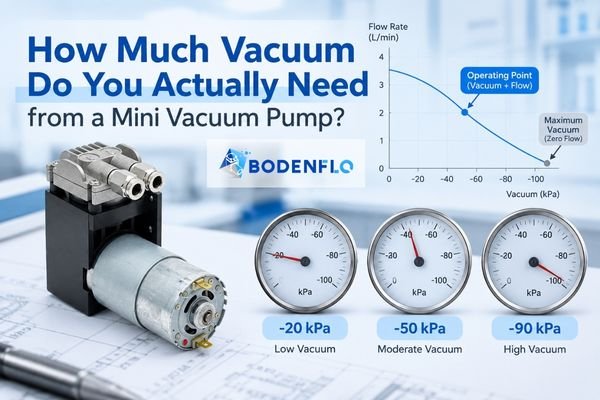
You’re staring at pump datasheets, confused by specs like -70 kPa vs. -90 kPa. Choosing a pump with too little vacuum means your device fails, but over-specifying it wastes power, money, and precious space. The truth is, you don’t need the highest vacuum pump. You need the right pump—one that provides the exact vacuum level […]
How Do You Find a Replacement for a Discontinued Mini Vacuum Pump?
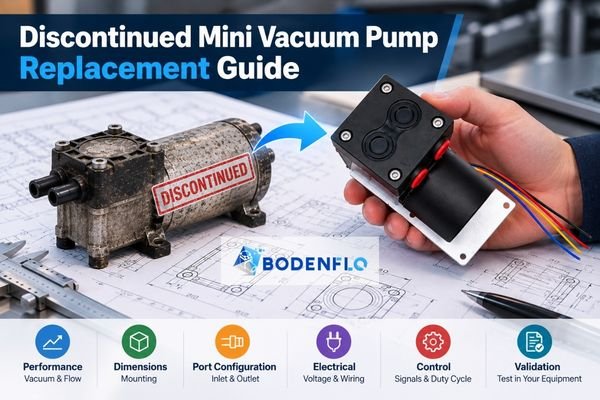
Your production line is running, but a critical mini vacuum pump in your Bill of Materials has just been discontinued. Your service department can’t get spare parts. Suddenly, your entire product is at risk. To replace a discontinued mini vacuum pump, you must go beyond a simple spec sheet comparison. The process involves identifying the […]
How to Choose a Micro Diaphragm Vacuum Pump for 24/7 Continuous Operation?
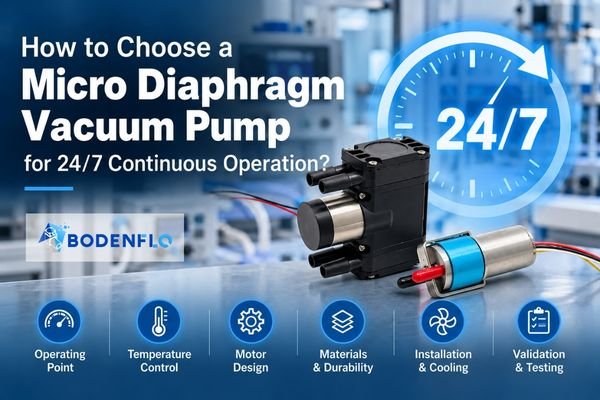
You need a vacuum pump for an instrument or process that runs around the clock. But choosing a pump based on its datasheet alone can lead to unexpected failures, costly downtime, and a loss of trust in your equipment. Yes, a micro diaphragm vacuum pump can be designed for 24/7 operation, but this capability depends […]
How Do Micro Vacuum Pumps Support Automated Wafer Handling?
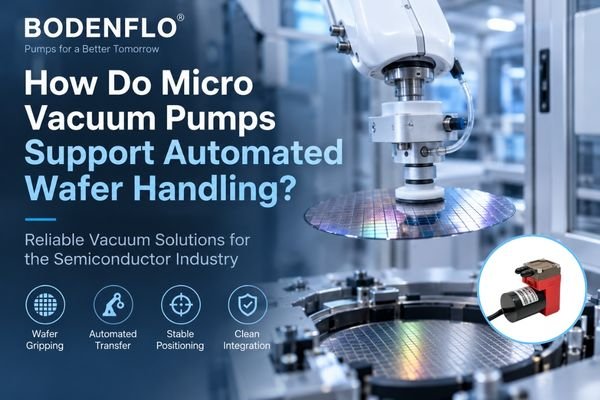
You are designing an automated wafer handler and need a reliable, compact vacuum source for the pick-and-place end effector. Choosing the wrong pump can lead to pickup failures, contamination, and costly equipment downtime. Success isn’t about finding the pump with the highest vacuum. Instead, it’s about integrating a suitable micro vacuum pump into a complete, […]
Which Liquids May Be Compatible with a PPS, PTFE, and FFKM Micro Liquid Pump?
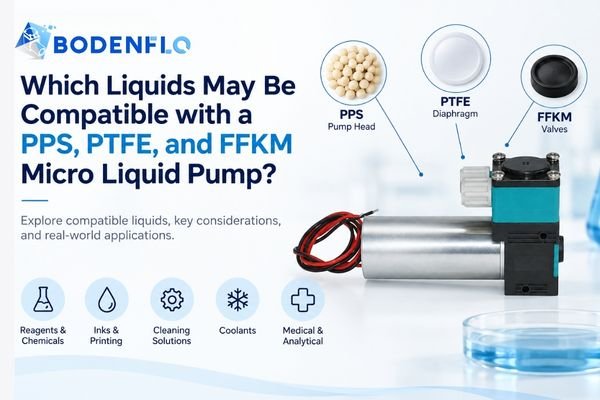
You selected a pump with premium materials like PPS, PTFE, and FFKM, expecting bulletproof chemical resistance for your new inkjet printer or medical analyzer. Yet, the pump failed, causing leaks and project delays, leaving you questioning the datasheet. The problem is that material resistance charts don’t tell the whole story. A pump’s true compatibility depends […]
Free Flow vs. Working Flow vs. Rated Flow: Understanding Micro Air Pump Performance?
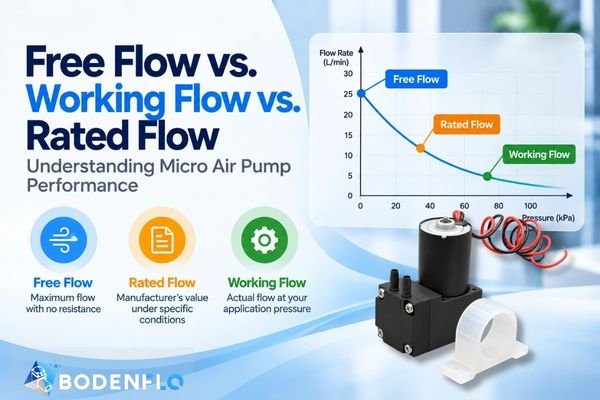
You chose a micro air pump rated at 20 L/min, but it’s delivering far less in your device. This performance gap can cause project delays and system redesigns. A micro air pump’s advertised flow rate is often its "free flow," measured with no resistance. The real performance, or "working flow," depends on your system’s pressure. […]
How to Select a Micro Diaphragm Liquid Pump for Coolant Circulation?

Your system is overheating because the coolant pump isn’t delivering. Choosing a pump based on free-flow rate alone often leads to failure under real-world system pressure. To select the right pump, an engineer must define the coolant, flow at operating pressure, temperature, materials, and duty cycle. A pump rated at 1 L/min free flow won’t […]
How Do Voltage, Frequency and Waveform Affect Piezoelectric Pump Performance?
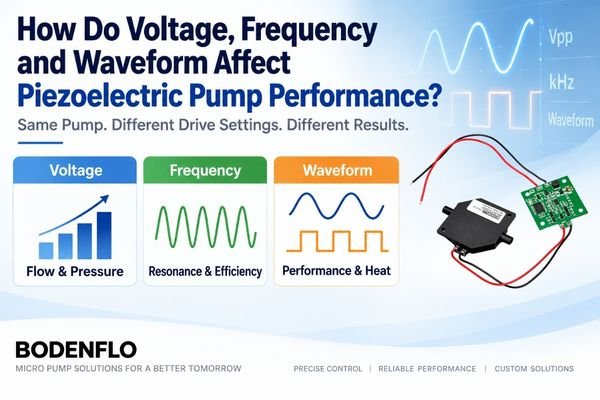
Your new piezoelectric pump isn’t hitting the flow rate on its datasheet, causing project delays. The problem isn’t the pump alone, but the driver’s voltage, frequency, and waveform, which must be perfectly matched. Piezoelectric pump performance depends entirely on its driver. Drive-voltage amplitude affects diaphragm displacement, frequency determines operation near resonance, and waveform influences efficiency […]
How Do You Prevent Pressure Overshoot in a Micro Air Pump System?
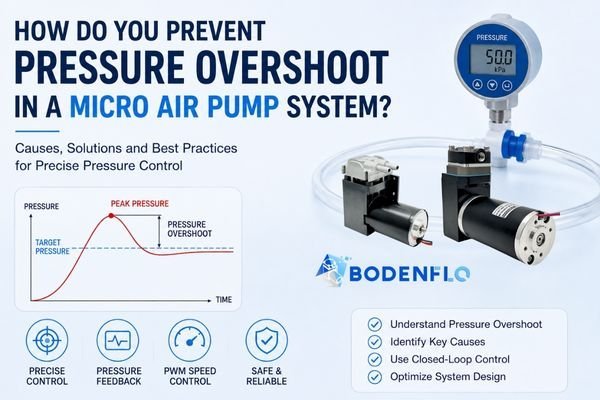
Your micro pump hits its target pressure, but the pressure keeps rising, risking safety. This guide explains how to achieve precise, reliable control. Preventing pressure overshoot requires a systems approach. Use closed-loop feedback with a pressure sensor and PWM control to slow the pump near its target. Also, carefully consider system dynamics like tubing, valves, […]
Why Do Two 11 L/min Micro Diaphragm Pumps Inflate and Repressurize the Same Air Bag at Different Speeds?
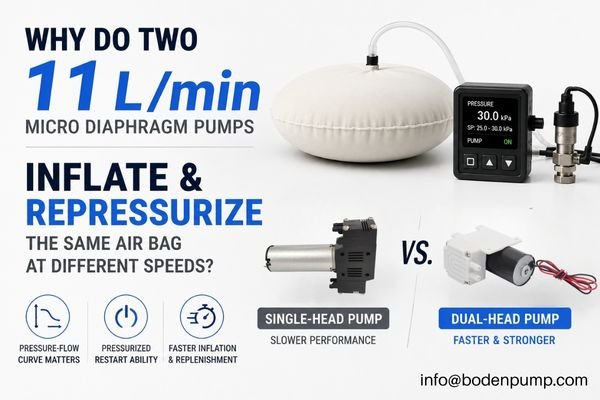
You selected two pumps with the same 11 L/min rating. Yet, one inflates your air bag much slower, jeopardizing your project. This guide explains why. The 11 L/min rating is "free flow," measured with no back-pressure. System performance depends on the pump’s ability to maintain flow as pressure increases and to restart against residual pressure. […]
How to Design a Flushing Cycle for Micro Pumps Handling Crystallizing Liquids?
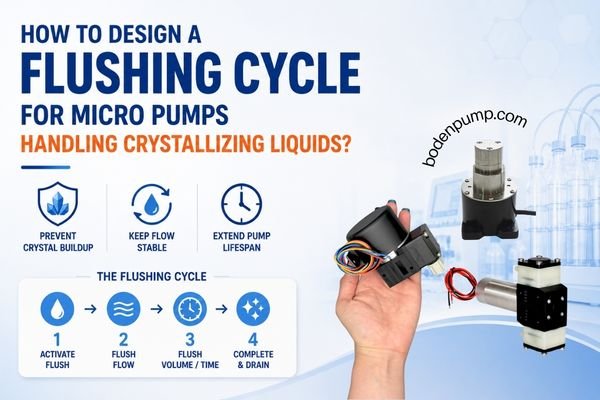
Your pump works perfectly with a new reagent, but after a day of intermittent use, it fails to prime and its flow drops. You suspect crystal buildup is choking your system. A flushing cycle removes residual liquid from the pump head, valves, and tubing before dissolved solids can crystallize. An effective cycle must define the […]